The United Nations Committee on the Rights of Persons with Disabilities (UN CRPD) has issued a call for further evidence that the UK government have (not) acted upon the recommendations that they made following their 2016 investigation.
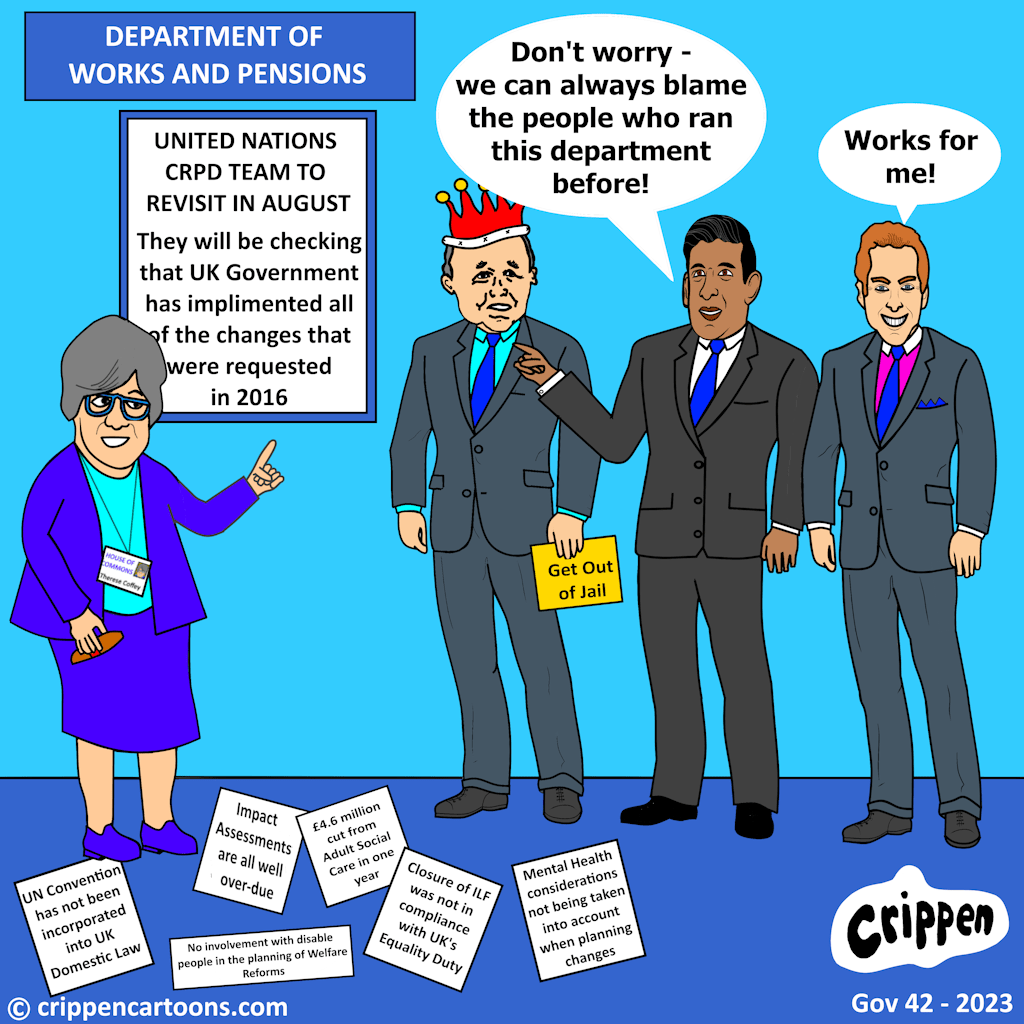
It’s long been my intention to have a proper read through of the findings of the 2016 United Nations Committee on the Rights of Persons with Disabilities (UN CRPD) following their investigation of the way in which the UK parliament has brought in massive changes to the legislation, policies and measures relating to social security schemes and to work and employment, and the cumulative negative impact that this has had on disabled people. Most of the factual information written here is taken from the UN report, with a link added to that source at the end of this article.
You’ll recall that the UN investigation happened after the UN CRPD began receiving information about the alleged adverse impact on disabled people following the implementation of a process of reform of legislation and policies by the UK government. The information indicated that the implementation of the welfare reform had introduced significant cuts to social benefits that were affecting several of the rights of disabled people enshrined in the UN Convention.
Serious and Systematic Violations
In April 2013, the Committee received a formal request from a number of disabled people’s organisations (DPOs) alleging that serious and systematic violations of the provisions of the UN Convention were occurring in relation to disabled people. They requested that the UN Committee initiate an investigation into the matters raised in the request.
In 2014, the Committee assessed all the information before it and determined that there was reliable information indicating grave or systematic violations of the rights set forth in the UN Convention. The Committee therefore established an inquiry and appointed two of its members as rapporteurs who visited the UK on 12th to 23rd October 2015 interviewing more than 200 disabled individuals, and several DPOs.
Strangely enough, local authorities and councils chose not to cooperate with this investigation, and the UK government, having agreed to meet the UN investigators on the first day of the visit, postponed to the last day with no explanation forthcoming. Also, despite the UK Parliament acknowledging that the UN Convention is a binding obligation in international law and that they should have given them adequate consideration in decision-making processes, the UN Convention has not been incorporated into UK domestic law and is still not directly justiciable.
To Recap
To recap, the UN investigation found at that time that the Welfare Reform Act 2012 was the main legislative instrument on welfare that applies in England, Scotland and Wales, and the Welfare Reform Act (Northern Ireland) 2007. The Care Act 2014 which came into effect in April 2015, sets forth the provisions relating to care and support for adults and provisions relating to support for carers. The act shifts the duty of local authorities from providing services to meeting needs and providing information amongst other things.
The Welfare Reform and Work Act 2016 makes provision for various aspects of welfare, including reducing the benefit cap; freezing certain social security benefits and taxing credit amounts for four tax years; limiting child tax credit; changing the child element of universal credit; amending the Child Poverty Act 2010; removing the work-related activity component from employment and support allowance; and regulating the limited capability-for-work element of universal credit and its work-related requirements.
Coupled with this, the reform to the legal aid system affected claimants of the welfare system, including disabled people, and narrowed the scope of civil legal aid in England and Wales by excluding the use of legal aid in welfare benefit cases.
The UN investigators found that the UK welfare system has faced a progressive change in conception from the “welfare” of individuals to the economic well-being of the country. The stated goals of the policy being to transform British society from a low-wage, low-employment and high-welfare society to a high-wage, high employment and low-welfare one, which, they claimed, would be fairer to UK tax-payers (conveniently forgetting that many disabled people are tax payers!).
Benefit Fraud
They also claimed that this would put a stop to benefit fraud, perpetuating the myth that disabled people were making a good living out of benefits, committing fraud as benefit claimants, being lazy and putting a burden on taxpayers, who are paying “money for nothing”, although the UN inquiry found no substantiation of the alleged benefit fraud by disabled people.
Ironically, the UK government produced evidence of formal efforts and public awareness campaigns to improve the image of persons with disabilities [sic], despite the UN inquiry collecting evidence that show how disabled people continue to experience increasing hostility, aggressive behaviour and sometimes attacks on their personal integrity.
Impact Assessments
Because of this, various people had expressed concerns about the potentially discriminatory effects of the welfare measures on disabled people and called on the Government to fulfil its duties under the Equality Act 2010. They also called for a cumulative impact assessment to consider the impact on groups with similar characteristics, such as disabled people, and to monitor the post-legislative impact of the measures in the welfare reform.
Public sector equality duty obliges the UK government to carry out impact assessments when they plan to introduce measures, including legislative measures, to ensure that groups with protected characteristics, among them disabled people, are properly consulted and any adverse impact on them is properly justified.
Similarly, a court of law found that the decision to close the Independent Living Fund (ILF) was not in compliance with domestic equality duty, which compelled the authorities of the UK government to carry out another equality assessment before implementing the legislation.
Although the UK government asserted that a cumulative impact assessment of the various policy measures affecting disabled people was not technically feasible or practicable, the evidence collected by the UN inquiry indicates that a cumulative impact assessment could have been conducted with the data and information available.
Domestic Equality Duty
The UK government submitted evidence that it had complied with domestic legal duties for all the intended changes to the welfare system. However, the inquiry collected evidence that a major piece of legislation of the welfare reform, the Welfare Reform Act 2012, was not thoroughly compliant with those requirements. The inquiry also collected evidence that the views of disabled people and their representative organisations that had participated in the few consultations launched by the UK government were not meaningfully taken into account in the decision-making process and had little or no influence on policy decisions.
Retrogressive Impact
The Joint Human Rights Committee of the UK Parliament also warned of the potentially retrogressive impact of the reform on the rights of disabled people, referring to the negative impact of the introduction of personal independence payments (PIP) on the right of disabled people to live independently. It also warned of the risk of discrimination regarding the proposals on employment support allowance and housing benefit and the risk of “destitution”.
This was substantiated by independent studies conducted by academics and research centres, including several DPOs. The UN report detailed many of the issues raised by these studies including more disabled people living in poverty, a risk of social isolation and more reliance on informal and family care and negative stereotyping of disabled people.
Cuts to Funding
Importantly, the UN investigators found reliable information that indicated that up to 2015, public funding of adult social care was reduced by £4.6 billion. Consequently, local authorities reduced their spending on social care and cut community services that had been of importance to disabled people. All these findings were disputed by the UK Government whilst conversely, statements made by them were not supported by any evidence collected during the investigation (Ed: No surprise there then!).
Medical Model
The Committee observes the prevalence of the medical model approach in the assessment procedures for determining the eligibility of disabled people for entitlements. Also, that the main assessment procedure for determining eligibility for out-of-work benefits resulted in the needs of disabled people not being fully understood. The evidence collected from various sources indicates that the needs, views and personal histories of disabled people and particularly those requiring high levels of support, such as persons with intellectual and/or psychosocial impairments, were not properly taken into account or given appropriate weight in the decisions affecting them.
The UN Committee also observed that various pieces of legislation related to recent welfare policies do not fully enforce the international human rights framework related to social protection and independent living. In that connection, it was observed that in the field of social protection, disabled people in the UK have not been properly considered as rights holders and entitled to benefits with regard to their right to social protection.
Lack of Access
The UN inquiry collected evidence indicating that the information, advice and counselling provided to disabled people on the different steps in the assessment processes and decisions on their entitlements were limited, non-existent or not provided in accessible formats and languages. That was coupled with uncertainty about the outcomes of those processes, triggering anxiety, psychological strain and financial hardship. The Committee also collected evidence of how mental health conditions had severely deteriorated as a result of the factors mentioned above.
Lack of representation
The evidence indicates that the UK government have carried out surveys and regularly published statistics about welfare reform. However, there is no evidence of the involvement of disabled people and their representative organisations in periodic monitoring and evaluation activities on the impact of the implementation of the reform measures.
In Conclusion
The evidence collected by the UN and other reputable bodies within the UK make it clear that the UK government is failing the estimated 10 million disabled people currently living in the UK. Not only that, but by presenting unsubstantiated information about so called benefits fraud by disabled people, they are complicit in changing the UK public’s views of disabled people, supporting the view that we are all ‘useless eaters’ and a drain on society.
Unfortunately, the impetus for challenging the UK government by disabled people disappeared in 2020 when the COVID Pandemic arrived, and we all went into lock down. However, this second request for information by the UN is a chance to raise these important matters once again and confront the government about its failure to protect the rights of disabled people in the UK.
Organisations can submit written evidence to inform their follow-up review by 1 August 2023 or can share evidence in-person as part of the oral briefing on 28 August 2023. If you would like more information on this, then please contact the Secretariat for the UN CRPD on Jorge.araya@un.org or by reading the full UN report.
Description of cartoon for those people who use screen reading software
PM Sunak and MP Pursglove are standing side by side in the office of the DWP. Opposite them is Sir Duncan-Smith and MP Coffey both ex-DWP. A sign on the wall reminds them that the United Nations CRPD team are revisiting to check if any of their recommendations have been implemented. On the floor is scattered lots of pieces of paper with examples of the changes that the UN wanted to see made. Sunak is saying: “Don’t worry – we can always blame the people who ran this department before!” Pursglove is saying: “Works for me!” Both Coffey and Duncan-Smith, who is carrying a ‘Get out of Jail’ card are looking at Sunak as if he is making a huge joke.
 Crippen Cartoons