Archive for the ‘Uncategorized’ Category

Crippen discovers that Clause 34 is becoming a reality

The Data Protection and Digital Information (DPDI) Bill has moved to the House of Lords for scrutiny following completion of the Report stage and third reading in the House of Commons.

Various Civil Rights groups, including the Public Law Project have been briefing MPs that the Bill will weaken important data protection rights and safeguards, reducing transparency and putting individuals at greater risk of unfairness and discrimination. The main cause for concern is Clause 34 which will give the government the right to inspect the bank account of anyone who claims or who is connected to someone who claims ‘social security benefits’.

The Open Rights Group (ORG) claim that the new welfare surveillance powers were slipped into the DPDI Bill by stealth to circumvent Parliamentary scrutiny:

“They treat vulnerable populations as potential criminals rather than individuals in need of support. In combination with weakened protections against faulty automated decision-making and curtailed rights to access our data, the DPDI Bill is an injustice waiting to happen.”

ORG’s Legal and Policy Officer, Mariano delli Santi added:

“Welfare surveillance further stigmatises people who receive benefits, many of whom already face discrimination and negative stereotyping. It could lead to some of the most vulnerable people facing unjust accusations of fraud, and potentially having their benefits removed and their lives destroyed.”

ORG explains that we currently have protections against solely automated decision-making when there are life-changing or significant consequences:

“The DPDI Bill weakens those safeguards, exposing more areas of our lives to algorithms and all their associated biases, except where it involves special category data.

“People who claim benefits will have fewer financial freedoms and will be over-exposed to algorithmic injustice. This isn’t a theoretical possibility. The DWP has been criticised already for using AI secretively to target welfare fraud “despite warnings of algorithmic bias against groups of vulnerable claimants.” With the DWP algorithm already being challenged for discriminating against people with disabilities, these new welfare surveillance powers are primed for disastrous consequences.

“The government is opening up financial information of benefit claimants to an expanding use of AI, while weakening the rights of individuals to challenge how those decisions are being made. The lack of transparency over the algorithm used in the DWP’s Integrated Risk and Intelligence Service only serves to leave vulnerable people overexposed to harms. And it’s not like the public sector is renowned for having robust and effective IT systems – over 200,000 pensioners were underpaid by the DWP last year as a result of computer errors.”

You can read the fuller analysis by the ORG on their web site.

BTW: Did you realise that the Tory’s are pushing through a section of the Bill that will allow the Secretary of State broad powers to amend our data protection laws via statutory instrument, without adequate scrutiny by Parliament. The wide powers given to the Secretary of State in Clauses 5, 6, 12 and 114 should be removed or narrowed.

Description of cartoon for those using screen reading software

A white female wheelchair user is sat at a table with a small amount of money in front of her. She is holding a series of final demands for gas, electric whilst a tear glistened on her cheek. A small children peer across the table at her. A wall mounted television has on its screen ‘DWP to employ more fraud investigators to curb disabled scroungers’. A sinister figure wearing a dark hat with a card reading DWP inserted in the hat band looms over her shoulder. He is peering through a magnifying glass at her and is holding copies of her bank statements. In his pocket is a copy of the Data Protection and Digital Information (DPDI) Bill. He is saying: “Hmm … now let’s see what I can find to justify my nice fat salary!”.

Crippen looks at the Blame Game

Not content with spreading malicious lies that thousands of disabled people are fraudulently claiming benefits, the DWP is now spending more money hiring ‘covert surveillance officers’ to work within 20 locations around the UK to crack down on these so-called fraudulent claims.

I’ve lost count of the number of times that John Pring from Disability News Service, Mo Stewart Research Lead on the Preventable Harm Project and myself have published corroborated facts that contradict this harmful rhetoric that the DWP continue to pump out to a gullible public through the national press.

One such article in the Torygraph [sic] included using the ‘welfare calculator’ to “reveal how much of your salary bankrolls the welfare state” whilst also claiming that millions, including disabled people were claiming benefits “without ever having to look for work”.

Disability Rights UK describing its coverage as “an incitement of hatred” towards disabled people and claiming the aim was “to vilify people who are too sick to work by angering those who are paying taxes that go towards Disability benefits”.

This rhetoric, which will be familiar to those who remember the propaganda used by the German Nazi Party back in the 1930 – 40’s when thousands of disabled people were identified as ‘useless eaters’ and exterminated, has created a massive increase in disability hate crime in the UK.

New stats from the Home Office reveals that disability hate crime has more than doubled in the last four years. In the last year alone, disability hate crime has risen by 43%. It doesn’t take much of a leap to connect this to the vitriol being pumped out by the DWP.

Even the United Nations have stated that:

“Reforms within social welfare benefits in the UK are premised on a notion that disabled people are undeserving and skiving off and defrauding the system. This has resulted in hate speech and hostility towards disabled people.”

Another voice from the international community has spoken out in defence of disabled benefit claimants in the UK. Rosemary Kayess, Australia’s new disability discrimination commissioner, stated recently:

“We see a reform agenda [in the UK] that is framed in a political narrative that demonises disabled people, including proposals to cut disability benefits to reward working people by cutting taxes, which tells disabled people they are undeserving citizens.”

I recently ran an article which claimed that the DWP were deliberately feeding false information to the mainstream press. Again, Disability News Service was instrumental in bringing in the Information Commissioner John Edwards around to their belief that that DWP were “engaged in a campaign to stir up hostility towards disabled claimants of benefits” to act as cover for its planned cuts and reforms which had recently been announced, which “could have fatal consequences”.

I could go on, but returning to this latest ploy by the DWP who are now claiming to need more ‘covert surveillance officers’ to stem this flood of non-existent benefit fraud, it’s just another part of this concentrated attack against disabled people in the UK.

To conclude, Scottish Greens MSP Maggie Chapman has joined the ranks of those speaking out against the DWP and its policies. She is reported as stating:

“It is as if the DWP is desperate to cement its reputation as one of the harshest, cruellest and most punishing government departments. The sanctions regime it oversees has ruined lives and hounded people to early graves. It’s rotten to the core and has no place in the compassionate society we want to build.”

Well said Maggie.

The government’s own accounting system Hansard – Fraud and Error National Statistics state that the annual statistics for fraud and error in the benefit system for the financial year ending 2023 confirm that fraud and error in 2022-23 fell to 3.6% of welfare expenditure.

Description of cartoon for those people using screen reading software

This Crippen cartoon is a complex panorama showing the chain of hate that originates from a group of DWP officials and government ministers on the right to a group of disabled people on the left. Large red arrows between the four groups portrayed provide the direction that the chain is progressing (from right to left). The DWP/Gov representatives are handing to a group of newspaper owners’ misinformation about disability benefits fraud. The press in turn are handing out newspapers with anti-disability slogans printed on them, blaming disabled people etc. A third group representing the general public are reading the newspapers and pointing at the final group of disabled people on the left of the picture whilst shouting “They’re taking our taxes” and “They don’t even try to find work” and “They’re all scroungers” and “they’re the ones to blame”. Between the group of disabled people and the group of the general public is a large card with ‘Disability Hate Crime up by 43%’. The disabled people are looking on with fearful expressions on their faces whilst behind them lurks a covert DWP benefits officer holding a copy of the proposed Data Protection and Digital Information (DPDI) Bill.

Crippen hears about DWP destroying more evidence

The Department for Work and Pensions (DWP) is again facing cover-up allegations after suggesting that it has destroyed reports showing why it weakened guidance on when to investigate suicides of benefit claimants.

Once again, our friends over at Disability News Service (DNS) have been successful with a freedom of information request and have discovered that DWP have once more attempted to wriggle out of their obligations. The department said:

“As discussions around Internal Process Reviews, their management and the criteria that relate to them, are operational in nature as opposed to policy based, there is no requirement for the Department to retain any such reports.”

It was revealed last month that DWP had weakened the rules on when to carry out an internal process review (IPR) in April 2021. Although, the previous year it had told the National Audit Office it would always carry out one of its secret reviews when it heard of a claimant’s death if they had died by suicide, even if there were no allegations that DWP’s actions had contributed to that death.

However, figures obtained through another freedom of information request have shown that on at least four occasions in 2022-23 – as a result of the new rules – the department failed to carry out an IPR when told of the suicide of a claimant.

For more than a decade, DNS has been revealing how DWP has covered-up evidence of links between its actions and the deaths of claimants, and how it has repeatedly tried to delay evidence of those links being released.

Read the full DNS report here.

Description of cartoon for those using screen reading software

A sign upon the wall identifies the location as being a room within the DWP. A white male in a grey suit is throwing documents headed ‘claimants suicide report’ into a burning container. Alongside of him is an Asian woman sat at a computer. She is looking back at the man who is saying to her: “And once you’ve scrubbed the hard drive it’ll be a case of reports – what reports!”

Crippen – Government’s response to UN committee ‘was insult to disabled people’

Disabled people’s organisations (DPOs) from across the UK have described the government’s evidence to a United Nations disability rights committee last month as “an insult to disabled people” and full of “half-truths, untruths” and “empty assertions”.

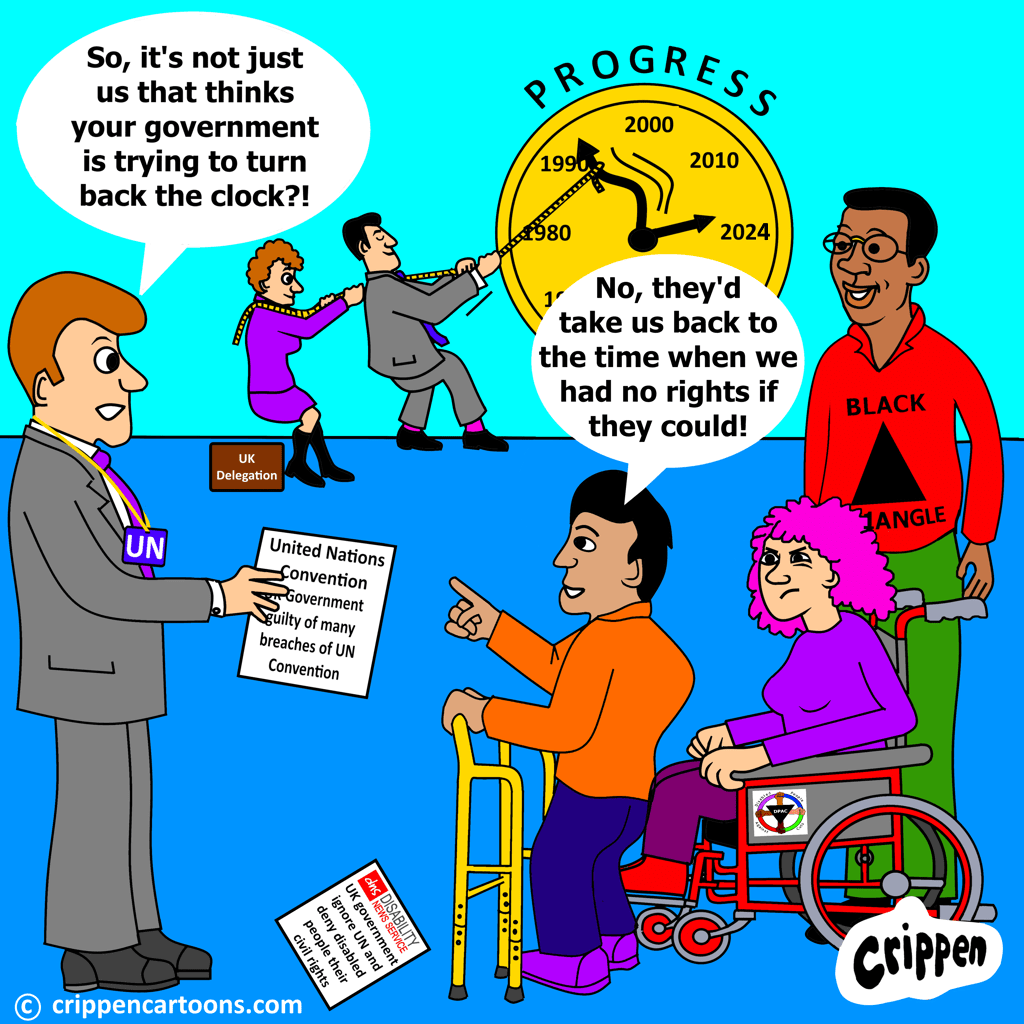
Following on from my last blog, representatives from more than ten DPOs were in Geneva to witness the evidence given by the UK government as it attempted to persuade the committee it had made progress since being found guilty of “grave and systematic violations” of the UN Convention on the Rights of Persons with Disabilities in 2016.

In an initial statement Alexandra Gowland, deputy director of the Disability Unit, pointed to a string of recent government policies across disability strategy, social security, housing, social care and employment – nearly all of which have been widely discredited. She and fellow civil servants were also asked to respond to concerns and questions raised by members of the committee.

But representatives of the DPOs that had travelled to Geneva to brief the committee and watch the session say they were appalled at the evidence given by the UK government’s delegation.

Ellen Clifford, who coordinates the coalition of DPOs that monitors the implementation of the convention in the UK, told Disability News Service (DNS) that:

“The UK government’s representatives had avoided all of the substantive issues with which the special inquiry is concerned and failed to answer any of the committee’s questions. They chose instead to talk out their time on issues not relevant to the inquiry and in a misleadingly positive light. We felt their approach was disrespectful to the committee and showed how little they value the lives of Deaf and disabled people.”

She said the questions and comments from the UN rapporteurs – the committee members who have led investigations into the UK’s progress showed how well they understand the true picture of what is happening and that “they had really listened to and valued the evidence we submitted and the testimonies that were shared with them by Deaf and disabled people”.

John McArdle of Black Triangle told DNS that the UK government was guilty of “whitewashing and ignoring the rock-solid evidence” and that its delegation had kept trying to “dodge the bullets” by not addressing the issues raised by committee members. He added that the failure of the UK delegation to address the issues raised by the committee was “insulting, not only to us, but to the United Nations, the rapporteurs and the institution itself”.

Kamran Mallick, of Disability Rights UK, said:

“Although we are not surprised by the UK government’s response today, we still feel that their refusal to properly engage with this process is an insult to all disabled people whose experiences are reflected in the evidence we’ve provided to the UN.

“Despite requesting a delay last year, they have provided us with no new evidence – instead signposting to plans and policies that create no transformative change … but they know, just as we do, that no progress has been made. In fact, we have gone backwards.”

Read the full report in Disability News Service.

————————————————-

The representatives from the 10 UK DPOs included Svetlana Kotova, director of
campaigns and justice at 
Inclusion London ; Kamran Mallick, chief executive of Disability
Rights UK
; Natasha Hirst, president of the National Union of Journalists and the
disability representative on its national executive; Rhian Davies, chief
executive of 
Disability Wales ; Mark Harrison,
a member of the steering group of the 
Reclaiming Our Futures Alliance ; Tony
O’Reilly
, from Northern Ireland’s Northwest Forum of People with
Disabilities;
Ellen Clifford who is a member of the national steering committee of Disabled People Against Cuts and John McArdle, co-founder of the Scottish-based grassroots
group 
Black Triangle.

Description of cartoon for those using screen reading software

A UN representative is stood talking to a group of disabled people from the UK. In the background are two UK government representatives who are hauling on a rope attached to the arm of a large clock face. The clock face represents ‘progress’ and they are dragging the indicator arm back from 2024. The UN rep is asking the disabled people: “So it’s not just us that thinks that your government is trying to turn back the clock?” One of them replies: “No, they’d take us back to the time when we had no rights if they could!”


Crippen – UN asks government: “Why are you demonising disabled people?”

A United Nation’s committee vice-chair told a delegation of civil servants in Geneva that “Reforms within social welfare benefits in the UK are premised on a notion that disabled people are undeserving and skiving off and defrauding the system. This has resulted in hate speech and hostility towards disabled people.”

The UN’s committee on the rights of disabled people Australian vice-chair, Rosemary Kayess, said the UK social security system and rhetoric from ministers “devalues disabled people and undermines their human dignity”, and she suggested the government had breached its treaty obligations to “combat stereotypes, prejudices and harmful practices relating to disabled people”.

The committee had previously accused the UK government of demonising disabled people and treating them as “undeserving citizens” by preparing to fund tax cuts through slashing disability benefits. They had also found the government guilty of grave and systematic violations of the UN convention in 2016 as a result of breaches of articles on social security, employment and independent living.

Members of the UN’s committee on the rights of disabled people provided a string of examples of how the government had continued to breach its obligations under the UN Convention on the Rights of Persons with Disabilities.

They pointed to a benefits system that traumatised claimants and led to some taking their own lives; increasing rates of institutionalisation; and a disproportionate number of disabled people who were now too poor to heat their own homes or buy food. They added that there was also evidence of “regression” in how the UK government was meeting its obligations under the convention.

Rosemary Kayess, a human rights lawyer and Australia’s new disability discrimination commissioner, told the UK’s delegation: “We see a reform agenda that is framed in a political narrative that demonises disabled people, including proposals to cut disability benefits to reward working people by cutting taxes, which tells disabled people they are undeserving citizens. And this is coupled with an onerous and complex social benefit system that is the basis for trauma and preventable mental distress.”

She also questioned whether the government had failed to meet its obligations to “closely” and “actively” consult disabled people’s organisations when drawing up its National Disability Strategy.

Following the session and absorbing the “significant” amount of written and oral evidence provided by disabled people, disabled people’s organisations and allies, the committee will now prepare a report on its findings.

Read John Pring’s full report of the UN session in Disability News Service.

Description of cartoon for those using screen reading software

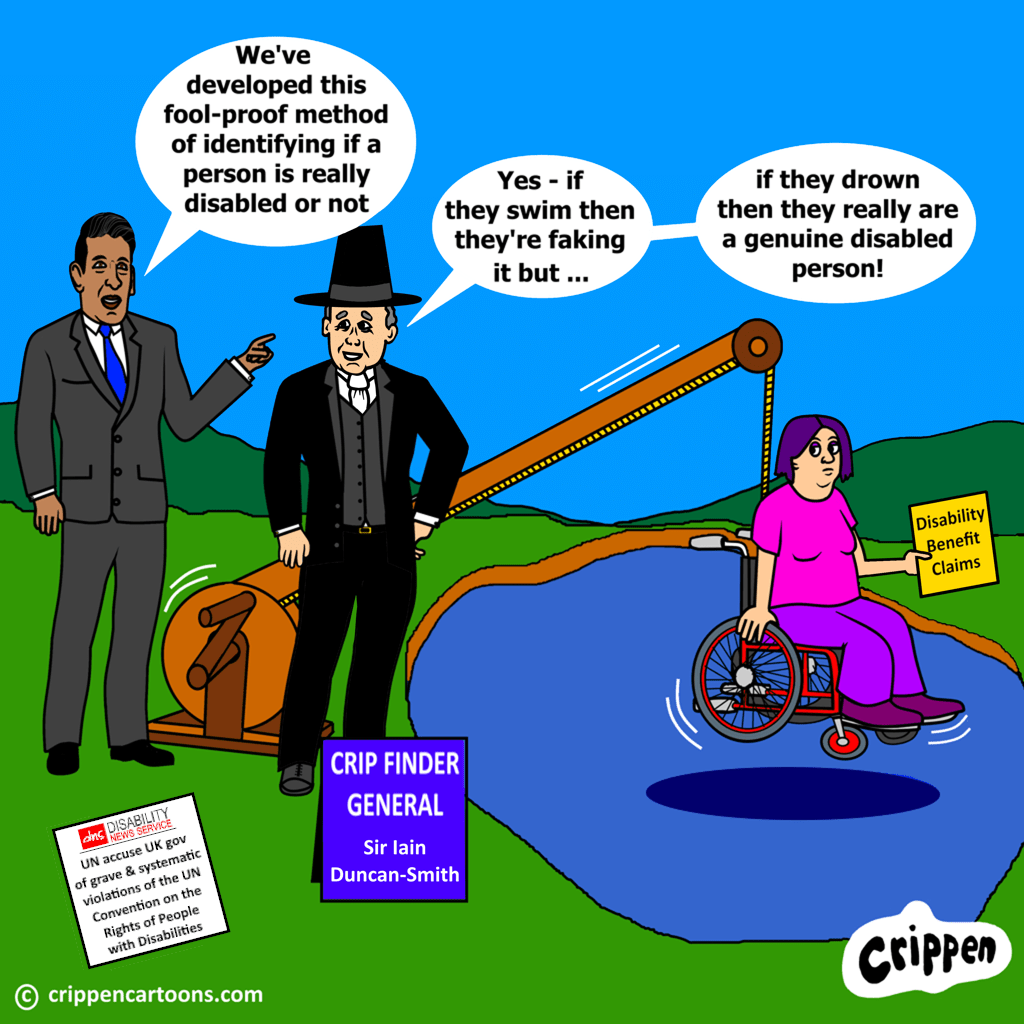
The scene is at a village pond where a wheelchair user, holding a ‘disability benefit claim form’ is suspended over the water. Standing at the side of the pond next to a large winching system are Rishi Sunak and Sir Iain Duncan-Smith who is dressed in a Puritan costume. A sign at their feet carries the message ‘Crip Finder General – Sir Iain Duncan-Smith’. On the floor alongside the sign is a copy of Disability News Service with headlines ‘UN accuse UK government of grave and systematic violations of the UN Convention on the Rights of People with Disabilities’. Sunak is saying: “We’ve developed this fool-proof method of identifying if a person is really disabled or not …”. Duncan-Smith adds: “Yes – if they swim then they’re faking it … If they drown then they really are a genuine disabled person!”  

Crippen talks about spoiling our ballot papers

As the UK welfare state continues to be systematically demolished by the Tory government and disabled people are labelled as work shy scroungers, I suspect that many of us are looking forward to the next general election where we’ll all have the opportunity to vote in an alternative government and put a stop to this tyrannical behaviour.

But wait. If you’re thinking of voting Labour, don’t forget that it was the Labour party under Tony Blair (1997-07) that introduced the 2006 Welfare Reform Bill that brought in the American social and labour market policies. This guaranteed that claimants of long-term out-of-work sickness and disability benefit were to be coerced and intimidated by the Department for Work and Pensions (DWP) simply for committing the ‘crime’ of being too ill to work.

Also, it was Labour again when Gorden Brown (2007-10) introduced the fatally flawed Waddell-Aylward biopsychosocial (BPS) model of assessment, adopted for the Work Capability Assessment (WCA).

And it wasn’t just Labour. The justification for the increased use of sanctions against disability benefit claimants was brought in by the Cameron-Clegg Coalition (2010-15). This caused a major mental health crisis for many disability benefit claimants.

So, that seems to leave us with the Lib Dems or the Green Party, both of whom make little or no reference to disabled people in their manifestos. In fact, I couldn’t find a single reference to disability on the Green party web site and the Lib Dems just seem to have tacked on ‘disability’ to their various equality-oriented sound bites without any real recognition of our oppression.

At the last count there were around 16 million disabled people in the UK which makes up a quarter of the total population. This also means we have a loud voice if we all decided to shout out together.

I seem to remember a film based upon a similar situation over in the States. Thousands of people spoiled their vote by printing ‘none of the above’ on their ballot papers which resulted in a minority party being elected in the rerun. I suppose that we could all do something similar and spoil our ballot papers by printing ‘Disabled people demand equality’ across them!

It’s a thought.

Description of cartoon for those using screen reading software

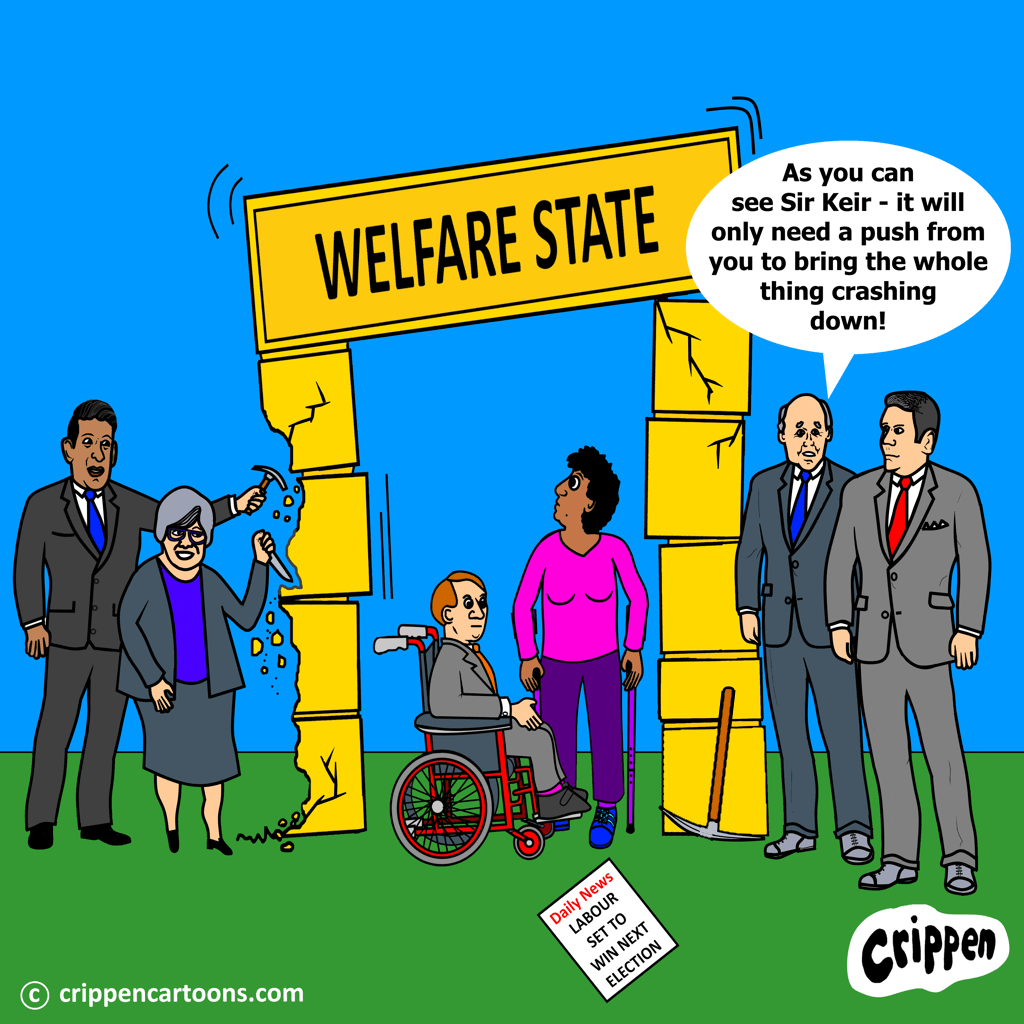
A large stone edifice representing the Welfare State is slowly being eroded by Rishi Sunak and Therese Coffey of the Tory party who are attacking one of its pillars with a small pick and a large knife. Under the large main slab which has ‘Welfare State’ etched into it are two disabled people. They are both looking fearful as the main slab starts to move. Alongside an adjacent pillar are Iain Duncan Smith and Keir Starmer. IDS is saying to Starmer: “As you can see Sir Keir – it will only need a push from you to bring the whole thing crashing down!”

Crippen asks has DWP encouraged the Telegraph to stir up hostility towards disabled people?!

In yet another ruling against the Department for Work and Pensions (DWP) the Information Commissioner John Edwards has ruled that Disability News Service (DNS) was not being “vexatious” when it tried to find out whether the DWP had tried to encourage a national newspaper to stir up hostility towards disabled people.

In a decision notice, the Commissioner has found that DNS was entitled to ask the department what communications it had with the Torygraph [sic] in the months before the newspaper ran a “toxic” and “divisive” article which included using their calculator to “reveal how much of your salary bankrolls the welfare state” whilst also claiming that millions were claiming benefits “without ever having to look for work”.

DNS had explained in lodging its complaint to the Information Commissioner that there were concerns that DWP was “engaged in a campaign to stir up hostility towards disabled claimants of benefits” to act as cover for its planned cuts and reforms which had recently been announced, which “could have fatal consequences”.

DNS had asked DWP last July for details of all meetings, correspondence and calls between DWP ministers and special advisers and staff of the Torygraph in the previous three months. But DWP refused to comply with the request because it claimed it was “vexatious”.

This led to DPO Disability Rights UK describing its coverage as an “incitement of hatred” towards disabled people and claiming the aim was “to vilify people who are too sick to work by angering those who are paying taxes that go towards Disability benefits”.

More than 300 mental health professionals signed a letter raising concerns about the “benefit calculator” story, calling it “a divisive narrative last seen at the height of austerity politics, which is likely to lead to an increase in hate crimes and have a profound impact on psychological well-being and societal cohesion”.

The Independent Press Standards Organisation (IPSO) received a “large volume” of complaints about the Telegraph’s “Exactly how much of your salary bankrolls the welfare state” article, but rejected claims that it discriminated against disabled people, because the article “did not relate to any specific individuals”.

Oh, that’s alright then?!

You can read the full story in Disability News Service.

Description of cartoon for those using screen reading software

Two men in suits and with ID badges identifying them as members of the Press are standing alongside Iain Duncan Smith, the Tory Pier. IDS is handing them pieces of paper with ‘work shy disabled claim millions’ and ‘exclusive – disabled taking your money!’ On the ground is a front page of the Torygraph newspaper which reads ‘Useless eaters are ruining the economy ACT NOW. One of the Press is saying to IDS: “I don’t know what we’d do if we didn’t have your made-up stories about disabled claimants!” IDS replies: “People will believe anything if you repeat it often enough!”

Crippen hears that Capita caught out data breaching … again!

The controversial outsourcing company Capita is facing questions over its data security procedures after it admitted sending a recording of a disabled woman being assessed for a disability benefit to another claimant.

This is not the first time, nor I suspect will it be the last time that Capita have been accused of sending information about one claimant to another. And in some cases, merging information from several claimants into a single claim. I have heard from several people who have received personal independence payment (PIP) rejections from Capita based upon a dialogue that just doesn’t fit their claim. It’s almost as if the interviewer had dropped their papers after a series of interviews and then reshuffled them into a random order!

I spoke to one disabled woman who, having had her first PIP claim rejected, tried again some 12 months later as her medical condition had worsened considerably. After the telephone interview she waited for the result, only to discover that she’d been rejected yet again because … and here is where the problem arose. The rejection letter contained information that clearly belonged to another claimant mixed in with some of her own responses.

Another claimant I spoke to had a similar experience when his rejection feed-back letter containing information that just didn’t relate to his claim. He is going to lodge an appeal, bringing up this anomaly as part of his claim. Regrettably, the disabled women I mentioned previously just doesn’t have the energy to fight her rejection and will probably try again sometime in the future if she feels stronger.     

Despite Capita being awarded another new government assessment contracts worth £565 million last September its suitability for that work, which will see it carry out hundreds of thousands of assessments a year for a range of disability benefits across the Midlands, Wales and Northern Ireland, has again been called into question.

Only last year, the information commissioner reported how “a large number” of organisations had reported breaches of personal data by Capita, following the company being targeted in a cyber-attack, while reports also emerged that it had been storing people’s information in a publicly-available online location.

You can read the full story in Disability News Service.

Description of cartoon for those using screen reading software

A couple of Capita employees are folding assessment response letters into paper aeroplanes and launching them at a row of slots in a far wall. Each slot is labelled claimant A, claimant B, etc., and each paper plane is labelled A, B, C etc. One of them is saying to the other: ”See – some of them get into the right slots!”

Crippen heralds the return of ‘active resistance’ to DWP cuts

Disabled activists have announced a fightback against a series of “horrific” government social security reforms and have called for “active resistance” to the plans.

Commencing with a national day of action for Monday 4th March, two days before the spring budget, this will include a protest in London, and – it is hoped – other protests organised by local groups around the country, while DPAC will also suggest ways that disabled activists can take part from home.

Ellen Clifford, of Disabled People Against Cuts (DPAC) and the UK coalition of Deaf and disabled people’s organisations that monitors the implementation of the UN disability convention, told Disability News Service that disabled people were now faced with “another set of horrific proposals in the pipeline” after 14 years of their lives becoming “harder and harder” under Conservative-led governments.

A meeting in parliament this week heard that disabled people would not wait for the general election, because there was no guarantee that a Labour government would reverse the government’s proposals. Instead, they called for a return to street protest, led by DPAC, to resist Conservative plans to cut out-of-work disability benefits and introduce other harmful social security reforms.

Among DPAC’s concerns are government plans to intensify the conditions and sanctions imposed on benefit claimants, and to tighten the work capability assessment (WCA). They also point to proposals that will eventually scrap the WCA, and rely instead on the personal independence payment (PIP) assessment.

Paula Peters, a member of DPAC’s national steering group, told the meeting that “We need to build a united campaign that speaks loudly to say that these changes are completely unacceptable, and we need to demand instead a social security system that is fair for all, one that provides a social safety net that affords a decent living, one that we can access without having our mental health destroyed, and one that doesn’t kill us.”

Andy Greene, a member of DPAC’s national steering group, who has played a crucial role in past DPAC direct action, told the meeting: “I think there is a real need just to get back on the streets… and make sure we’re a street presence again, because I think that is where our strength came from previously.

“I think that re-establishing that commitment to street politics is important for any campaign.”

John McDonnell, the Labour MP, DPAC member and former shadow chancellor, who hosted the meeting, said he believed the event was about the “relaunch of a resistance movement on disability” after years of “cuts, austerity, stigma, threats, and to be frank, abuse”. He said it was vital to “demonstrate we are back again” and that disabled people needed to “mobilise” and “ruthlessly pursue” their demands.

Read the full story in Disability News Service.

Description of cartoon for those using screen reading software

In the foreground of the cartoon a large group of disabled people can be seen protesting in front of a larger crowd in the background. Several are holding placards that read ‘We demand an end to benefit sanctions’ and ‘Stop Tory attacks on disabled people’. They are chanting: “What do we want? … An end to oppression … When do we want it? … NOW!”

Crippen remembers Vicky Waddington (1948-2024)

Our dear friend and fellow campaigner Victoria (Vicky) Waddington has died peacefully, at home after a long illness.

Vicky will be remembered for her dedication to the fight for accessible public transport. She was one of the founder members of the Campaign for Accessible Transport (CAT) as well as supporting other disabled activists in their fight for an equal society.

Due to a gradual deterioration in her health over the years, Vicky was unable to continue taking an active part in direct protest. However, with the support of her partner, disabled artist and activist Allan Sutherland, she continued to keep herself informed and involved with the UK disabled people’s movement.

Vicky will be sadly missed by many of us who campaigned with her through the 1980’s and 90’s. Her sense of humour, and her concern for the welfare of those who campaigned with her helped set the safe-guarding parameters for future protest.

Description of cartoon for those using screen reading software

A caricature of Vicky Waddington is seen standing in front of a large green bus and holding a large sign that reads ‘Campaign for Accessible Transport’. She is saying: “We will ride!”