Archive for the ‘Uncategorized’ Category

Crippen and another cut to services that will affect disabled people

Further to my theme of ‘you’re not being paranoid if the bastards are really out to get you’ we hear another disturbing piece of news from our friends over at Disability News Service (DNS).
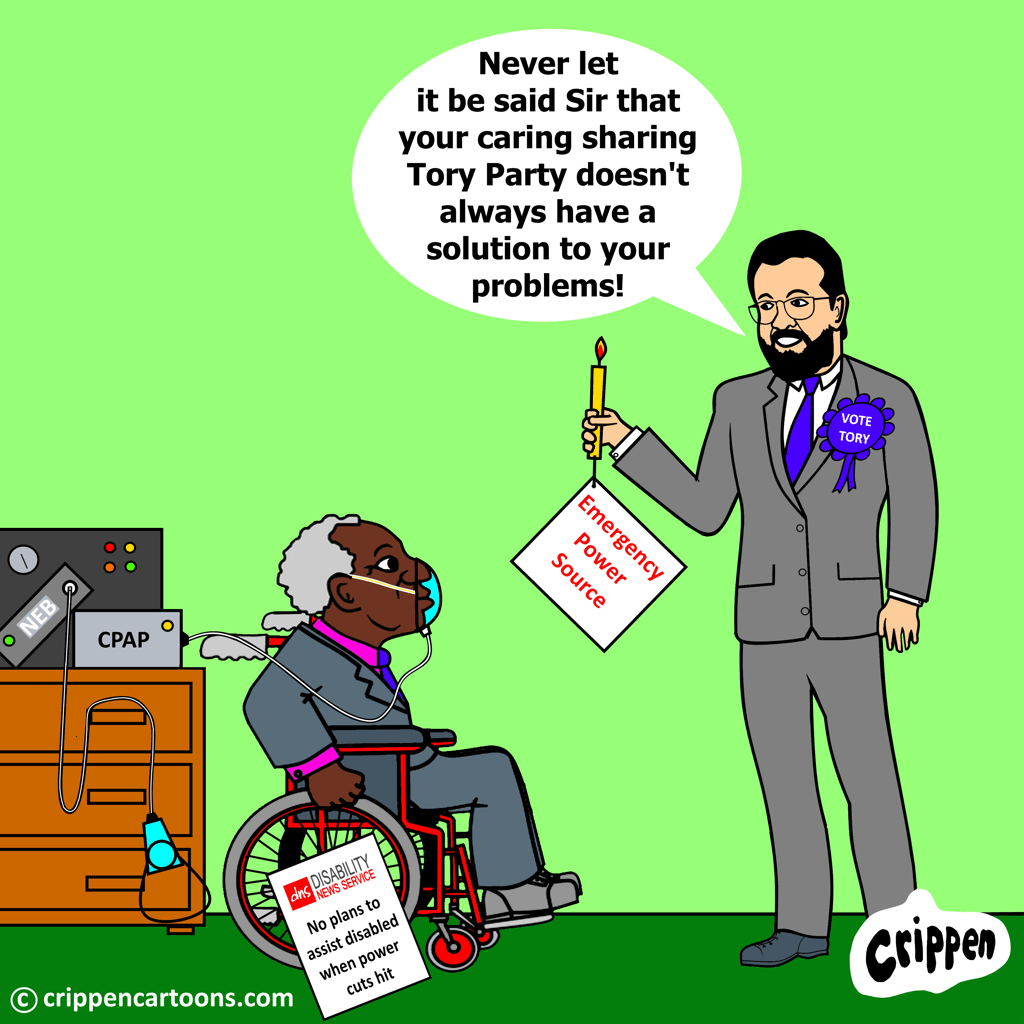
Following yet another freedom of information request DNS has been able to report that because ministers have shelved power-cut action, this could have a serious impact upon the health of some disabled people.

An unfinished government report warned that national power cuts could cause “catastrophic deterioration” in some disabled people who rely on medical equipment in their own homes, but ministers still decided NOT to draw up plans to protect them.

The DHSC scoping paper – Rolling Power Outages: Medical equipment and vulnerable people – considered what advice was available for disabled people who rely on mains-powered medical devices at home and whether there was a need for the Department of Health and Social Care (DHSC) to issue its own guidance. This report was left unfinished last summer.

The report – significant chunks of which are redacted – admitted that “in a national power outage scenario it would not be possible to notify PSR households pre-emptively” that they were about to lose electricity.

DHSC decided not to draw up any guidance and to leave it to individual disabled people and their “care teams” to draw up plans for “how they can prepare for and respond to loss of power to their home”.

That conclusion was reached even though the document makes clear that some disabled people could be “at very high risk of catastrophic deterioration” if the power cut was unexpected or continued for longer than their equipment’s batteries lasted. It also warned of the “significant impact on vulnerable people who rely on the use of medical equipment at home for their health and care” if there were national blackouts.

The paper also admitted that there were significant flaws with the system of local priority services registers (PSRs), which are supposed to ensure energy companies provide “enhanced support to their more vulnerable customers”.

And the paper warned of “an issue” with understanding how many devices supporting “the more critical conditions” were being used in disabled people’s homes. It said this information “would be critical to have in the event of planned outages so that the government have a clear idea of the impact and where support is required”.

And it also admitted that in a “reasonable worst-case scenario” in at least some types of “national power outage”, services such as providing emergency power to those on the PSR who rely on “at home medical equipment” would “not be available due to the scale and complexity of the outage”.

It is just the latest attempt by DNS over the last 16 months – in the face of government resistance – to find out what plan ministers have put in place to protect people who rely on equipment such as CPAP machines, ventilators, oxygen concentrators, nebulisers and dialysis machines in the event of a major blackout.

Read the full report in Disability News Service.

Description of cartoon for those using screen reading software

An elderly Black male is sat in a wheelchair with an oxygen mask over his mouth and nose. Behind him are other pieces of electrical medical equipment. At his feet is a copy of Disability News Service with the headline ‘No plans to assist disabled when power cuts hit’. Standing in front of him is a white, bearded male wearing a ‘Vote Tory’ rosette and holding a single, lit candle. Attached to the candle is a sign that reads ‘Emergency Power Source’. He is saying to the Black male: “Never let it be said Sir that your caring sharing Tory Party doesn’t always have a solution to your problems!”


You can still register with the Priority Services Register (PSR) to receive (in theory) extra help and support should you experience an outage of gas, electric or water supply.

Crippen hears of victory for disabled campaigners

Disabled campaigners have secured a significant victory over a local authority that threatened to force people with high support needs into residential care.

The grassroots group Bristol Reclaiming Independent Living (BRIL) had secured pro bono legal advice in its battle to persuade the Labour run Bristol City Council (BCC) to abandon its draft Fair and Affordable Care Policy. BRIL had argued that the draft policy breached the Care Act, the Human Rights Act, and the UN Convention on the Rights of Persons with Disabilities.

The draft policy (PDF) had said that disabled people could be offered a “residential or nursing home placement” if “a care package to remain at home would substantially exceed the affordability of residential care”, and it had warned that “exceptions” to this policy were “likely to be rare”.

If no agreement was reached about such a placement, the council would only offer funding for direct payments up to the cost of the residential care option, with the disabled person needing to make up the difference themselves to cover the rest of the support they needed to continue living independently at home.

In its response to a council consultation, BRIL said the policy was “fundamentally flawed, likely unlawful, and would cause misery to many disabled people and their family and friends in Bristol”. It said many disabled people had experienced “significant worry and distress” since BCC published its draft policy last year, when Disability News Service (DNS) first reported BRIL’s concerns.

But just days after submitting its response, and following a much-praised column written by disabled journalist Frances Ryan in the Guardian, the council abandoned its policy.

This was confirmed in a letter to Bristol Disability Equality Commission (BDEC) from Cllr Helen Holland, the Labour cabinet member with responsibility for adult social care, who wrote that the council’s cabinet and its mayor had decided that “the policy will not be taken forward at this time”.

She said she had noted “the strong concerns that some Disabled people in our city and nationally have raised” about the council’s draft policy.

However, BRIL said it was still concerned by parts of her letter. They pointed out that disabled people were not to blame for the financial crisis, and despite recognising the harm caused by 14 years of government cuts to local authorities, they said “councils must still make choices with communities, and decisions that are both lawful and in the interests of people they aim to serve”.

They also feared that a proposed working group would not be independent or genuinely co-produced with disabled people as its terms appeared already to have been set by the council. BRIL also warned that the “allocation of support based on budgets, rather than need, may lead to unlawful decisions contrary to the Care Act 2014” and that by setting up an ‘inquiry’ led and controlled by themselves, with hand-picked representatives, is clearly an attempt to shut down any genuine dialogue or co-production.

Cllr Holland has since asked BDEC’s chair, Alun Davies, to set up a new group that would “consider how to build a system to fairly allocate Adult Social Care funding within the agreed budget to meet the diverse needs of the population”.

BRIL would like to thank everyone all over the country for their support and hope it will make other local authorities work in partnership with disabled people before doing anything that may harm their quality of life.

Read the full story in Disability News Service courtesy of John Pring – Editor.

NB: BRIL’s response to the consultation had included a legal position based on pro bono advice from Oliver Lewis and Alice Irving, barristers at Doughty Street Chambers.

Description of cartoon for those using screen reading software

Rishi Sunak is standing holding a glass of champagne. Alongside of him are two people representing care homes. They are both holding up a glass of champagne whilst sitting on large bags of money. A sign on the wall reads ‘Care homes for the disabled – nothing about them without us’. Sunak is saying to them: “Here’s to maintaining the status quo!”. One of the care home owners replies: “Cheers”.

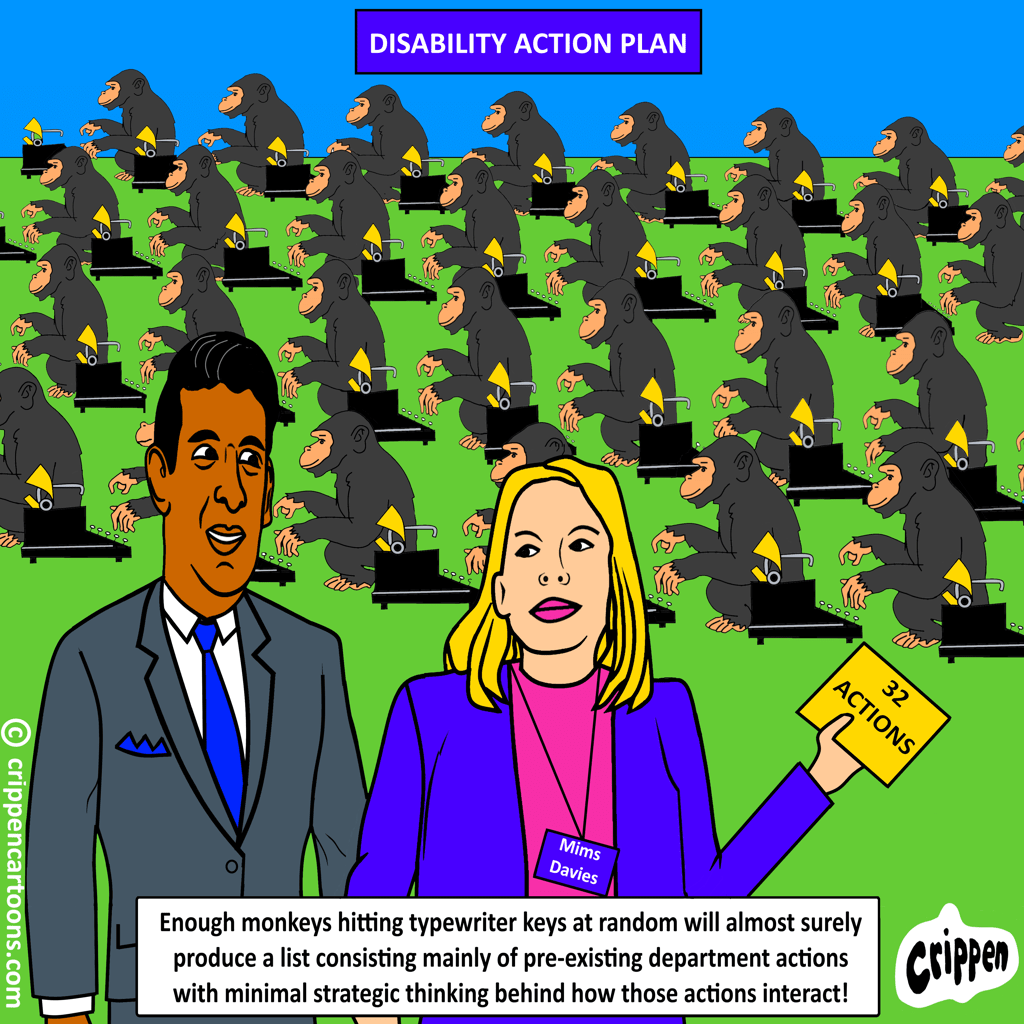
Crippen looks at empty promises from the government’s Disability Action Plan

Disabled People’s Organisations (DPOs) have dismissed the government’s new Disability Action Plan as a series of “empty promises” that fail to address the “dire situation” disabled people are facing.

The plan, and its 32 “practical actions”, was launched by disability minister Mims Davies on Tuesday, following a 12-week public consultation that took place last year.

All 32 actions appear to be low or zero budget measures, and there are no striking new policies, and apparently no new legislation or spending commitments before the general election. The plan is intended to run alongside the longer-term National Disability Strategy, which was heavily criticised by a cross-party committee of MPs last year.

That report by the Commons women and equalities committee said in December that the disability strategy was merely “a list consisting mainly of pre-existing departmental actions with minimal strategic thinking behind how those actions interact”.

Reactions to the action plan from DPOs have been uniformly negative, with all those contacted by Disability News Service highlighting the government’s failure to address the major issues affecting disabled people, such as the cost-of-living crisis, social care charging, disability hate crime, a hostile Department for Work and Pensions (DWP), and inaccessible housing and transport.

Read the full story in Disability News Service.

Description of cartoon for those using screen reading software

Rishi Sunak and Mims Davies stand against a backdrop of some 30 monkeys all tapping away on typewriters. A large sign above their heads read ‘Disability Action Plan’. Davies is also holding a card with ’32 Actions’ printed upon it. Below the image is a text block which reads: “Enough monkeys hitting typewriter keys at random will almost surely produce a list consisting mainly of pre-existing department actions with minimal strategic thinking behind how those actions interact!”

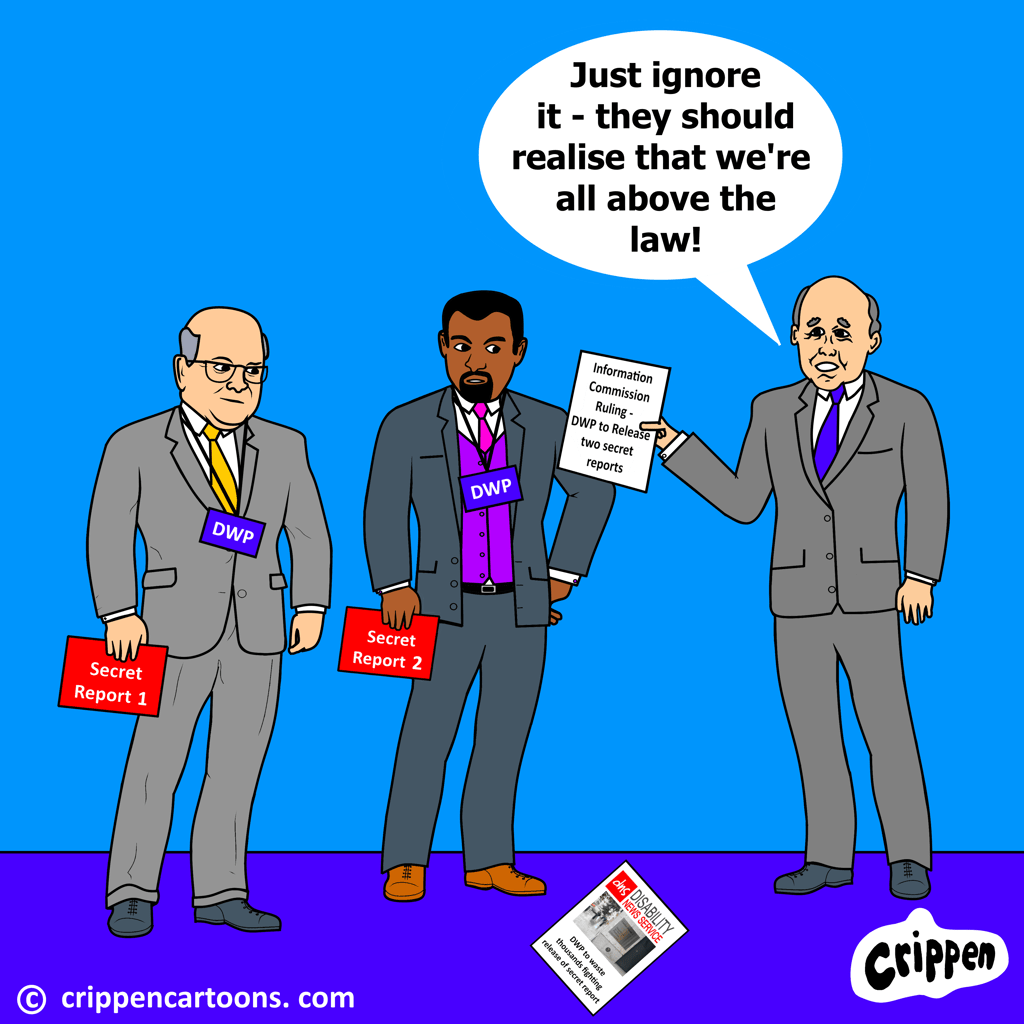
Crippen hears that DWP set to waste thousands fighting release of two secret reports

You’ve got to give John Pring, disabled journalist and editor of Disability News Service (DNS) his due. It’s been mainly down to his dogged pursuit of the Department for Work and Pensions (DWP) that they have had to release ‘secret’ documents that provide an insight into their Machiavellian tactics and their callous treatment of disabled claimants.

Only last year DNS obtained a ruling by the Information Commissioner that DWP must release two secret reports concerning the abolition of the Work Capability Assessment (WCA) and the affect it would have on millions of disabled people. In response DWP are set to waste thousands of pounds of public money fighting these rulings.

It is the latest example of how the department has used delaying tactics for many years to avoid being held to account over its own actions that have been linked to countless deaths of disabled benefit claimants.

The information commissioner ruled late last year that DWP should release both reports to DNS.

The first report was a written assessment of how the government’s decision to abolish the work capability assessment (WCA) would impact millions of disabled people and other groups protected under the Equality Act.

DNS had told the Information Commissioner’s Office (ICO) that although the WCA has been “closely linked to the deaths of hundreds of disabled people”, the plans to scrap it could lead to further deaths of claimants.

In a decision notice, the information commissioner said he “considers that DWP has failed to consider the strength of the public interest in the timely understanding and scrutiny of the decision to remove the Work Capability Assessment” and noted “a particularly strong public interest in disclosure of information relating to disability benefits reform”.

The second report describes the impact of DWP errors on “vulnerable” benefit claimants, which it has admitted could have a “negative” impact on its reputation. The report contains “worst case scenario” information that DWP has calculated about the impact of its errors on claimants, which it appears keen to keep hidden from the public, and probably includes estimates of how many claimants have been harmed by its errors.

The information commissioner added that there was a “strong public interest in the timely understanding and scrutiny” of the recommendations made by the report, and “in understanding DWP’s approach to preventing future errors and safeguarding issues”.

Read the full DNS article for additional information.

Description of cartoon for those using screen reading software

Two suited males from the DWP are standing together with each holding a secret report folder. On the floor is a copy of DNS with the headline ‘DWP to waste thousands fighting release of secret reports’. Opposite them is Iain Duncan Smith who is holding the ruling from the Information Commission. He is saying: “Just ignore it – they should realise that we’re all above the law!”

Crippen and the Sisters of Frida

A disabled women’s collective is looking to recruit fresh blood to help it spread the intersectional feminist values that lie at the heart of its groundbreaking work, in what it says is a “pivotal moment” in its history.

For the first time since it was founded in 2013, Sisters of Frida has secured funding that will allow it to pay members of its steering group. It is now calling for disabled women, including those who identify as queer, non-binary and trans, and women of colour, to put their names forward as potential steering group members.

It hopes the funding from London-based network Propel, together with an influx of new members, will help it develop leaders in marginalised communities, while keeping intersectional feminist values at the heart of its work.

Since Sisters of Frida was founded, it has shaped conversations in the UK and internationally about disabled women within both the feminist and disability rights movements. It has also highlighted the barriers faced by disabled women in a series of reports to the UN, and has supported work around the UN Convention on the Elimination of all forms of Discrimination Against Women, the UN Convention on the Rights of Persons with Disabilities, and the UN Commission on the Status of Women.

It also researched disabled women’s experiences of independent living during the pandemiccampaigned for changes to the law on violence and domestic violence against disabled women; ran a year-long peer-led skills development course for disabled women; and spoke publicly about the importance of intersectionality.

Eleanor Lisney, a founding member of Sisters of Frida, said she believed the collective’s biggest achievement so far had been to “promote the voices of disabled women and our visibility in issues related to disabled women”.

She said she hoped any recruits would bring “some freshness and passion” into the disabled people’s community through new voices and ideas, and “inspire and support each other to be leaders”.

They are particularly looking for disabled women with skills in fundraising, finance, strategy, organisational development and communications, and with a knowledge of intersectional feminist values and lived experience of disability.

Read the full story in Disability News Service.

Description of cartoon for those using screen reading software

A caricature of members of Sisters of Frida standing together with their large hand-made banner.

Crippen joins Rosie Jones in challenging Ableism

Disabled comedian Rosie Jones is a force of nature. You either love her or hate her. There’s no middle ground with this feisty young person. And she certainly takes no prisoners!

Speaking out recently, Rosie told one journalist that she certainly gets “more hate” directed at her than “perhaps any other comedian” due to her being disabled.  

The comedy star, who recently condemned the “same old ableism” after she was inundated with abuse following an appearance on CH4’s Big Fat Quiz of the Year, praised the support she gets from comedy peers, including Katherine Ryan, Nish Kumar, James Acaster and Joe Lycett.

But Rosie also reflects on the negative side of her fame, stating:

“Of course, for all the support I do get, I get an awful lot of negativity and abuse too, perhaps more than any other comedian going right now. When you’re disabled like me, with a speech difference, that opens even more hate.”

Reflecting on why this might be, Rosie suggested that:

“Perhaps when you are disabled, society either feels as though it should feel sorry for you or else celebrate you for being a hero at the Paralympics. I don’t fall into either of those camps. I’m a comedian; I’m not particularly inspirational and I’m also not a victim. So, what am I to people?”

She added that these “trolls” are “angry at the world” and might feel triggered by seeing her “being unapologetically myself, swearing, talking about having sex and living my dream”. Rosie recently spoke out about being “proud to be a Gay, disabled woman”.

While the comedian, who is a vocal campaigner against ableism and frequently calls out trolls who attack her during TV appearances, says she has “learnt how to deal with it” and “rationalise it”, she says she “hates that my mum has to see it”.

As Rosie often points out, there’s a difference between personal preference and downright ableism.

Description of cartoon for those using screen reading software

The image is a caricature of comedian Rosie Jones who is holding a survey clip board and is talking to a neanderthal type male. He is wearing a white vest with ‘I hate Cripples’ printed on the front. Rosie is saying: “Final question Sir – do you hate me because I’m a strong articulate woman or because I might be Gay?!” The man responds with: “Duh?!”

Crippen feels a breath of fresh air from Paralympian Hannah Cockcroft

Having viewed most Paralympians as being on a different planet when it came to challenging the inaccessibility of our society, I note that wheelchair racer Hannah Cockroft has decided to break the mold and speak out against the government’s lack of support for disabled people.

I take my hat off to her as many Paralympians have told us in the past that they risked upsetting sponsors etc. if they were to use their position to challenge the status quo and be seen to rock the boat.

Speaking to Guardian journalist Paul MacInnes, Hannah told him that Britain is an “incredibly scary place for disabled people right now” with the government “failing to listen” to the needs of some of the most vulnerable people in society.

She said that the recognition achieved by Paralympians in the decade since London 2012 has meant that public perception has become one of overcoming adversity (what we perceive as the Super Crip stereotype), when the truth is that the struggles disabled people face have only grown in that time.

“You see us go out on the track and field and you see us do incredible things and suddenly our disability (sic) disappears in people’s eyes. We come across as massively independent and that we can conquer the world, but we can’t. I still can’t get on a train on my own I still can’t catch a bus. I still depend on Personal Independence Payments.

“The segregation between Paralympians and every other disabled person is damaging. Britain is an incredibly scary place for every disabled person right now. You feel targeted with every announcement that comes out; you feel unsupported.”

Hannah hopes that the Paris Paralympics will return the spotlight to disability sport and activism but argues that the momentum for change commonly accepted to have sprung from London 2012 fizzled out a long time ago.

“I think I really noticed it in the journey between Rio and Tokyo. That was when I noticed the TV coverage fall away, we didn’t get the crowds anymore, we didn’t get integrated as much as we had been the previous four years. Everything started to disappear.”

For further information about Hannah’s stand please read Will Reynold’s DAO blog.

NB: The new disability flag, unveiled in October 2021 by its creator Ann Magill, shows a straight diagonal banner of five colors on a dark background. The flag is an update of Magill’s original 2019 disability pride flag, which showed the banner with zigzag lines.

Description of cartoon for those using screen reading software

Crippen has created a caricature of Hannah Cockroft seated in her racing chair with ‘Disablist UK’ printed on her chest (replacing the original ‘Great Britain’ logo) and holding the flag of the disabled people’s movement (replacing the Union Flag).

Crippen warns about Labour’s disregard for disabled people

‘Up the workers’ seems to be Labour Leader Sir Keir Starmer’s main message in Labour’s new campaigning pamphlet ‘Let’s Get Britain’s Future Back’.

With over 18 mentions of “working people” and not one mention of social care, disability or disabled people, this is the ‘bible’ that Labour will be following, leading up to a general election that is almost certain to be held later this year. Also, although there is a section on repairing the NHS, there is no mention of repairing the damaged social care system, courtesy of the Tory party.

We shouldn’t really be surprised as Labour has consistently shown a complete disregard for disabled people, with even their own disabled members group being ignored whilst recently attempting to bring up issues relating to Labour’s ableist attitude, along with the accusation that Labour was being “institutionally disablist”.

The party, and Labour leader Sir Keir Starmer, have been continually criticised for their focus on working people, and their failure to highlight the many concerns faced by disabled people and those who cannot work.

Disabled journalist John Pring, writing in the Disability News Service (DNS) reports that there is also no mention of addressing the harm caused by social care charging, which research by disabled campaigners has shown leads to tens of thousands of people across the country every year having debt collection action taken against them by their local authorities over unpaid charges.

DNS reported in October that Labour had dodged a promise made in 2022 that it would produce a policy on whether it would reduce or scrap care charges if it won power at the next general election.

Although this does not mean there will be no disability policies in the party’s final election manifesto, it does suggest that disabled activists will have to fight hard for their concerns to be heard during the coming general election campaign.

Read the full account of this story in Disability News Service.

Description of cartoon for those using screen reading software

Crippen has reproduced the Labour campaign leaflet in cartoon form. Starmer is portrayed wearing a flat cap and has a roll-up behind his ear. Racing pigeons can be seen flying in the background and he has a ferret in his top pocket. Karmer is saying: “Tha knows it’s working-class folk I stand for now – not those disabled scroungers!”

Crippen asks are the DWP over-picking disabled people for its benefit fraud investigation?

Not content with ignoring their own calculations which indicate that most of the money ‘lost’ in the Department for Work and Pensions (DWP) benefits system is due to their own incompetence, they are still insistent on convincing a gullible public that there is massive fraud taking place, and that disabled claimants sit at the centre of this criminal activity.

The most recent figures that I could find that had been substantiated by Hansard was that the 2023 statistics for fraud and error in the benefit system confirmed that the overall rate of fraud and error during that financial year was 3.6%. A more recent figure shows that the total of benefit fraud amongst disabled claimants was only 0.5% of this figure.

So, how does this justify them spending some £70 million on Artificial Intelligence (AI) technology to hunt down these claimants who are allegedly costing the country billions of pounds? As reported in Disability News Service (DNS) one Conservative MP Sir Desmond Swayne asked Peter Schofield, the most senior civil servant in the DWP whether there were “shades of the Horizon scandal” over its use of such technology? All Schofield could reply with was: “I really hope not.”

DWP’s annual report and accounts revealed last year that it was using machine learning to prioritise which universal credit claims to review for potential fraud. But the National Audit Office reported that using machine learning in this way creates “an inherent risk that the algorithms are biased towards selecting claims for review from certain vulnerable people or groups with protected characteristics”.

The disabled people’s organisation the Greater Manchester Coalition of Disabled People (GMCDP) continue to work with the justice campaign group Foxglove over concerns that the algorithm could be “over-picking” disabled people for its benefit fraud investigations.

Neil Couling, the DWP director-general responsible for universal credit said the DWP would report in this year’s annual report and accounts whether there were “particular groups with different protected characteristics impacted unintentionally by this kind of activity”.

But he also admitted that other countries had “got themselves into quite a bit of a pickle” when they have “tried to use this sort of technique”.

 Read the full account in Disability News Service.


Descriptions of cartoon for those using screen reading software


The Prime Minister Rishi Sunak is stood alongside of a Dr Who Dalek which has ‘DWP Fraud Detector’ printed upon it. In front of them is a large board with the heading ‘DWP Fraud profiles’ along with images of different disabled people portrayed on it. On the floor at their feet is a copy of the Stun newspaper with the headline ‘DWP uses AI to investigate benefits fraud’. Sunak is telling the Dalek: “This is what most of them look like – so feel free to exterminate whoever you fancy!”

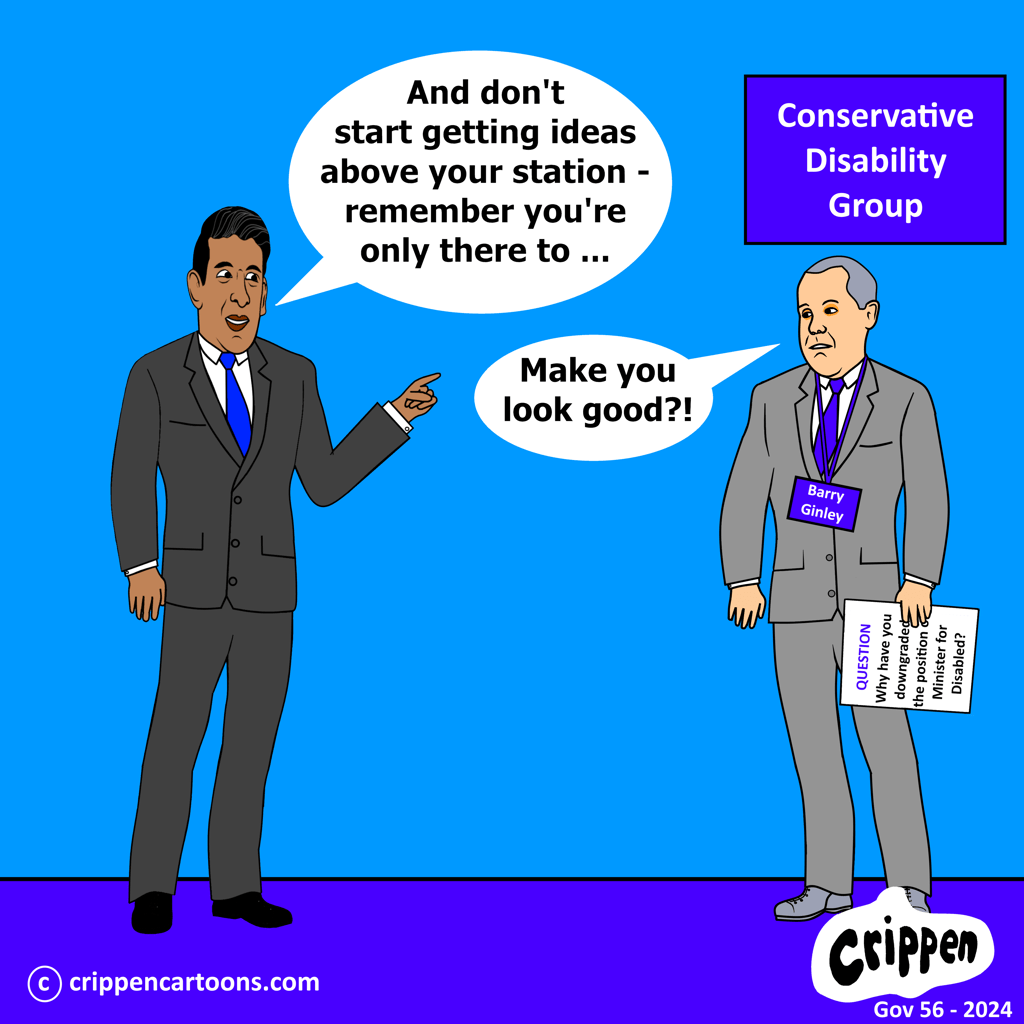
Crippen and the Tory Disability Group

Writing in her capacity as the research lead for the Preventable Harm Project (2009–19) Mo Stewart switches her focus to the Chair of the Conservative Disability Group (CDG), Barry Ginley, who has spoken out against the government’s downgrading of the role of disability minister.

In a letter to Ginley Mo writes that she notes with interest his concerns that the role of the disability minister is being downgrade, as reported in the Disability News Service. Also, his comments that “the government does not hold disabled people’s interests at the heart of policy”, and that disabled people would now “not believe the government” when it announces any future policy which claims to improve their lives.

She continues to inform the Chair of the CDG that the chronically ill and disabled community who are unfit for work will never believe that the government are trying to ‘improve their lives.’ The past 15 years having been filled with various DWP ministers and Secretaries of State relentlessly challenging the integrity of the disabled community who are unfit for work by claiming that many were fraudulent, which always was totally untrue, and was a thinly veiled character assassination of long-term disability benefit claimants.

In fact, as previously mentioned in this Blog the government’s own figures for fraud and error regarding DWP claims shows that any fraud committed by disabled claimants was recorded at only 0.5% and that most loss was due to the DWP’s own incompetence!

Indeed, as Mo continues to inform the CDG Chair, that adopting social policies which were guaranteed to cause preventable harm to those in greatest need was based on many false claims by the administration, which worked very well when supported by the national press. She reminds him that disability hate crimes, including murder, increased by 213% as advised by the Crown Prosecution Service.

Mo also points out another piece of misleading information put out by the Tory-LibDem Coalition was that the Labour Party had spent excessively on welfare, which wasn’t true. The biggest past expenditure on welfare was by the John Major Conservative government (1990-97) as identified by the Institute for Fiscal Studies. In comparison, the expenditure on welfare by the last Labour government had fallen.

Mo adds:

“The CDG doesn’t seem to be acknowledging this ongoing  government generated public health crisis, which suggests … that they don’t know about the very well documented and unnecessary human suffering created by social policy primary legislation and imposed by the Department for Work and Pensions (DWP) … identified as a ‘violent bureaucracy’.

“May I suggest that until and unless the CDG, and the Conservative Mental Health Group, acknowledge the oppression of the chronically ill and disabled community who are not in any position to benefit from paid employment, then the long-suffering disabled community will not take the concerns of the CDG very seriously. You appear to disregard their identified oppression due, entirely, to social policies and the often-shameful comments by successive government ministers, which always attracts publicity by the right-leaning press. Fortunately, the online press do their best to alert the public to this ongoing government induced public health crisis.”

Mo finishes by suggesting that someone urgently needs to investigate the many thousands of suicides directly linked to the DWP disability benefit assessments with, as yet, no-one held to account. Also, she hopes that the CDG will now offer much greater public support to those in greatest need and challenge the administration whose devotion to social policies adopted using a fiscal priority, whilst disregarding health and wellbeing, was guaranteed to cause death, despair and preventable harm to many of those in greatest need.


Mo Stewart – Fellow, Centre for Welfare Reform writing in her capacity as the research lead for the Preventable Harm Project (2009–19)

The public health crisis created by UK social policy reforms

       Justice, Power and Resistance 6(2): 217-228

Description of cartoon for those using screen reading software

The Prime minister Rishi Sunak is seen standing alongside of the Chair of the Conservative Disability Group Barry Ginley. Ginley is holding a piece of paper with the ‘Question – Why have you downgraded the position of minister for disabled?’ printed on it. Sunak is saying to him: “And don’t start getting ideas above your station – remember you’re only there to … “ Ginley interrupts by adding: “Make you look good?!”