Crippen looks back at government cover-up regarding emergency preparedness

I’ve been corresponding with a young disabled student about some of my cartoons relating to government cover-ups, especially those affecting disabled people. One in particular got his attention, which was the one regarding Exercise Cygnus which I blogged about back in April 2020.

You’ll remember that Exercise Cygnus, which took place in October 2016, involved all major government departments, including the NHS and local authorities across Britain looking at their preparedness should we ever be hit with something like the Coronavirus pandemic.

The finished report showed gaping holes in Britain’s Emergency Preparedness, Resilience and Response (EPRR) plan. They found that there was not enough personal protective equipment (PPE) for the nation’s doctors and nurses. The NHS was about to “fall over” due to a shortage of vital equipment and critical care beds and morgues were set to overflow. The report also raised awareness that they would need to build in additional support for disabled people, older people, and those with underlying health issues.

Well, we know that no action was taken following this report, and that when the pandemic arrived on our shores four years later the powers that be just ran around like headless chickens claiming that they hadn’t seen it coming. 

Tell that to the thousands of disabled people who died of Covid related illness over the past 12 months. I’m not sure that they’d appreciate the irony!

Description of cartoon for those using screen reading software

Boris Johnson and Theresa May are standing together in front of a hill of earth covered by white crosses. A sign in front says, ‘6 out of 10 Covid deaths are disabled people’. May is carrying a piece of paper that has ‘Cygnus report’ written on it. Johnson is saying: “I keep telling them – we had no idea that this could happen!”

Crippen asks – Bias or what?!

The Right-wing influences are at it again with two new appointments to high ranking roles within the broadcasting industry and the launch of a new TV channel that has raised more than a few eyebrows.

One of the things that clouds the judgement of the general public when ever they read or hear anything to do with disability is the usual right-wing bias that accompanies the report. This can simply be the old stereotypes such as portraying us as needy and reliant upon the many charities that claim to represent us, or it could be something more sinister, like a hidden agenda (Ed: here he goes again!) orchestrated, let’s say by the spin doctors at Tory HQ.

Whether you believe that this bias exists or not, you have got to admit that the appointment of two top Tory supporters to powerful roles within our broadcasting industry smells of something that’s distinctly fishy!

It’s been revealed that Richard Sharp, former Goldman Sachs banker and adviser to the chancellor, has been lined up to be the next chairman of the BBC after Sir David Clementi steps down. Electoral Commission records show that this man has donated more than £400,000 to the Conservative Party since 2001, leading to accusations of cronyism and a clear bias.

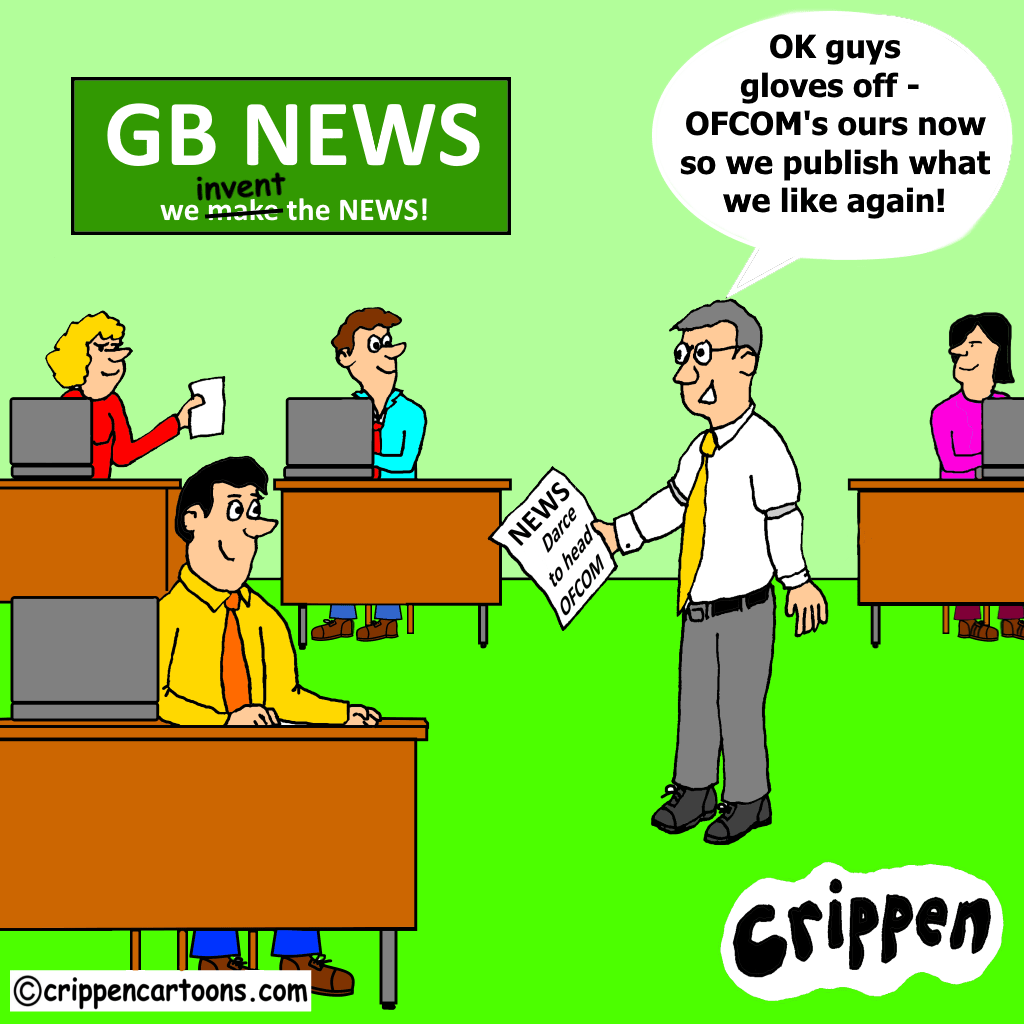
This appointment comes at the same time that another Tory supporter  Paul Dacre gets set to become the new Ofcom chair.

Under his tenure at the Daily Mail, Dacre ran such provocative headlines as “The Swarm On Our Streets” in relation to migrants as well as peddling other nationalistic hyperbole such as “Migrants Spark Housing Crisis”,  along with many biased disablist articles.

And GB News, the new TV channel chaired by Andrew Neil, launches in the UK soon. Billed as the UK’s version of American right-wing channel Fox News and claims to be the biggest news TV channel to be created since Sky News went on air 30 years ago.

The channel has yet to broadcast any coverage, but it has already faced an attempted advertising boycott started by campaign group Stop Funding Hate following speculations that the channel will be similar to Fox News.

Just what we need. A new right-wing tv channel plus a top Tory running the BBC and both overseen by a Tory Ofcom regulator. No bias there then?!

Description of cartoon for those using screen reading software

A large newsroom with a sign identifying it as ‘GB News – we make the news’ is filled with journalists at their desks and laptops. The sign has been changed however to read ‘we invent the news!’ An editor has just entered the room with a piece of paper that has ‘News – Darce to head OFCOM’ printed on it. He is saying: “OK guys gloves off – OFCOM’s ours now so we can publish what we want again!”

Crippen hears that lack of Covid plan for disabled Australians a ‘serious failure’ of their government.

So, it’s not just here that governments are failing to consult with disabled people about the ramifications of the COVID pandemic. I recently had an email from one of my disabled friends in Australia telling me that they’ve been experiencing similar disregard from their government.

I had a dig around and discovered an article in the Guardian reporting that the Australian federal government has been sharply criticised by the disability royal commission for its “serious failure” in not adequately consulting disabled people or creating a specific plan to protect them at the start of the coronavirus pandemic.

Those failings “produced serious adverse consequences for many disabled people”, the commission said in a report tabled in parliament on Monday.

At the start of the crisis no government agency “made any significant effort to consult with disabled people with or their representative organisations”, the report said.

“Even allowing for the novel challenges presented by the coronavirus, this was a serious failure.”

It said disabled people faced the “sudden loss of essential support services” and “impaired health and wellbeing” due to an “inability for prolonged periods to access essential supplies such as food and medications”.

Disabled people experienced “extreme stress and anxiety” stemming from the fear of contracting the virus because of support staffing issues and a lack of PPE.

So, there you go. We’re not alone in being ignored during this pandemic. Our Aussie friends are also feeling that they are just as expendable.

Description of cartoon for those using screen reading software

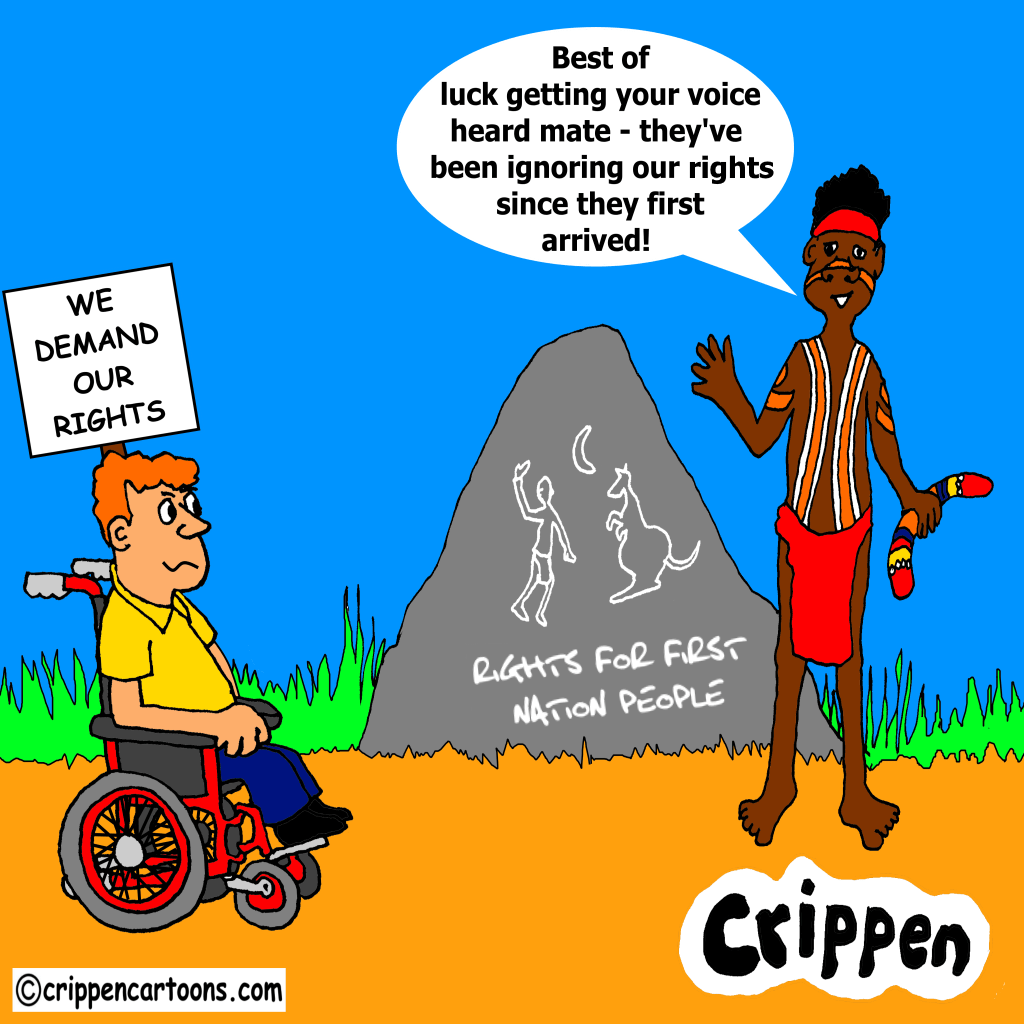
A white wheelchair user with a placard saying ‘we demand our rights’ is sat facing an Australian First Nation person. This person is stood next to a large rock on which is carved First Nation art and the slogan ‘rights for First Nation people’. He is wearing a red headband and loin cloth, carrying a boomerang and also wears traditional body paint. He is saying to the disabled man: “Best of luck getting your voice heard mate – they’ve been ignoring our rights since they first arrived!”

Crippen asks what use is our Minister for Disabled People?!

Don’t get me wrong, I think the post could be extremely useful, especially if the person appointed actually worked with disabled people and our groups and organisations.

It’s just that we’ve had a series of ministers in this role who seem hell-bent on doing the complete opposite; seemingly working against us and doing everything they can to undermine any progress we’ve made over the past few decades.

Take our present incumbent (please!), Justin Tomlinson. A man with a history of leaking parliamentary reports, voting down such bills as the one protecting the benefits of disabled children and those undergoing cancer treatment, and appearing to suggest that families facing a cap under the Universal Credit scheme could take in a lodger. In fact, just the sort of person we want fighting our corner (not!).

You’ll have read in previous blogs that he’s also quite happily misled fellow MP’s regarding the apparent success of the nine regional ‘disability’ networks he was instrumental in setting up a couple of years ago. These were intended to “amplify” the voices of disabled people, but as we all know, they are nothing more than a sham.

Problems recounted by those people involved with the few groups that have managed to get going, tell us that when they eventually appoint a Chair and manage to arrange a meeting, they are often cancelled at short notice, resulting in problems associated with rearranging support workers, travel plans, etc. A meeting which should have given a heads up about the UK Disability Strategy Survey was also cancelled at the last minute.

Tomlinson also has the nerve to tell the various select committee members who have queried the status of the Regional groups that everything is going great, adding that he found it: “a very, very rewarding part of my role”. Oh yeh?!

It’s a bit like ‘the emperor’s new clothes’ where no one wants to be the first person to point out that he’s not actually doing his job! I’ll say it for them then … TOMLINSON, YOU’RE A SHAM – YOU’RE SACKED!

Description of cartoon for those using screen reading software

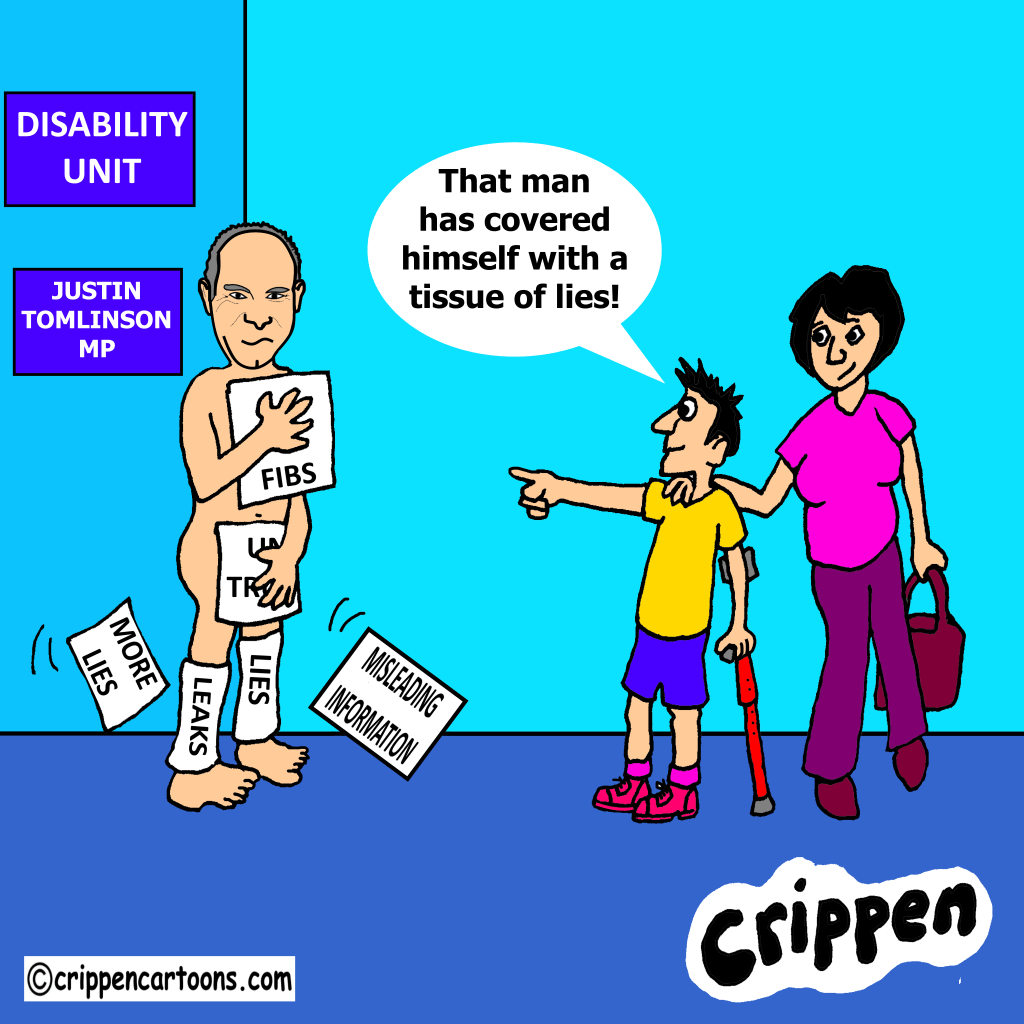
A young disabled boy is standing with his mother and is pointing at a naked Justin Tomlinson. However, Tomlinson has pieces of paper covering his body along with a few pieces that have dropped off. The papers read liar, fibs, un-truths, misleading information, leaks and more lies. Behind Tomlinson are two signs that read Disability Unit and Justin Tomlinson MP. The disabled boy is saying to his mother: “That man has covered himself with a tissue of lies!”

Crippen asks is there a pattern emerging?

Sorry, but I’ve got my cynical head on again (Ed: What’s new?!), and I can’t help thinking that there’s another agenda running along with this government and its future plans for disabled people.  

We’re all aware of just how hard it has been to get where we are today; the long, hard struggle to break out of those institutions that kept us segregated from the rest of society and the fight we had after identifying the many barriers that existed to disable us. And then fighting for accessible transport, accessible housing and access to an inclusive education and employment.

We’d not completely succeeded, but at least we were moving things in the right direction with the Disability Discrimination Act (DDA) and our own Disability Rights Commission (DRC). That was until this government came into power and started to pull apart this legislation followed by further dismantling of education and care provision at the outbreak of the Covid pandemic. And now, as I mentioned in my last Blog, we’ve got their complete disregard for accessible housing.

It seems obvious to me that ‘they’ want us all off the streets again and back into the homes and institutions that kept us out of their hair. It was certainly cheaper for them to have us ‘cared for’ by the many charities that existed for this very purpose. No more worrying about finding money for accessible transport, inclusive education, access to work etc.

It’s all so insidious that you can be forgiven for not having joined up the dots yet. But things are only going to get worse for us and that, if we don’t start to do something more proactive, we could soon reach the point of no return.

Description of cartoon for those using screen reading software

A young female wheelchair user is outside the front door of a supposedly new accessible house. A sign alongside of it states: ‘conservative party – fully accessible housing’. However, this is a façade, as behind it is a large grey building with bars on the windows. A large sign proclaiming ‘compulsory residential living unit for disabled’ is fastened above its entrance. On the grass outside of the institution a fire is burning inside of a metal dustbin. Several documents identified as ‘accessible transport provision’ and ‘accessible housing provision’ and also ‘inclusive education’ are all being burnt. A white male in a suit and tie is saying to the young disabled person: “welcome to your long awaited fully accessible new home!”

Crippen learns that the government sits on accessible housing report

You’ll remember that last year the government was accused of “showing contempt” for disabled people after publishing an “utterly shameful” 84-page white paper on the future of the planning system, without including a single mention of disabled people, disability or accessible housing.

Well, they’re at it again. Only this time they’ve delayed publishing a report that called for more research into the benefits of accessible housing for up to four years, it has been revealed by Disability News Service.

The report, provided by architectural firm PRP in March 2016, was finally published last week by the Ministry of Housing, Communities and Local Government (MHCLG).

The report examined evidence on the benefits of accessible housing, and the effectiveness of guidance relating to other buildings – under Part M of the building regulations – to see how well it was meeting the needs of disabled people.

The report found that the key benefits of accessible housing included reduced delayed hospital discharges, avoiding having to pay for temporary and permanent residential care and lower administrative costs of rehousing disabled people from inaccessible housing.

The report also examined the effectiveness of guidance on “buildings other than dwellings”, which has not been updated since 2004.

It found that, although the guidance was “considered to be reasonable in meeting most needs of disabled people”, the lack of enforcement of that guidance was seen as “a critical issue”.

It also found that the needs of some disabled people may not currently be covered “adequately” by the guidance, including hearing- and visually-impaired people, people with restricted growth, people with complex and multiple impairments requiring personal assistants, and users of powered wheelchairs.

It also called for consideration of the needs of autistic people, those with mental health conditions, and people with dementia and other “cognitive health issues”.

This week, MHCLG refused to say when the research was completed, and why its publication had been delayed for so long.

NB: Housing secretary Robert Jenrick has already been warned back in 2019 that he faced the threat of legal action over the government’s failure to take action to solve the crisis in accessible housing.

Description of cartoon for those using screen reading software

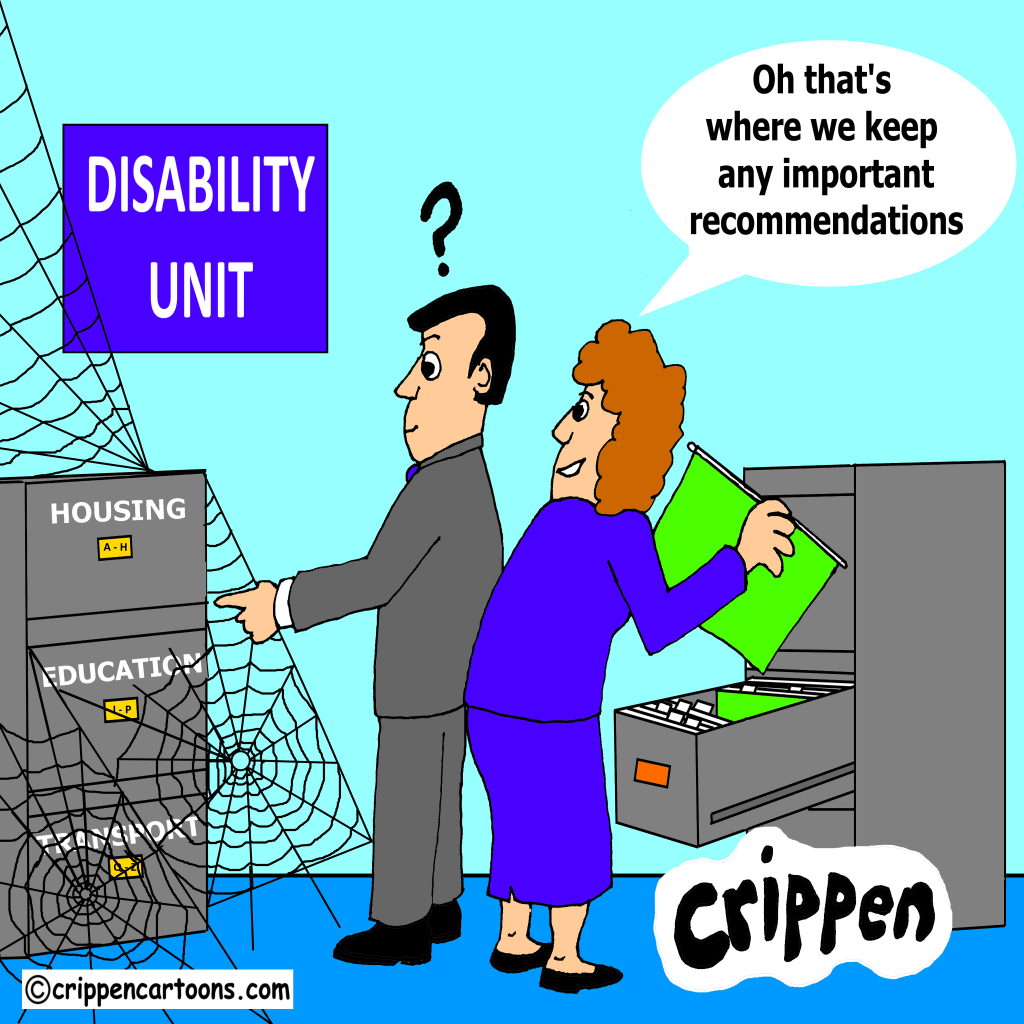
A man and a woman working at the Disability Unit are standing in front of two filing cabinets. One is open and the woman is taking out a file. The other is closed and has not been opened for some time and has cobwebs all over it. It also has the draws labelled housing, education, and transport. The man is looking at this cabinet with a question mark above his head. The woman is saying to him: “Oh that’s where we keep any important recommendations!”

Crippen and the National Disability Strategy Survey – Part 2

Following on from my last Blog about the National Disability Strategy Survey (NDS), several disabled people’s organisations (DPOs) have complained directly to Justin Tomlinson, the Minister for Disabled People.

The complaint is not only about the lack of prior consultation and notification about the launch of the Survey, but also about the ridiculously short timescale for Disabled people to respond.

Although the survey will be open until 23 April 2021, only responses received before 13 February 2021 will inform the development of the National Strategy, while those received after this date will only be used to inform its delivery.

ALLFIE, Inclusion London, and Reclaiming Our Futures Alliance (ROFA), have joined together to complain and Joe Whittaker, ALLFIE Trustee, explains:

“There is a clear failure of the Disability Unit to demonstrate meaningful engagement with DPOs and take seriously the essential contributions we can offer.”

The Disability Unit in the Cabinet Office claims it is: “working with government colleagues, disabled people, disabled people’s organisations, charities and businesses to develop and deliver a National Strategy for Disabled People.” However, as we all know, this is not the case.

In the letter to Tomlinson, calling for a deadline extension and engagement with Disabled People’s Organisations, Tracey Lazard on behalf of Inclusion London told him:

“I am frankly shocked and dismayed to receive this (information) in the light of the fact that at no point have we received any information, either in writing or at the DPO forum meetings, that the 13 Feb mentioned is the cut off period for feeding into the development of the strategy.

“Nor have we received any written information about the NDS or how the government plans to engage Disabled people and DPOs in its development … We have consistently requested that the DPO forum is organised and planned in a way that will facilitate DPOs strategic engagement in the NDS (as well as requesting basic improvements to the forum like minutes being taken which has to date not happened!) but no changes have been made. This presents a huge lost opportunity for DPOs to feed into the strategy.

“The decision to cancel the last two DPO forums in December and January without explanation were deeply frustrating but now in the light of this cut off period it is inexplicable that these meetings have been cancelled so close to the Feb deadline given this is the only way DPOs can engage directly with the disability unit and the Minister.

“The above can only be described as a failure to carry out the most basic engagement with Disabled people and our organizations in what will be the first disability strategy since 2011.

“Considering we are still in an ongoing pandemic in which nearly 60% of COVID related deaths are Disabled people and given the significant body of evidence that shows Disabled people are now experiencing deeper structural inequality that is eroding our quality of life and putting back our rights and inclusion it is absolutely vital that there is real and meaningful engagement between DPOs and the Government in the development of the NDS.

Given the above I am formally requesting that the NDS development period is extended and that the disability unit draws up a plan for specific DPO engagement to take place in this extended development phase.”

Members of the group report that they have not yet had a response to these concerns.  They urge other DPOs to share and support their concerns and stand in solidarity.

A full explanation of ALLFIE’s involvement and how you can obtain more information is available on their web site (please click here).

In Solidarity.

Description of cartoon for those using screen reading software

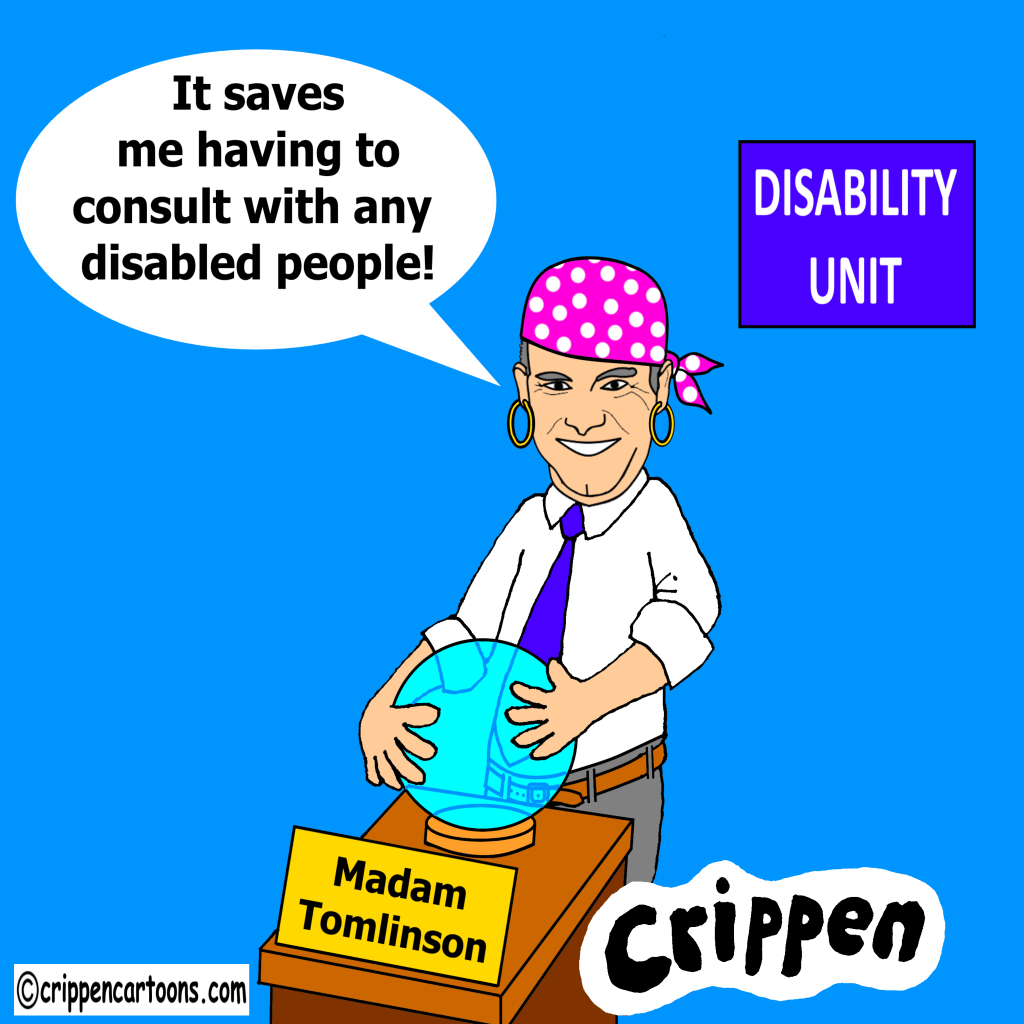
Justin Tomlinson is standing with a crystal ball on a table in front of him. His hands are wrapped around it and he is wearing a head scarf and golden hooped earrings. A sign saying ‘Madam Tomlinson’ is placed in front of him and another sign saying ‘Disability Unit’ is on the wall behind him. He is saying: “It saves me having to consult with any disabled people!”

Crippen discovers that prejudices and superstition still exists

I’m currently in the process of completing a project for DAO called ‘A history of disability – including the involvement of disability arts’. It has involved researching attitudes towards disabled people over the centuries including the many prejudices and superstitions that existed.

As much of this took place hundreds of years ago, and we’ve now moved into more enlightened times, imagine my distress when I received a link from an organisation called Humanity & Inclusion contradicting this assumption.

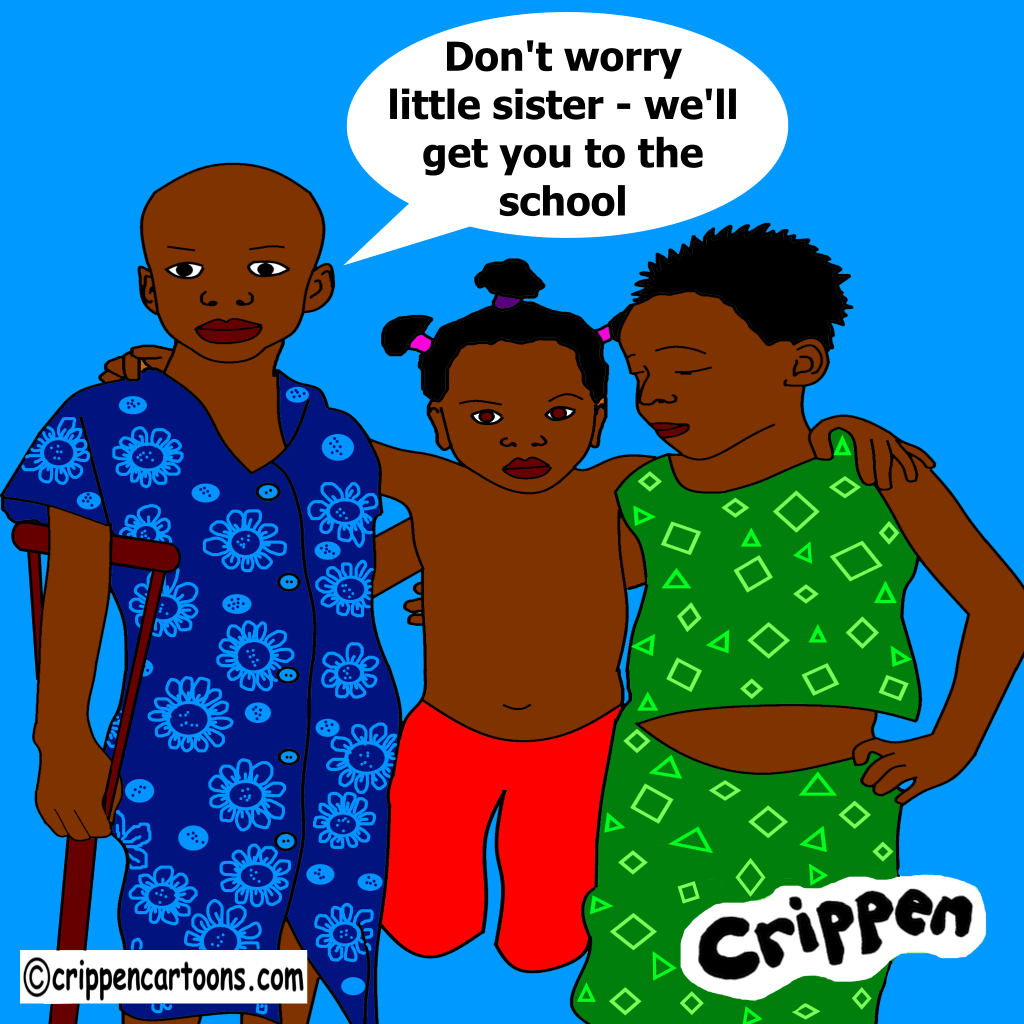
In parts of West Africa, having a disabled child is still seen by families as a punishment for some ‘sin’ committed by family members. Because of this the child will often be hidden from society, never venturing out or receiving any formal education. Some think that disability is contagious and react accordingly, ostracizing both the child and the family and in some circumstances driving them from their home.

Others believe that the bodies of disabled people have magical properties. Also, girls with intellectual disabilities are vulnerable to sexual abuse and violence because some believe that having sex with them will bring them wealth or even cure them of AIDS.

Humanity & Inclusion are playing an important role in challenging these prejudices and superstitions, and in particular supporting disabled children with achieving an education, especially young girls. As with many societies, young girls are often at the end of the queue for even the more basic educational opportunities. Being a girl and having an impairment represents a double discrimination in this part of the world.

In Mali, less than 18% of disabled women can read and write. In Niger and Mali, more than half of the girls enrolled in primary school do not access secondary education. And in Burkina Faso, only 1% of girls have completed secondary school with very few disabled girls in the Sahel region going to school at all.

When disabled girls do manage to attend school, they still face many obstacles. They often drop out of school early as they approach puberty, due to the family’s concern to protect them from sexual violence and early pregnancy. The lack of adapted toilets is also a cause of repeated absences and abandonment. And in rural areas, the distance between home and school is another major obstacle to schooling for disabled students with the cost of transport being too high for families.

To find out more about how this organisation are bringing help and a future for disabled children in West Africa, and how you might be able to help, please click on this link.

Description of cartoon for those using screen reading software

Two African teenage girls wearing brightly patterned clothing are carrying a younger African child between them. The younger child has no legs from the knees down. One of the older girls, who is using a crutch is saying: “Don’t worry little sister – we’ll get you to the school”.

Crippen and the National Disability Strategy Survey – Part 1

The launch of The UK Disability Strategy Survey has brought mixed reaction from fellow Crips and our groups and organisations (DPOs).

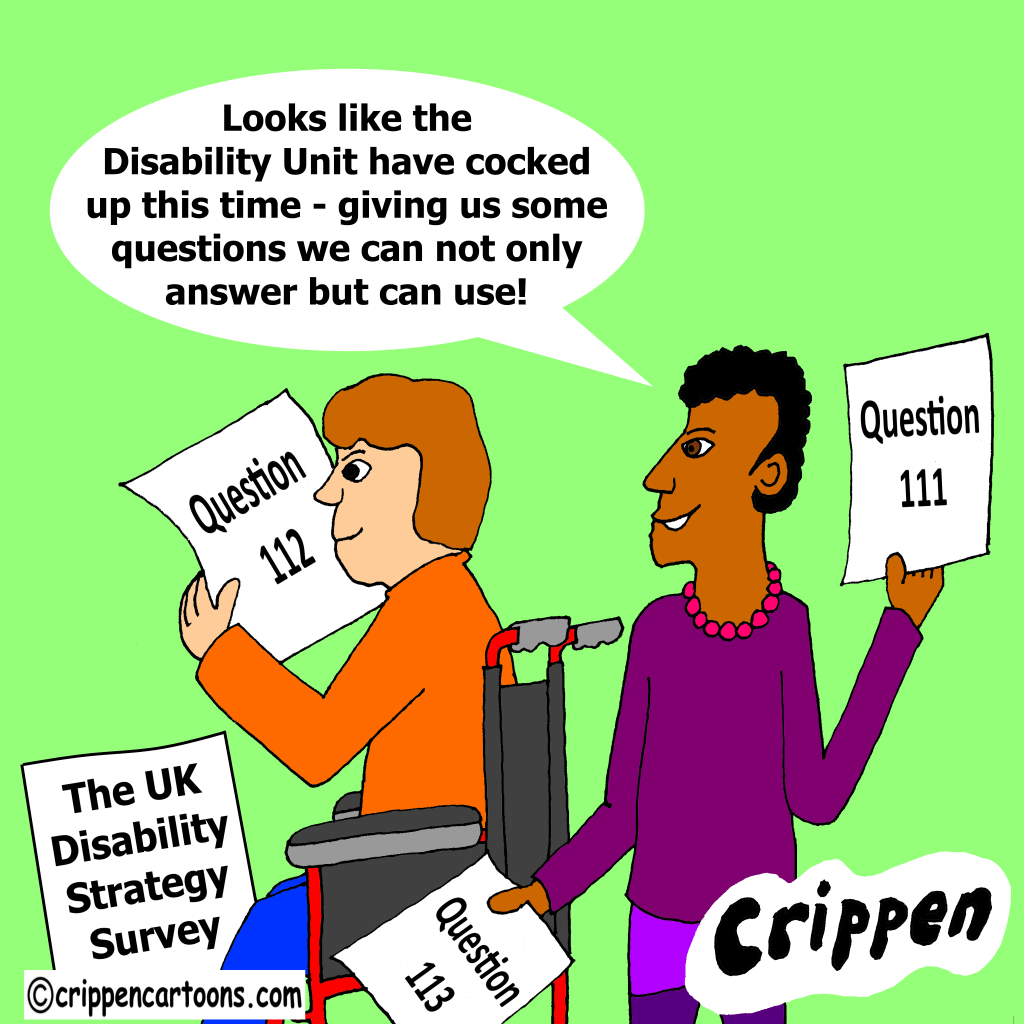
It is so obviously created by those faceless bureaucrats who have no real understanding of disability and who hide away in the Cabinet office’s Disability Unit. In fact, the only parts that seem to provide any real opportunity for us to have our say is at the very end of the survey – questions 111 to 113.

If we focus on these last three questions, the Survey actually provides a unique opportunity for us to try and hold the Government to account for the erosion of our rights and living standards over the last decade.  It also provides us with the opportunity to suggest ways that this government can implement the United Nations Convention on the Rights of People with Disabilities (UNCRPD).

Once again, our friends at The Alliance for Inclusive Education (ALLFIE) have come through and have provided some ideas on the sort of issues we should be addressing when answering these three questions.

The issues include addressing matters as diverse as demanding a fully inclusive education system within mainstream settings; tackling disability structural racism, intersectional inequality and discrimination; making Independent Living once again a reality, including creating a legal right to independent living and setting up a National Independent Living Support service; the de-institutionalisation and the closure of residential institutions and hospitals for Disabled children and adults and a radical reform of mental health and mental capacity laws, to name but a few.

You can read ALLFIES’ detailed list of suggested responses to the survey by clicking here.

More information about the UK Disability Strategy Survey, including accessible formats

Complete the UK Disability Survey

Description of cartoon for those using screen reading software

Two young disabled women are holding up three pieces of paper with question 111 on the first piece, question 112 on the second, and question 113 printed on the third. At their feet is another piece of paper with ‘UK Disability Strategy Survey’ printed on it. One of the women, of African heritage is saying to her companion: “Looks like the disability unit have cocked up this time – giving us some questions we can not only answer but can use!”

Crippen revisits the plight of learning disabled people still being held in secure units.

Thousands of learning disabled people and those with Autism in England are still being held in secure units, usually hundreds of miles from their families and facing increasing use of restraint and isolation.

Writing in The Guardian, journalist Saba Salman reports that parents who are fighting to visit their loved ones say that the pandemic is making things much worse, with more restraint, seclusion and segregation being used to deal with their children’s increasing anxiety and resulting behavioural issues.

After a year in secure care 105 miles from home, Jack Cavanagh, 17, who has autism, a learning disability and epilepsy, desperately misses his family. They used to see him every weekend, but with Covid restrictions have been unable to visit. As a result, they say, Jack has become more anxious and isolated.

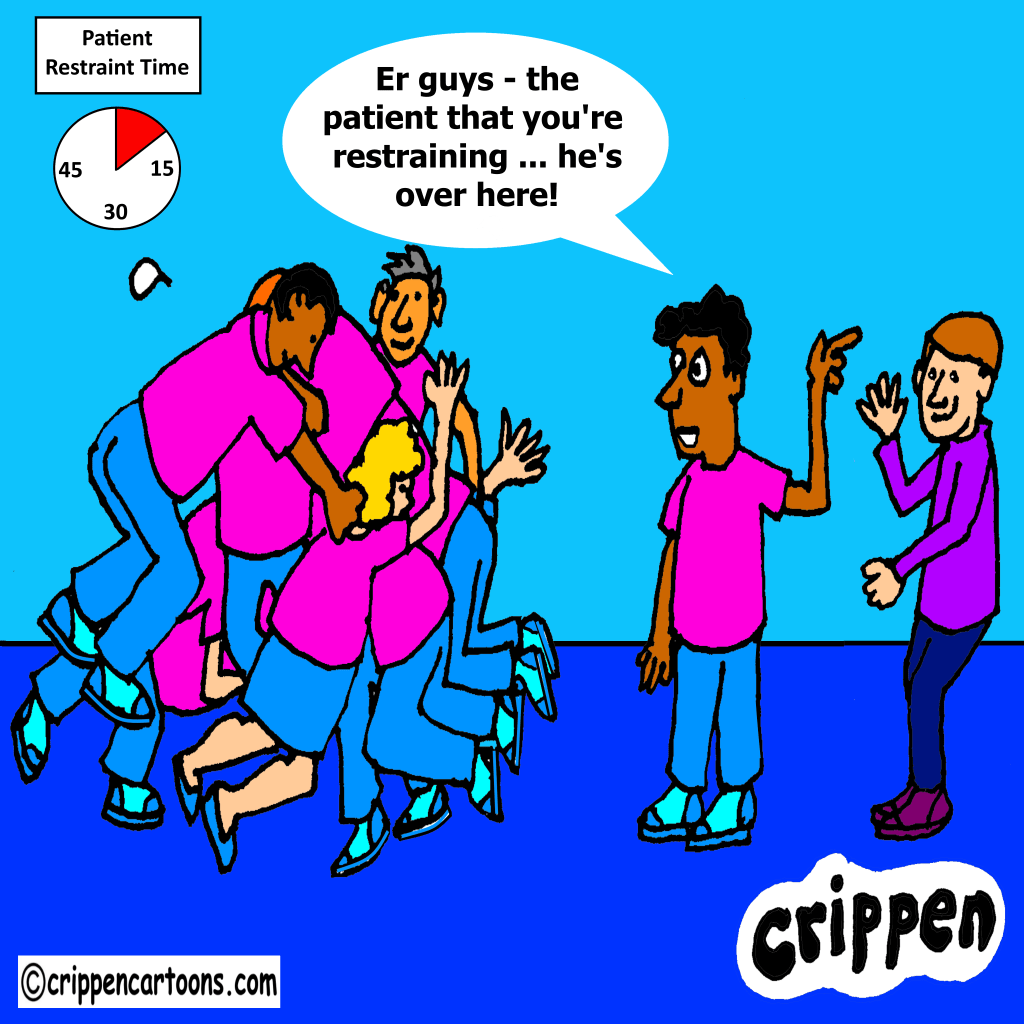
Also, the lack of affection makes Jack, who also has ADHD, become aggressive. This has led to staff increasingly restraining him, with up to seven adults holding him down for 10 minutes at a time.

Apart from the odd supervised walk in the grounds, Jack has been locked in a single bedroom, bathroom and living area. He also started self-harming and became selectively mute after his parents weren’t able to visit for more than 15 weeks due to measures to stop the spread of coronavirus. They later discovered that they could have visited him after taking legal advice.

Despite repeated government promises to shut down institutions for learning disabled and autistic people with complex needs in the wake of the 2011 Winterbourne View scandal, inpatient units alone are still home to over two thousand learning disabled or autistic adults and children in England.

You can read Saba’s full article in The Guardian and more about this issue by clicking here.

Description of cartoon for those using screen reading software

A large group of people all dressed identically in a nursing uniform are piled on top of each other on the floor. Above them on the wall is a clock that is labelled ‘Patient Restraint Time’. The first ten minutes are highlighted in red. Another nurse is standing along-side of them and is indicating a young man standing by his side. The single nurse is saying: “Er guys – the patient you’re restraining … he’s over here!”