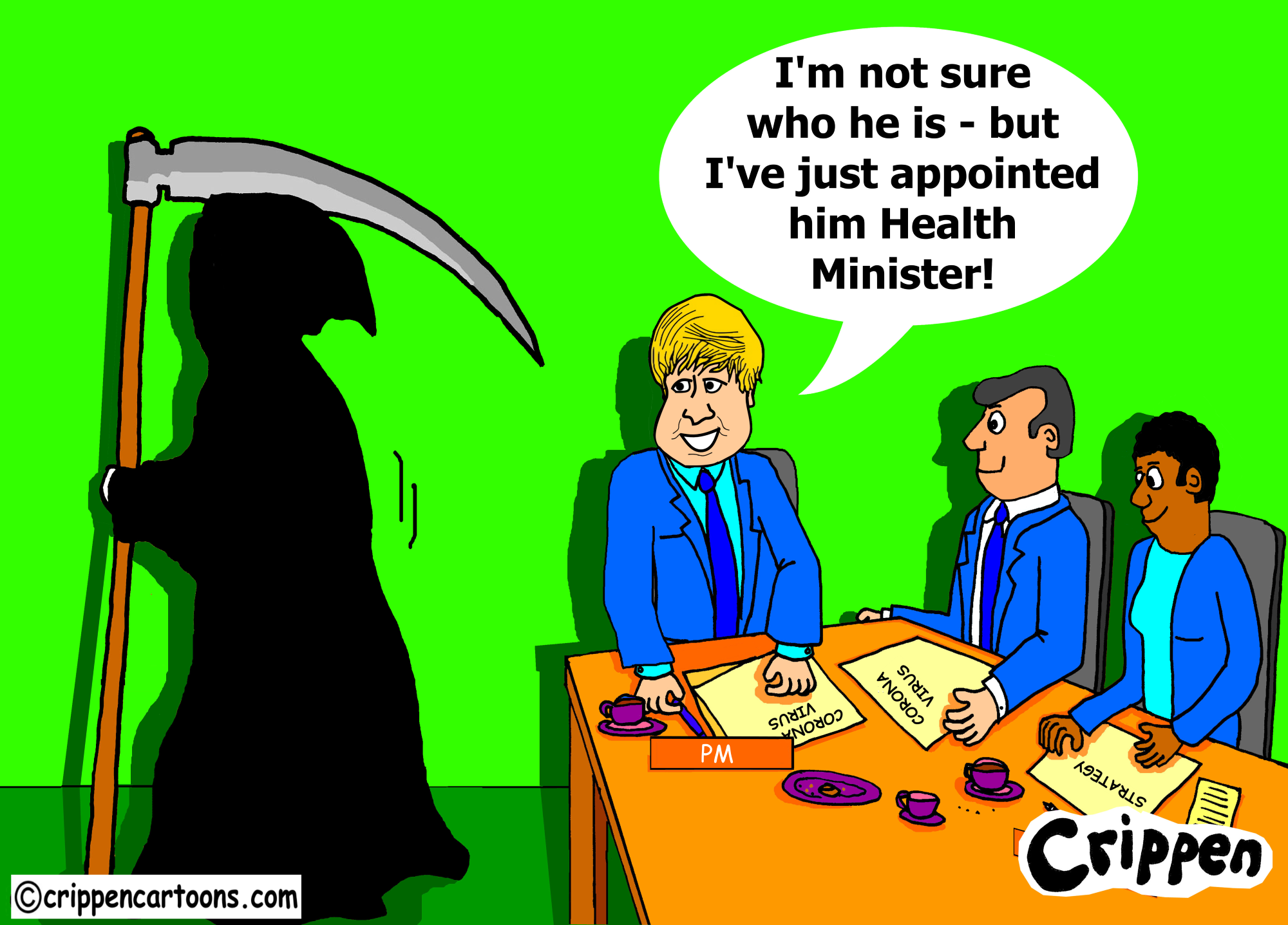
Crippen looks at a recent cabinet change

No comment!

Minister for health

Description of cartoon for those using screen reading software

Boris Johnson is sat at a table with a male and female colleague. They have documents in front of them relating to the Coronavirus. Boris is looking at a figure walking away from them. This is the grim reaper complete with black hooded gown and carrying a scythe. Boris is saying: “I’m not sure who he is but I’ve just appopinted him health minister!”

Crippen asks will they be withholding treatment for elderly and disabled as the virus worsens

As Dominic Cummings whispers in Boris Johnson’s ear about letting the elderly and vulnerable die off to help the economy, an open letter from Dr Matt Morgan, Intensive Care Consultant, from the University Hospital of Wales, Cardiff, has generated much more speculation about the lack of available treatment for the Corona virus.

He wrote: “We will be honest, we will hold your hand, we will be there. [Sometimes] intensive care offers no fix… but there is always care.”

According to government sources overwhelmed doctors will be given new guidelines to help them make life-or-death decisions about coronas virus victims if they run out of intensive care beds or ventilators.

The criteria – expected to be issued on shortly – are a recognition that hospitals are likely to be faced with terrible choices in the weeks to come and cannot be expected to make them alone.

They will cover patients with certain conditions, although it is unclear whether they will also set an age limit above which treatment could be withdrawn.

Potentially, it could also see a patient already on a ventilator removed to allow someone with a greater chance of survival to take his or her place.

It is understood the guidelines have been put together in little more than a week. This explicitly sets out the “comorbidity” – the level of sickness – criteria that will decide access to intensive care and ventilators, and potentially age.

Underlining the speed of the move, it comes only a few days after Boris Johnson suggested such fateful choices would be left to local hospitals. The prime minister told the Commons the issue was “one that is not unknown to the medical profession, and we will be relying on the clinical decisions of those medical professionals”.

The move follows terrible scenes in the worst-hit parts of Italy, branded “an apocalypse” as older and sicker patients are rejected for treatment in favour of the younger and fitter.

In the UK, the low number of ventilators is already a huge controversy. The NHS has just 4,000 – forcing the government to put out a desperate appeal for manufacturers to urgently build more.

https://www.independent.co.uk/news/health/coronavirus-uk-deaths-nhs-intensive-care-flu-wise-men-protocol-a9361916.html

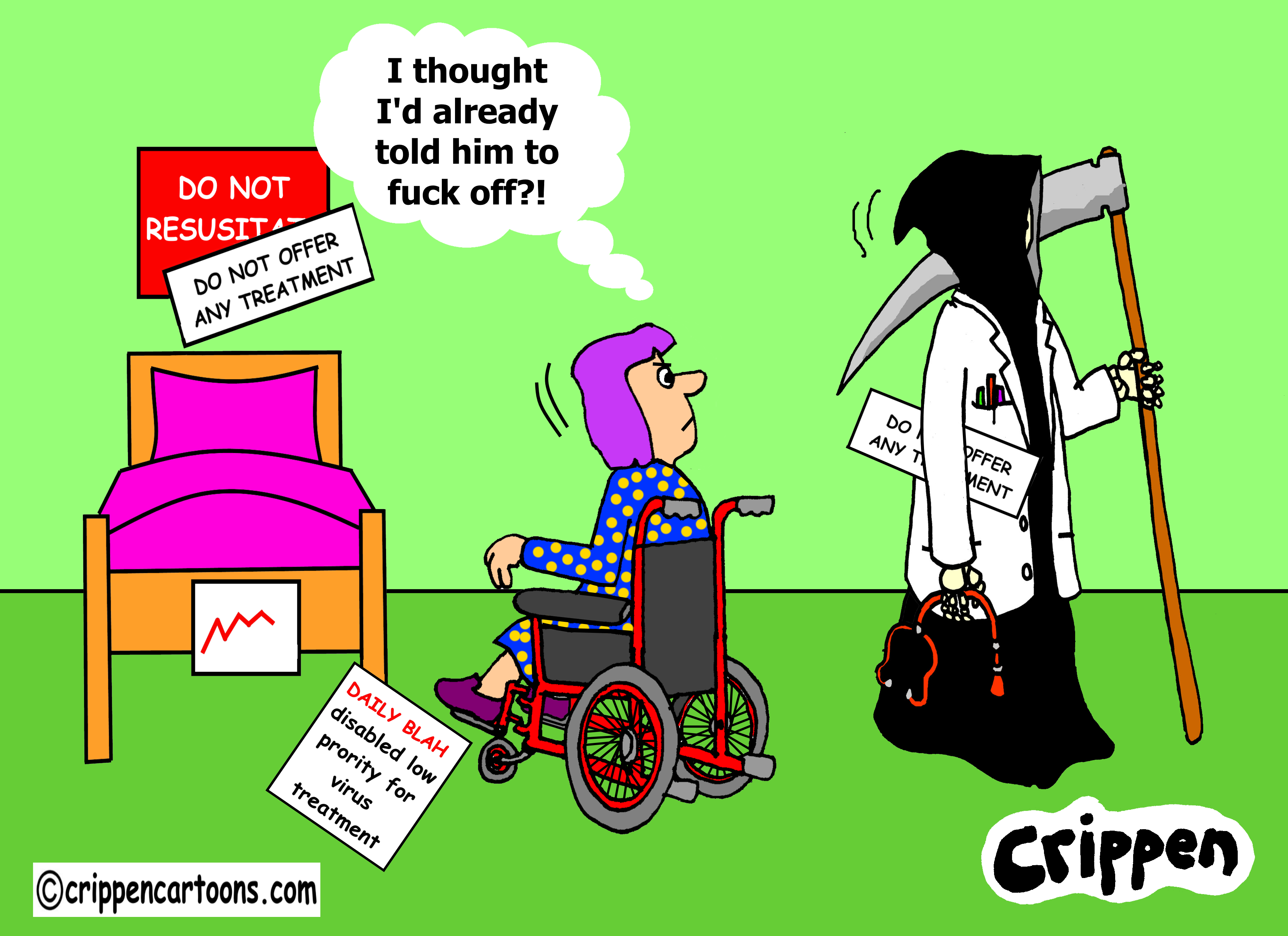
Description for those using screen reading software

A young female wheelchair user in a night gown is alongside of her hospital bed. At her feet is a newspaper that reads ‘Daily Blah – disabled low priority for virus treatment’. Above her bed is a sign that reads ‘do not resuscitate’ which is partially obscured by another sign that reads ‘do not offer any treatment’. The grim reaper is walking away from her in a white coat carrying one of the ‘do not offer treatment’ signs under his arm. He has a stethoscope around his neck and is carrying a large scythe. The disabled woman is thinking: “I thought I’d already told him to fuck off?!”

This cartoon also appears on the Disability Arts Online Crippen Blog. Click here to visit the site.

Crippen asks ” Did you know that the Tories are tearing up the 2014 Care Act?”

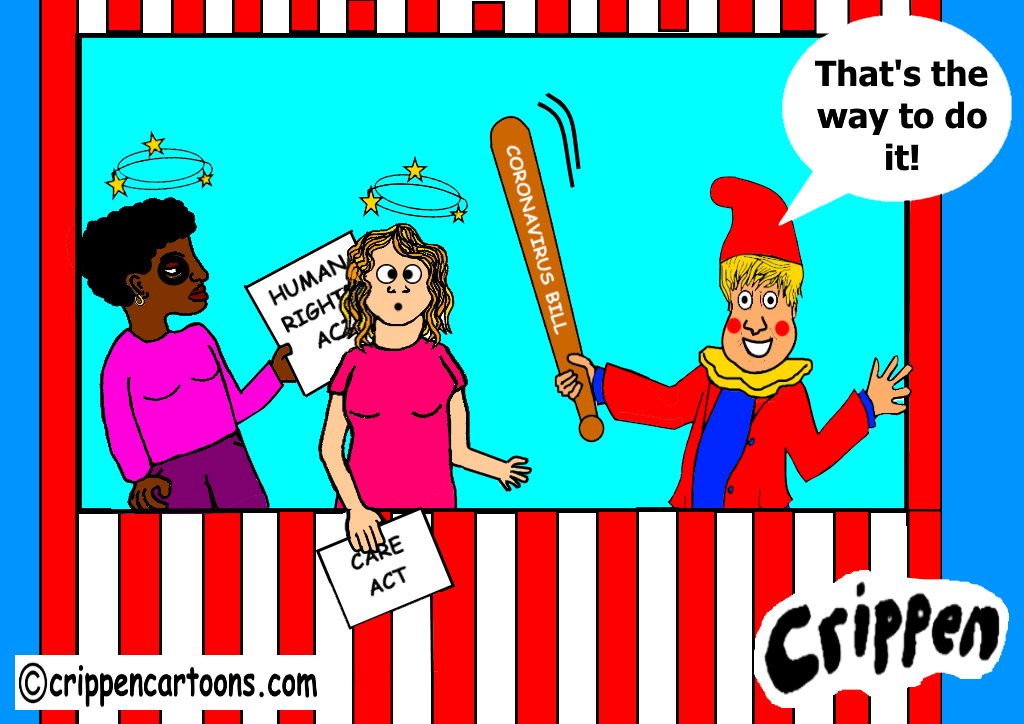
Are you aware that this government are proposing a Coronavirus Bill that will effectively free local authorities of their duties to provide social care support under the Care Act 2014.

This will have a devastating impact on the lives of thousands of Disabled people, especially those of us who need social care support. It also potentially poses a serious risk and can put the wellbeing of many in real danger.

An article on the Inclusion London web site explains what the new Bill will do.

Punch drunk

“The Bill suspends every duty in the Care Act, 2014, including the duty to meet the eligible needs of disabled people (Section 18) and their carers (Section 20).  Under the Corona Virus Bill, Local Authorities will only have to provide care ‘if they consider it necessary’ for the purposes of avoiding a breach of the European Convention of Human Rights (ECHR).  There is no human right to social care or positive obligation under the ECHR to meet care needs.”

“The Bill will effectively free local authorities of their duties to provide social care support under the Care Act 2014 and will only oblige local authorities to provide support in cases where the human rights of Disabled people will be breached. We know from experience that for human rights to be breached in social care context the situation has to be very critical or severe.”

This means that Local authorities will have a duty to uphold disabled people’s human rights under the European Convention on Human Rights, BUT the threshold for a breach, in terms of not providing care and support is high, which means that many disabled people will be left without care and support. Lack of care and support will have a significant impact on disabled people’s well-being but may not be considered to reach the threshold for their human rights to have been breached – disabled people do NOT have a right to care and support.

What about the Mental Health Act?

The power to recommend individuals be detained under the Mental Health Act will be implemented using one doctor’s opinion instead of two, making it easier for people to be detained.

The proposed bill will temporarily allow the extension or removal of time limits in mental health legislation which means individuals might be released into the community early or find themselves detained for longer.

Under section 5, emergency detention for people already in hospital would extend from 72 hours to 120 hours, and nurses’ holding powers would extend from 6 to 12 hours. Under sections 135 and 136, police powers to detain a person found in need of immediate care at a “place of safety” will extend from 24 hours to 36 hours. Under section 35/36, the cap on how long someone can be held in hospital while awaiting a report (currently 12 weeks) will be lifted.

Description of cartoon for those using screen reading software

Boris Johnson is portrayed as Mr Punch along with trademark red hat and jacket and holding a large club. On the club is printed ‘Coronavirus Bill’. Alongside of him are two women who have been hit by the club. They are holding signs which say ‘Care Act’ and ‘Human Rights Act’ respectively. Boris is saying: “That’s the way to do it!”

Crippen reveals a suspected DWP cover-up

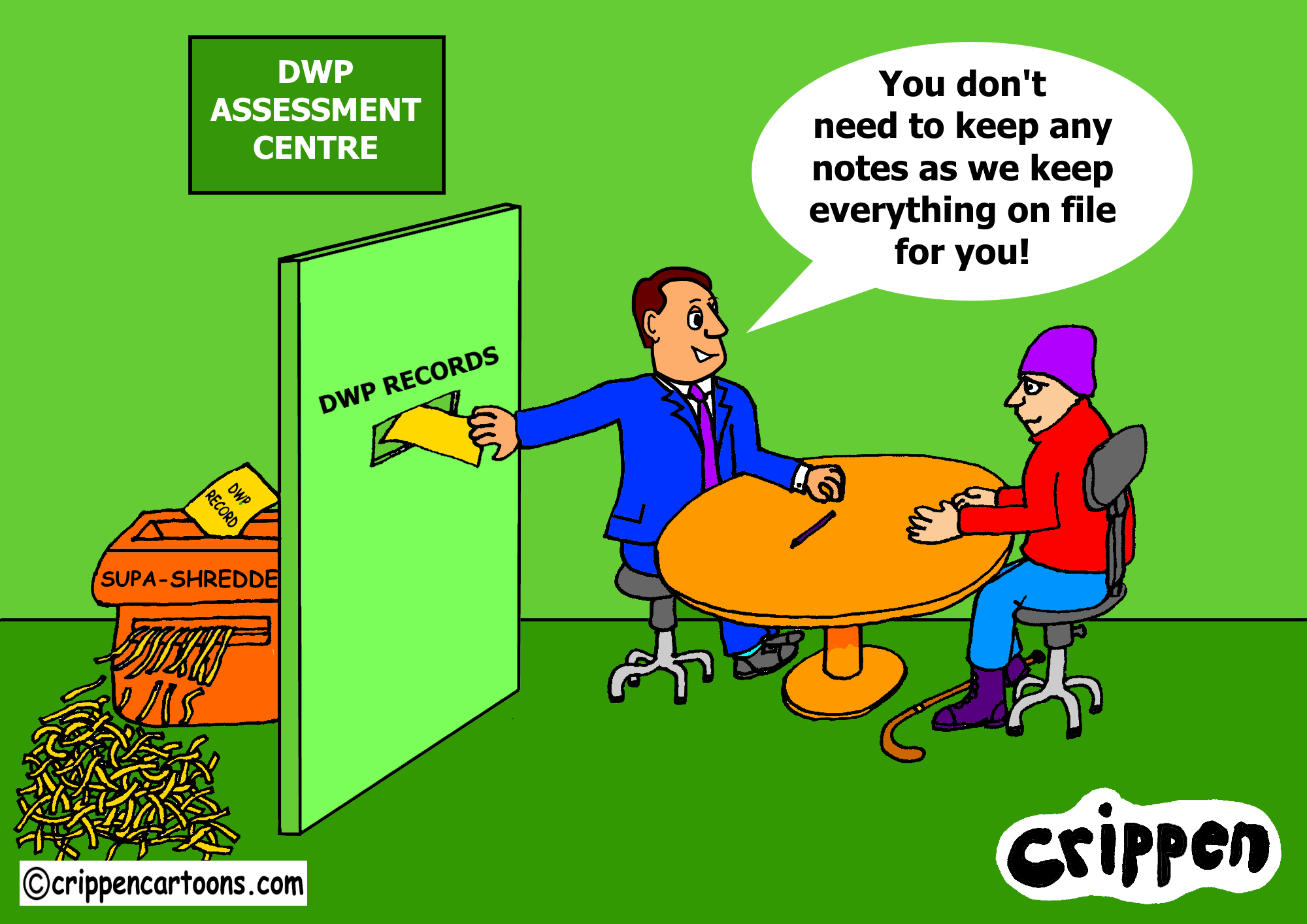
The Department for Works and Pensions (DWP) has been accused of “a cover-up” after shredding around 50 reports into suicides that were linked to benefits being stopped.

13 shredded 2
shredding @ crippencartoons.com

DWP officials have admitted that the files were shredded, but that this had been due to data protection laws stating that all data collected before 2015 should not be retained.

The sister of Tim Salter, a benefit claimant who killed himself soon after his benefits were stopped in 2013, accused the DWP of “trying to cover up”what was happening after she used the Freedom of Information Act to release information relating to her brother’s death.

“We should be allowed to find out what happened? Why would they want to destroy them? What are they hiding?” Linda Cooksey asked.

Stephen Timms, the chairman of the Commons work and pensions committee, agreed it was a possible cover-up, saying: “I’m very sympathetic with that view. It (also) underlines a lack of seriousness by the department about putting things right when they go wrong.”

On the DWP claim that data rules required the destruction of old investigations, Mr Timms said: “The law does not specify five years or six years and (anyway) this kind of information should be held for longer. Further, the data watchdog has said there was no requirement to destroy the reports by any particular date and that a ‘public interest’ exemption could have been used.”

Underlining this, a scathing National Audit Office report had warned that the DWP was unable to show it was learning lessons, despite the department saying: “We take these reviews extremely seriously … and any lessons learned.”

So, are the DWP just inept or, echoing Linda Cooksey’s words, are they hiding something?!

Description for those people using screen reading software

A white male DWP official in a suit and tie is seated at a table opposite an ill looking white male in casual clothing. The room in which they are meeting is marked as the DWP Assessment Centre. He is pushing a piece of paper through a slot in the wall behind him which is labelled ‘DWP records’. Behind the wall is a giant shredding machine which is catching any papers thrust through the slot and shredding them into a growing pile. The DWP official is saying: “You don’t need to keep any notes as we keep everything on file for you!”

(You can also follow Crippen on his Disability Arts Online Blog)

Crippen brings together some facts indicating the imminent sell-off of our NHS

Remember Boris’ infamous Brexit bus, which promised that leaving the EU would mean an extra £350m a week for the NHS? Well, he’s at it again! Having promised to ‘upgrade 20 hospitals and build 40 new ones’, an independent fact-checking charity has found the refurbishment of only six hospitals with no further work planned … unless he’s thinking that a move into private health care will result in this work being undertaken by the private sector!

8 NHS sell-off
NHS Sell off @crippencartoons.com

We’ve already had Len McCluskey, UNITE’s general secretary, blowing the whistle on 71 MP’s with links to private healthcare interests having voted to sell-off our beloved NHS. Then Donald Trump inadvertently letting slip that he’s been in talks with Boris regarding an NHS sell off! This comes in the form of a US trade deal called TTIP which, despite Trump’s denials, is likely to include the NHS.

And don’t forget that our former Prime Minister David Cameron refused to use his veto and exempt the NHS from TTIP. This was seen at the time as exposing the Government’s real plan for the NHS – complete and irreversible privatisation.

Here’s a few facts unearthed by an independent investigation by UNITE that underlines this inevitable slide into privatisation of the NHS:

  • Since the Health and Social Care Act passed in 2012 over 70 per cent of tendered contracts have been awarded to the private sector, amounting to over £13 billion worth of NHS services falling into private hands.
  • Over £1.5 billion worth of contracts has been sold-off to just 15 private companies.
  • While preparing the white paper that led to the act in 2009, then shadow health secretary Andrew Lansley received £21,000 to his personal office from John Nash, then chairman of the private healthcare company Care UK.
  • In 2013, 96 percent of Care UK’s business, amounting to over £400 million, came from the NHS.

Click this link for more details.

Too late to do anything about this whole debacle. Probably?!

You can also follow Crippen on his Disability Arts Online Blog

Description for those people who are using screen reading software

A large sign reads ‘Conservative Party – Sale of the century’. Beneath this is a slippery slope down which large letters spelling out NHS are sliding. Lots of arms are waiting at the bottom of the slide throwing money and waving an american flag. At the top of the slide Boris Johnson is patting a colleague on the back and is saying: “You can stop pushing now – it’s gathering its own momentum!”. A piece of paper on the floor at their feet reads ‘TTIP Trade Deal’.

Crippen reports how Tories continue to shoot themselves in the foot

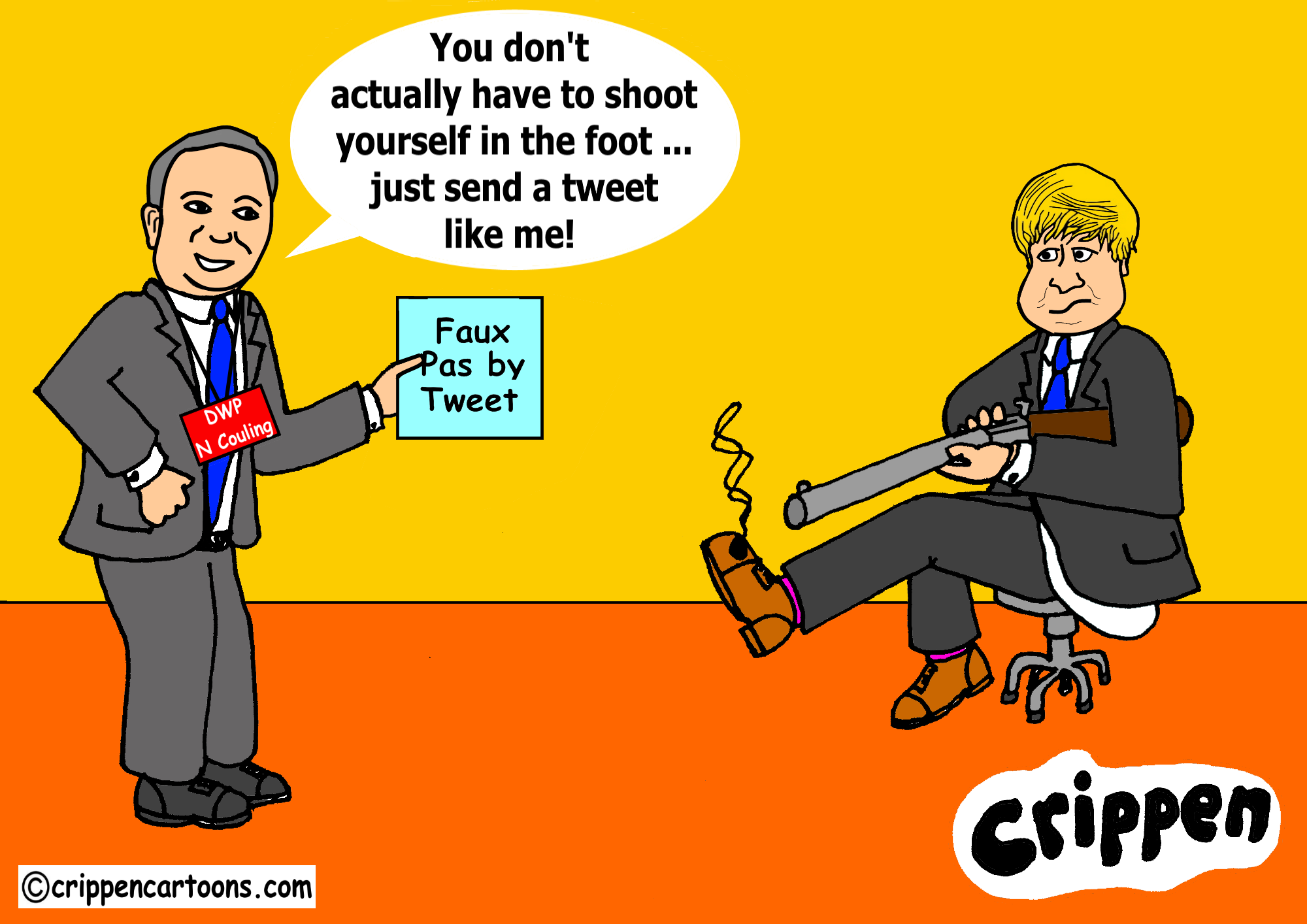
Well, what can I say?! Seems like if we leave the Tories alone, they’re more than capable of shooting themselves in the foot!

15 Universal discredit

The first one comes from Boris Johnson, who in response to a question from SNP MP Mhairi Black about whether one of her constituents had enough to live on after having her benefits cut, Johnson responded:

“The answer to her question, in a word, is no.”

Johnson initially responded to the question with the usual waffle about how the benefit is supposedly helping people. But in a weird diversion from normal practice at PMQs, when the PM doesn’t answer the actual question, Johnson did.

Given Johnson’s comment, it’s clear that even the government is admitting this horrendous system isn’t working. Any decent government would view this as an urgent reason why the benefit needs scrapping. Unfortunately, with Johnson in charge, this is very unlikely to happen.

And another self-inflicted injury comes from the Department for Work and Pensions’ (DWP) head of Universal Credit Neil Couling.

In a tweet he made a bit of a faux pas by dismissing the financial difficulties that people on benefits are experiencing as “scaremongering” and that we must change the way that we speak about benefits, and in particular Universal Credit. The tweet also shows the staggering denial that exists in the DWP about the impact the benefit has on people.

He must be aware that the evidence, including from the DWP itself, paints a much different picture. All of which has been forwarded to Mr Couling, in his role as senior civil servant in charge of Universal Credit.

And just a few examples of people or groups who have said Universal Credit is bad for claimants include:

  • The Residential Landlords Association. In 2019, it said that 54% of its members had tenants on the benefit fall into rent arrears in the past year.
  • Foodbank charity the Trussell Trust. It reported a 52% increase in food bank use. This was in areas where Universal Credit had been live for a year.
  • Thinktank the Joseph Rowntree Foundation.It said that 5.1 million in working families would lose money under the benefit.
  • UN special rapporteur Philip Alston. He said Universal Credit was like a “digital and sanitised version of the 19th-century workhouse”.
  • A study for the Lancet which found a 6.6% rise in claimants in “psychological distress” between 2013 and 2018. This ties in with the Universal Credit roll out.

And the DWP itself has even shown the chaos Universal Credit causes. Its survey in 2017 found that only 25% of claimants said they were “keeping up with bills… without any difficulties”. In total, 72% either struggled from “time to time”, struggled constantly, fell behind, or were having “real financial difficulties”.

As Bill Tanner nicely summed up for 24Housing, this is the same Neil Couling CBE who… told the Work and Pensions Committee that issues over Universal Credit were down to ‘claimant misunderstandings’.

But I like the response from the UN special rapporteur on extreme poverty Philip Alston who, after reading the tweet, said that the benefit should be renamed “Universal Discredit”.

This article is also posted on the Disability Arts Online Crippen Blog – https://disabilityarts.online/blog/dave-lupton

Description for those people using screen reading software

Boris Johnson is sat in a chair cradling a shot gun. He has just shot himself in the foot with his shoe having a large hole in the toecap with smoke curling from it. Opposite him is DWP boss Neil Couling holding a piece of paper that says ‘ Faux Pas by Tweet’. Couling is saying to Boris: “You don’t actually have to shoot yourself in the foot … just send a tweet like me!”

Crippen wonders just how bad you have to be to get knighted?!

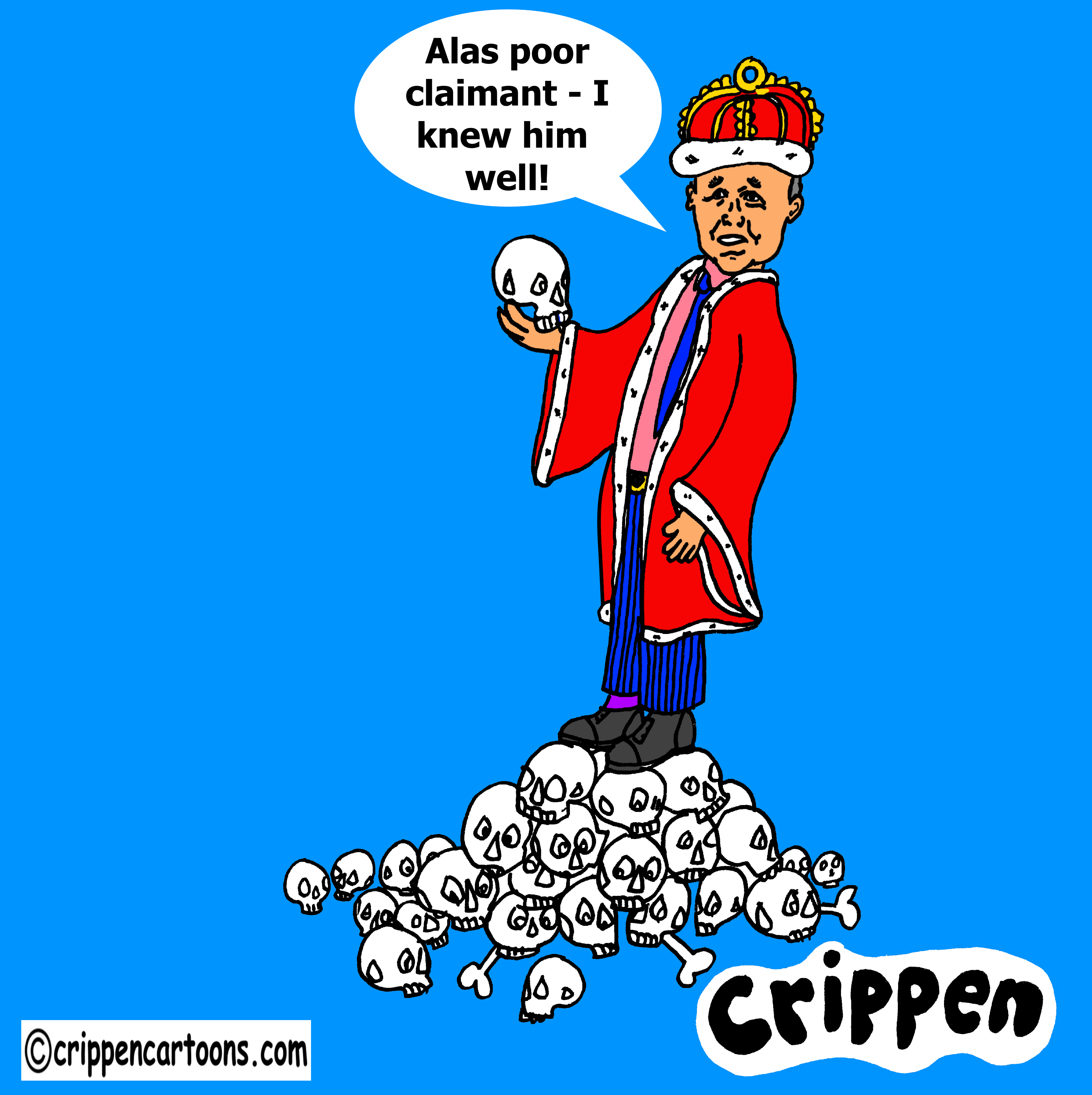
Get knighted

Iain Duncan Smith MP, the architect of the universal credit benefits system which left thousands of disabled people without benefits and for some, little incentive to continue with their lives, has been awarded a knighthood for services to the Conservative Party.

As work and pensions secretary with the Department of Works and Pensions (DWP) for six years from 2010, Duncan Smith was the central figure as significant cuts were made to benefit and disability entitlements during the peak of the Conservative-led austerity period. Some of these cuts led to many disabled people taking their own lives as their benefits were stopped, leaving them nothing to live on.

He was also responsible for recruiting the French company ATOS who undertook benefit assessments on behalf of the DWP. Over 70% of the disabled people who ‘failed’ the assessment and had their benefits stopped, had them reinstated after an appeal. The cruel and inhuman way in which the assessments were undertaken were also laid at the door of Duncan-Smith, along with helping preside over a rhetorical culture centred on “shirkers” and “scroungers”, which charities said led to an increase in abuse against disabled people.

He also introduced emergency legislation to reverse the outcome of a court of appeal decision and “protect the national economy” from a £130m pay out to jobseekers deemed to have been unlawfully punished by the DWP. The retroactive legislation effectively changed a decision by three senior judges and denied benefit claimants an average pay out of between £530 and £570 each.

While it is not uncommon for long-serving MPs, particularly former party leaders, to receive honours, Duncan Smith’s knighthood was met with criticism from opposition parties because of his record on benefits.

Labour criticised the decision to honour “the primary architect of the cruel universal credit system, which has pushed thousands of people into poverty”, while the Liberal Democrat MP Christine Jardine said the award “beggars’ belief”.

Description of cartoon for those people using screen reading software

Sir Iain Duncan Smith MP is stood on top of a pile of skulls. He is wearing his investiture gown and a coronet (from when he was knighted). In his hand is a skull. He is saying to it: “Alas poor claimant – I knew him well!”

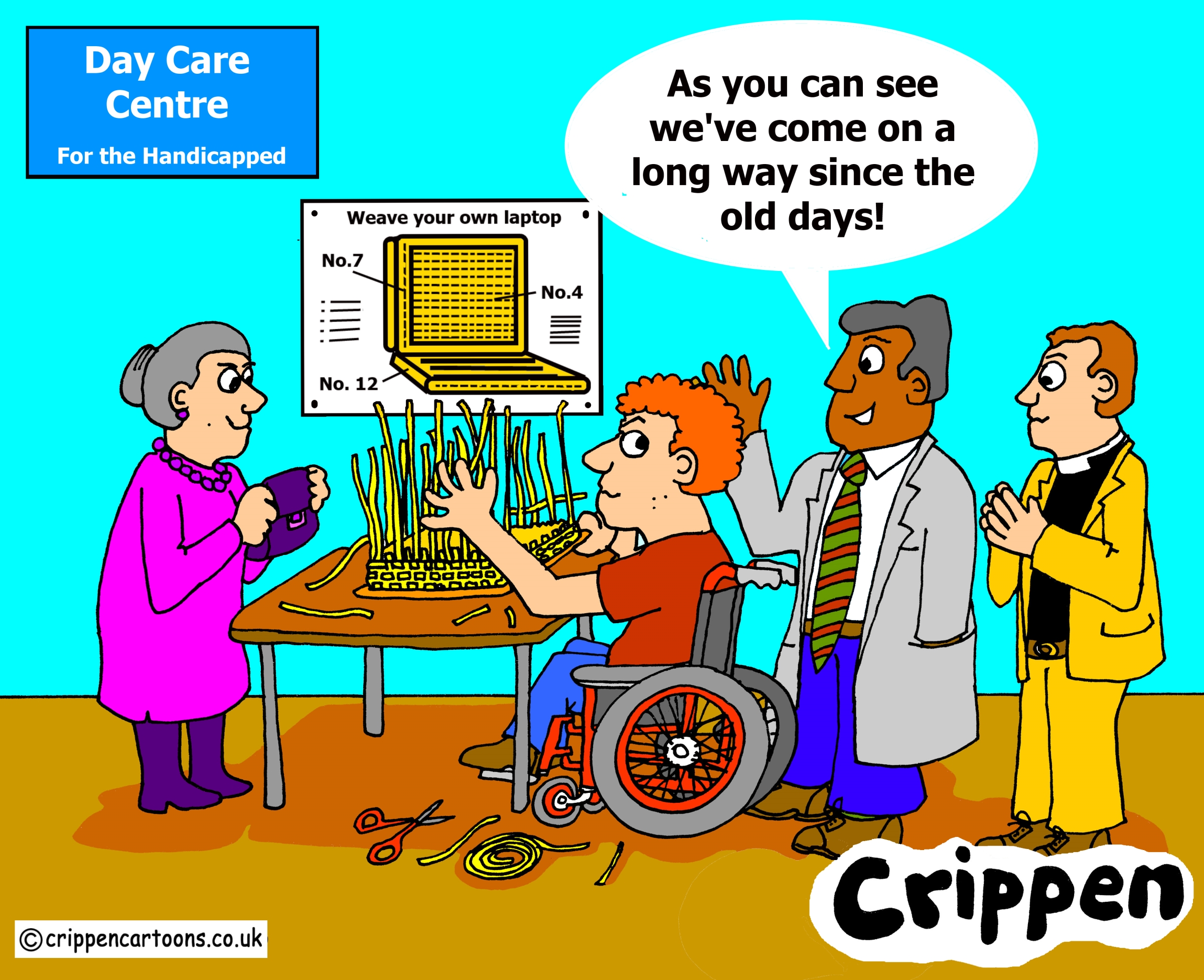
Crippen learns to weave his own laptop

Day Care

Many of you will be aware that I rate most Day Care establishments alongside many of the charities that have been set up to “provide” for us. Most of them are run by non-disabled ‘professionals’ who receive a decent salary to basically keep us in our place!

Of course, the term ‘Day Care Centre’ has now been replaced by the term ‘Resource Centre’, but this is about the only change, as they are mainly still run and controlled by non-disabled people.

Admittedly I’m taking the proverbial with this cartoon, but it does deliver the message that it’s the same old same old, despite the new terminology.


Description of cartoon for those people using screen reading software

A sign sits on the wall of a large room that states ‘Day care centre for the handicapped’. Also, on the wall is another sign that shows the plan for weaving a computer laptop. In front of the signs, a young white male wheelchair user is weaving a computer laptop with a perplexed look on his face. Around him are several visitors including a vicar and an older woman. An Asian care worker in a white coat is saying to them: “As you can see we’ve come a long way since the old days!”

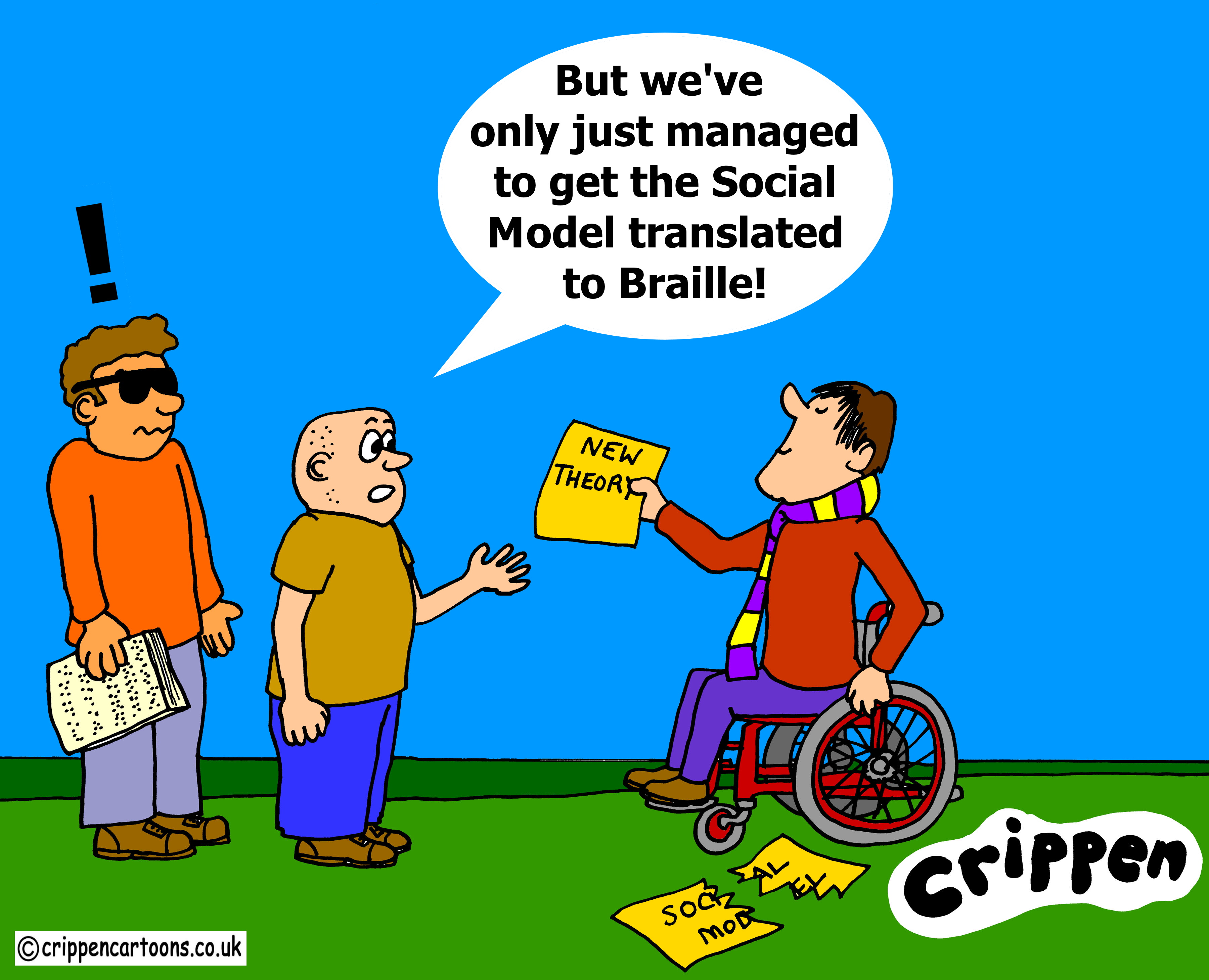
Crippen looks at the models of disability

models

A lot has been written and talked about regarding the Social Model understanding of disability. The academic Crips think that we should be moving on and have suggested some other frameworks with which to view disability. They feel that the Social Model is no longer valid and that it was only intended as a starting point anyway.

The problem as I see it, however, is that there are still millions of people out there who still haven’t heard of the Social Model, never mind anything new!

Most Disability Equality training is based around the Social Model concept, the Disability Rights Commission (remember them?!) based most of its recommendations on this Model. To change it now would probably send us back to the earlier days when the Medical or Individual Model was the only alternative.

For those of you who’re not familiar with these understandings of disability, here’s something about each one. Rather than reinvent the wheel, I’ve lifted the following information from an article by Richard Rieser, Director, Disability Equality in Education (DEE) who was writing for Inclusion Week back in 2002.

I make no apologies for its length, as I feel that it’s one of the best explanations currently available. I have to say that as I write in 2020 it is as valid as ever.

The Medical Model

The ‘medical model’ of disability sees the disabled person as the problem. We are to be adapted to fit into the world as it is. If this is not possible, then we are shut away in some specialised institution or isolated at home, where only our most basic needs are met. The emphasis is on dependence, backed up by the stereotypes of disability that call forth pity, fear and patronising attitudes.

Usually the focus is on the impairment rather than the needs of the person. The power to change us seems to lie within the medical and associated professions, with their talk of cures, normalisation and science. Often our lives are handed over to them.

Other people’s assessments of us, usually non-disabled professionals, are used to determine where we go to school, what support we get and what type of education; where we live; whether or not we can work and what type of work we can do and indeed whether or not we are born at all, or are even allowed to procreate. Similar control is exercised over us by the design of the built environment presenting us with many barriers, thereby making it difficult or impossible for our needs to be met and curtailing our life chances. Whether in work, school, leisure and entertainment facilities, transport, training and higher education, housing or in personal, family and social life, it is practices and attitudes that disable us.

Powerful and pervasive views of us are reinforced in the media, books, films, comics, art and language. Many disabled people internalise negative views of themselves that create feelings of low self-esteem and achievement, further reinforcing non-disabled people’s assessment of our worth. The ‘medical model’ view of us creates a cycle of dependency and exclusion, which is difficult to break.

‘Medical model’ thinking about us predominates in schools where ‘special educational needs’ are thought of as resulting from the individual who is seen as different, faulty and needing to be assessed and made as normal as possible. If people were to start from the point of view of all children’s right to belong and be valued in their local school we would start by looking at ‘what is wrong’ with the school and looking at the strengths of the child.

The Social Model

This second approach is based on the ‘social model’ of disability thinking which views the barriers that prevent disabled people from participating in any situation as what disables them. The ‘social model’ arises from defining impairment and disability as very different things.

Impairment and chronic illness exist and they sometimes pose real difficulties for us. The Disability Movement comprises those disabled people and their supporters who understand that they are, regardless of their particular impairment, subjected to a common oppression by the non-disabled world. We are of the view that the position of disabled people and the discrimination against us are socially created. This has little to do with our impairments. As a disabled person you are often made to feel it’s your own fault that you are different. The difference is that some part, or parts, of your body or mind are limited in their functioning. This is an impairment.

This does not make you any less of a human being. But most people have not been brought up to accept us as we are. Through fear, ignorance and prejudice, barriers and discriminatory practices develop which disable us. The understanding of this process of disablement allows disabled people to feel good about themselves and empowers us to fight for our human rights.

The disabled people’s movement believes the ‘cure’ to the problem of disability lies in the restructuring of society. Unlike medically based ‘cures’, which focus on the individual and their impairment, this is an achievable goal and to the benefit of everyone. This approach, referred to as the ‘social model’, suggests those disabled people’s individual and collective disadvantage is due to a complex form of institutional discrimination as fundamental to our society as sexism, racism or heterosexism.

In addition to this, the obsession with finding medically based cures distracts us from looking at causes of either impairment or disablement. In a worldwide sense, most impairment is created by oppressive systems – hunger, lack of clean water, exploitation of labour, lack of safety, child abuse and wars. Clearly, this thinking has important implications for our education system, particularly with reference to primary and secondary schools.

Prejudicial attitudes toward disabled people and, indeed, against all minority groups, are not inherited. They are learned through contact with the prejudice and ignorance of others. Therefore, to challenge discrimination against disabled people, we must begin in our schools.

Our fight for the inclusion of all children, however ‘severely’ disabled, in one, mainstream, education system, will not make sense unless the difference between the ‘social’ and the ‘medical’ or individual model of disability is understood.

Taken from an article by Richard Rieser, Director, Disability Equality in Education (DEE)

To find out more about Richard Rieser and the work of the DEE you can visit their website:


Description of cartoon for those people using screen reading software

A studious looking white male wheelchair user is holding out a piece of paper with ‘new theory’ written on it. At his feet a paper with ‘social model’ has been torn in two. A short, bald white male is looking in exasperation at him whilst alongside of him a blind man holding a braille manuscript is looking equally perplexed. The short male is saying to the wheelchair user: “But we’ve only just managed to get the social model understanding translated into braille!”
You can also follow Crippen on his Disability Arts Online Blog

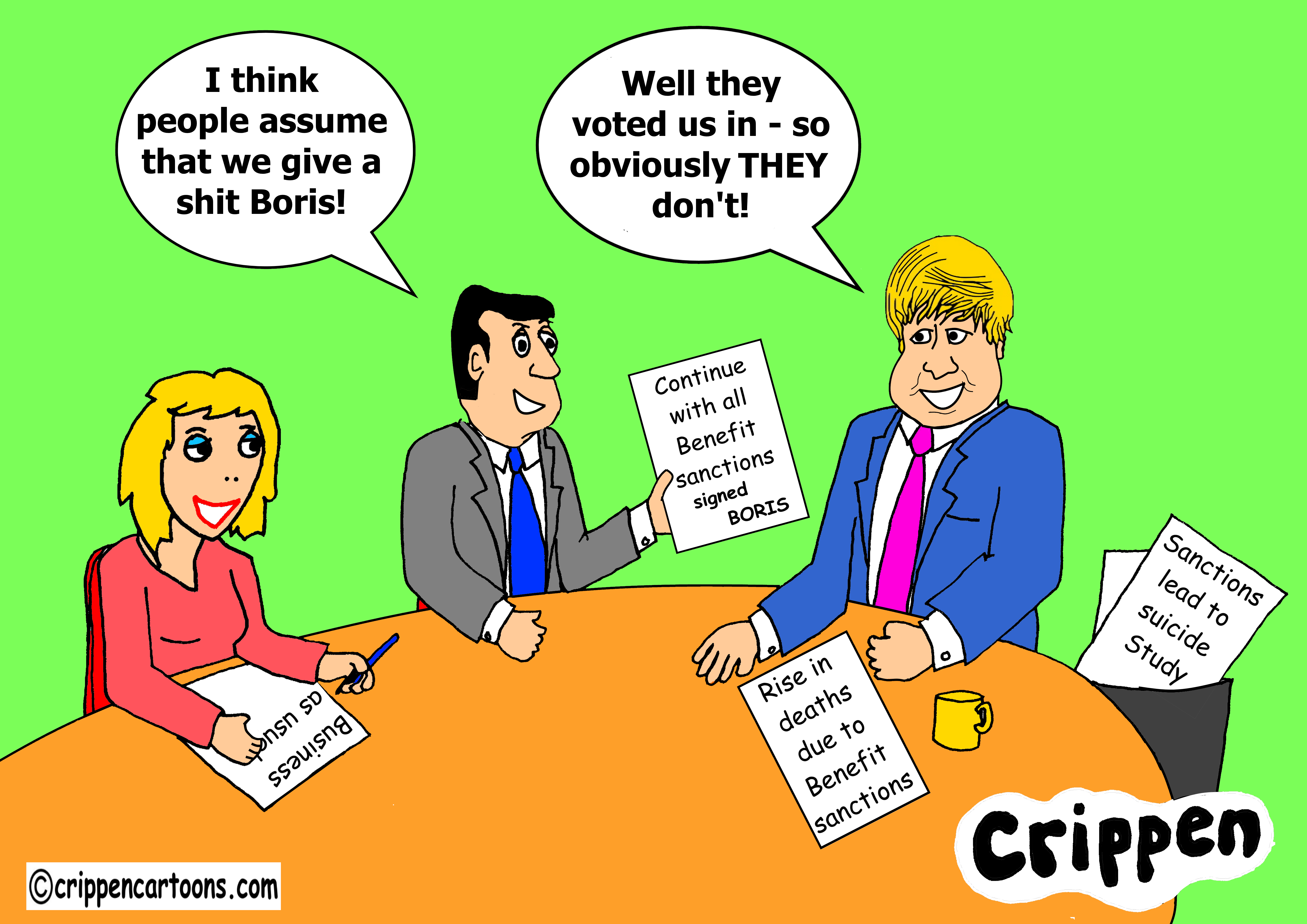
2 sanctions

Click here to go to Crippen’s Disability Arts Online (DAO) Blog