Crippen – back from sharing the craic in Ireland

I sometimes wonder if it’s worth taking a break, especially when you come back to an overflowing in-box! Not that I’m complaining. It’s always good to have work coming in on a regular basis (hint!).
Those of you on my monthly newsletter will have already heard about my successful setting up of both my new book store and also the distribution system for sales. My first book ‘Crippen – And the COVID years’ is now online and can be found here.

I’m also almost ready to publish the second book in the series ‘Crippen – And the DWP’ which I’m hoping to get online next week. As you can imagine our old nemesis Iain Duncan Smith featurers widely.

Hopefully, I can get back into my regular weekly blogs next week as well. I’m just having to create a whole new raft of political characters to replace those Tory bastards who have made most of our lives a complete misery. They’re all going to have to find a new hobby, perhaps pulling the wings off butterfly’s?!

(Apologies to those who get the monthly newsletter as I repeat myself here!)

I’ve just spent a couple of days in Dublin catching up with friends and enjoying the craic as they say. We got to talking about the situation in Ireland as opposed to our own regarding the progress made by disabled people in challenging the status quo.

We soon discovered that there wasn’t much difference; the various charities that claim to represent them and the organisations run and controlled by non-disabled people are still the main recipients of any funding that’s going. The only real difference was that the Catholic church seems to have its fingers in a great deal of the charitable giving over there, with very little being given to those Crips who are trying to self-organise.

I seemed to spend a lot of the time explaining about the Social Model under- standing of disability and how this had made a real difference in the UK. It shouldn’t have surprised me, as I still come across many disabled people in the UK who are unfamiliar with the concept.

This is one of the reasons that I continue to reiterate the social model message in my ongoing work, despite criticism from those ‘enlightened’ Crips who say that we should be moving on. It’s a simple explanation and one which has enabled thousands of disabled people the opportunity to empower themselves and challenge the medical and charitable models imposed on them by society.

One response that I had from the newsletter was from our friend, disabled researcher and activist Mo Stewart. She suggested:

“There is a very good reason why many disabled people have never heard of the ‘social model’ of disability, and that included me when I first started the research.

“Models of disability are not a common subject in everyday life and to learn about the ‘social model’ usually means you need to be involved somehow with the disabled community either online or with a local support group.

“Most disabled people are not, hence there are many who do not know about the ‘social model’ which is still misinterpreted by many but was the reason Aylward was able to produce research which disregarded clinical need as being the basis for the WCA.”

I’d be interested to hear what your thoughts are about the value of still using the Social Model Understanding of Disability as a part of our continued struggle?

Please leave your thoughts in the ‘Comments’ section of the Blog. Thanks.

Description of cartoon for those using screen reading software

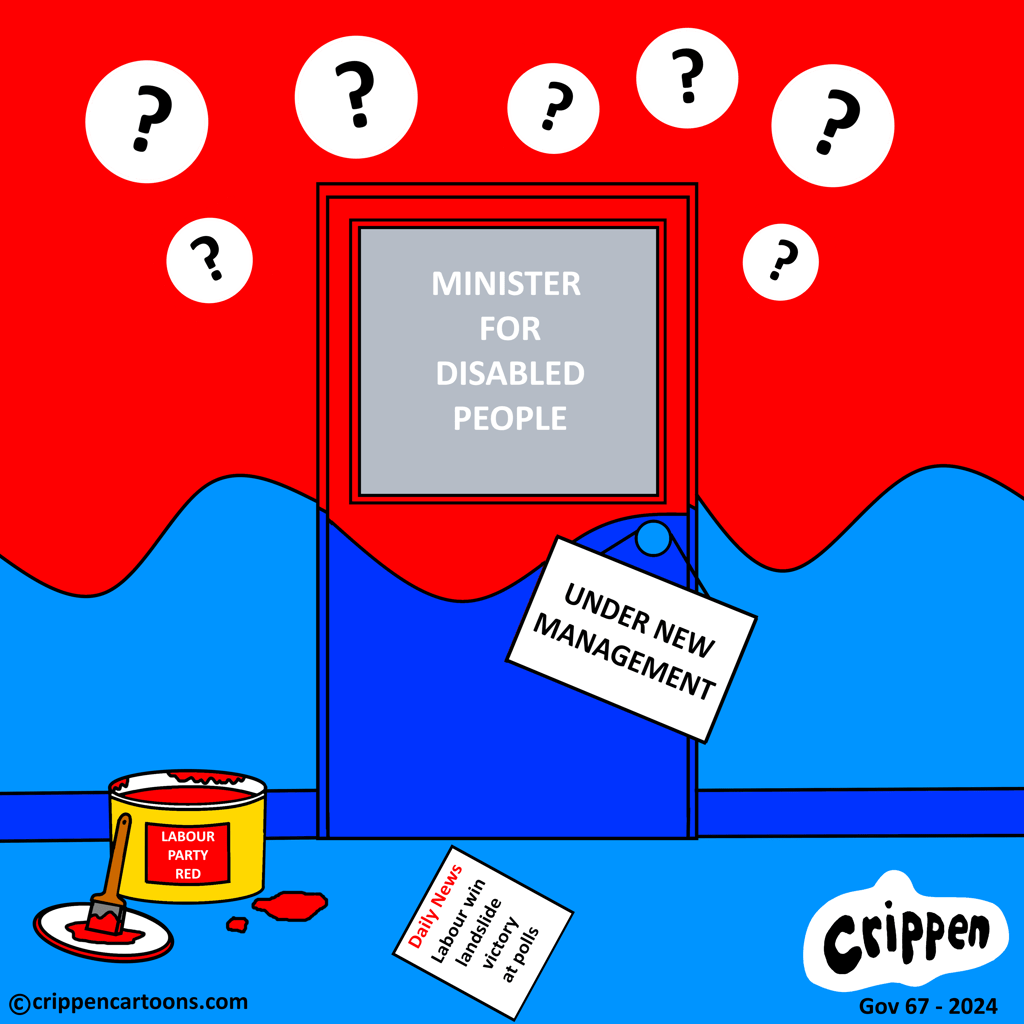
The scene is a corridor with a facing door. The door has a frosted glass top upon which is printed: ‘Minister for Disabled people’. The top half of the wall and the door have been painted Labour red, leaving the bottom half still Tory blue. A paint tin with the label ‘Labour Party Red’ printed upon it, and also a paint brush loaded with red paint is adjacent the door. Hanging on the door handle is also a large sign that reads: ‘Under New Management’. On the floor is a newspaper with the headline ‘Labour win landslide victory!’. The door is surrounded by floating question marks.

Crippen prepares for more of the same

So it’s finally happened. Having limped along for a few more miles, the Tory Party has eventually imploded taking with it the various members who had been awarded the meaningless title of Minister for Disabled People. Meaningless, in that not one of them had displayed any interest in working with the 16 million disabled people who currently reside in the UK, choosing to ignore our voices and allowing institutions like the Department for Work and Pensions (DWP) to put the boot in whenever we were at our most vulnerable.

So, what’s going to change? Well, if the past record of the Labour Party and its lack of interest in anything that related to disability is anything to go by, nothing! When even the Labour Party’s own Disabled Members Council reported on being ignored at Conference when they had repeatedly tried to challenge the lack of access, we can expect to be disregarded in the same way.

So, what are we going to do about it?

If you’re available on Thursday 18th July at 12 noon and would like to join a day of action in Parliament Square, London organised by various Disabled People’s Organisations including Disabled People Against Cuts (DPAC), Recovery in the Bin, Bromley & Croydon Unite Community then here’s where you’ll get your voice heard.

Here’s your chance to join with other disabled people to both challenge the incoming government and demand our rightful place at the heart of rebuilding our society and also celebrate our history and culture with an afternoon of music, art, theatre and more.

If you, your group, organisation or campaign would like to join with others in presenting your own policy solutions or demands in a creative way – If you are a disabled creative – an artist, musician or performer, and you would like to join in then please get in touch with event facilitator DPAC.

Description of cartoon for those using screen reading software

A large hand holding a drawing pen is putting the finishing touches to a caricature of Sir Keir Starmer. The lower body is coloured in, whilst the head is newly created in plain black ink. In a waste bin at Starmer’s feet are caricatures of Tory ministers Rishi Sunak, Iain Duncan Smith, Tom Pursglove and Therese Coffey, each with a large red cross across their face. Starmer is holding a card which has written upon it ‘Disabled – what disabled?!’ A word bubble from Crippen (off screen) is saying: “Same old upper-class people with the same old policies … just means that I’ll be creating the same old cartoons but with different heads!”

Crippen decides to self publish

Well, I’ve done it. After years of trying to get my books published I’ve taken matters in hand and have gone the self publishing route.

Although that’s not as easy as you’d think. Some of the templates offered with some self publishing companies turn out to be completely unfathonable. Take Amazon for example. I just couldn’t get my head around their templates. Then again, perhaps it’s just me?

I eventually settled on a company called Lulu which has enabled me to set up my first self published book entitled ‘Crippen and the Covid Years’. The book is a collection of the blogs and their associated cartoons that I wrote about between 2020-23.

Lulu allows you to see how much it will cost to produce a book in a variety of formats, including hard cover, paper back, spiral bound, colour, black and white etc. Also, the cost of posting the book to different places around the world. I eventually decided on the paperback version, which at A5 is a handy size for a hundred page book and is relatively cheap to post. There’s no up-front costs as Lulu uses the money you spend on a book to cover the printing and postage, and then pays me a commission.

But how to sell the book? That turned out to be a completely different ball game. Again, there are quite a few ways of setting up an online store, especially one that links to your publishing company. I decided to follow the recommendation of Lulu and go with one of their associated companies called Wix.

Wix is actually a website builder which includes the option of creating an online store. It’s worth noting that there are some start-up costs involved here, such as the domain name you choose for your online store. It guides you through the process, showing you how to add things like a shopping trolly, how you want paying, etc. I found it relatively straight forward although I must admit to calling on one of their ‘experts’ at one stage as I just couldn’t get the link between Lulu and Wix to work! I’ve also kept the layout very simple as you’ll see.

I now have my first self published book available online at my bookstore. I’m already working on a second book in the series, but this time focussing on that machiavellian organisation the Department of Work and Pensions (DWP). I’ll also be re-creating some of the books I presented as downloadable pdf’s from about 15 years ago.

Note: I’ve included hyper-links in this blog for both Lulu and Wix, and also my Bookstore which should help you find your way around the different sites.

Description of illustration for those using screen reading software

The illustration is the front cover of a book entitled ‘Crippen and the COVID Years – how the coronavirus pandemic impacted on disabled people in the UK (2020 – 2023). The book has a blue surround with a square white inset into which a Crippen cartoon is placed. The Crippen cartoon showing Boris Johnson playing cards with the Grim Reaper. Boris is saying: “I’ll raise you another two disabled people!”

Crippen learns that DWP destroyed files and prevented investigation into disabled claimant’s death

When she was minister for Disabled People in 2017, Leader of the House of Commons Penny Mordaunt wrote to disabled claimant Michael O’Sullivan’s family, telling them that a review into his death had not been carried out because “much of the DWP documentation” had “been destroyed”.

She added that this had taken place in accordance with DWP’s “records management policy [where] most benefit records are destroyed fourteen months after a claimant’s death”. But what Mordaunt failed to tell the family was that the DWP’s new Benefits Document and Data Retention Guide, in place at the time Michael died, stated that documents relating to claimant suicides should be kept for at least six years!

The email and letter are part of a huge quantity of documents relating to the death of Michael O’Sullivan that have been drawn together over the last decade by his family. They show that senior civil servants at the Department for Work and Pensions (DWP) destroyed vital documents about his case – in breach of the department’s own rules – months after a coroner linked his death with DWP’s “fitness for work” test.

The decision, taken some time in 2014 – probably 14 months after his suicide in September 2013 – meant DWP was not able to carry out an in-depth investigation into the circumstances around his death, known at the time as a peer review.

Most of his records were destroyed even though a coroner Mary Hassell had concluded earlier that year – in a ground-breaking ruling that later received significant media coverage – that the “intense anxiety” that triggered Michael’s suicide had been caused by his being found fit for work by DWP following a work capability assessment (WCA).

Disability News Service (DNS) reported earlier this year how the O’Sullivan family had concluded beyond any doubt – following their decade-long investigation – that DWP was responsible for their father’s death.

Read the full story in Disability News Service.

The Department, DNS editor John Pring’s book on DWP and how its actions led to countless deaths of disabled people in the post-2010 era, will be published by Pluto Press on 20 August. Visit the DNS website before publication for a 50 per cent discount 

Description of cartoon for those using screen reading software

Sir Iain Duncan Smith (IDS) can be seen driving a large bulldozer with DWP documentation concerning Michael O’Sullivan’s death piled into the front scoop. He is heading towards a large pit in which a fire is burning, destroying other DWP documents. A copy of a headline from Disability News Service lays upon the ground in front of IDS. It reads ‘Coroner hears that documentation regarding the death of disabled claimant is destroyed by DWP!’   A male figure from the DWP is standing on the edge of the fire pit and is saying: “I just knew that you’d have the answer to our problem Sir Iain!” IDS replies: “Works every time – if they can’t find the evidence then they don’t have a case!”

Crippen asks why the silence from DWP as benefits fraud falls to zero?! 

You’ll be aware that one of the big sticks that the Tory government use on a regular basis against disabled people on PIP is that we are all fraudulent scroungers.

However, DWP figures, released just days before Rishi Sunak called a general election, showed that overpayment of personal independence payment (PIP) due to fraud had dropped to Zero per cent, a fall from 0.2 per cent the previous year. 

The figures were released just a month after Sunak said in a speech – in which he announced cuts to PIP spending and other social security reforms – that he worried about PIP being “misused” and wanted to make it “harder to exploit”. 

These comments, and others made by Sunak, including calling for an end to what he called a “sicknote culture”, led to him being accused of whipping up hostility towards disabled people, and demonising and scapegoating claimants of disability benefits. 

Asked about the figures, a DWP spokesperson said:

“I have checked – the stats are correct, with PIP overpayments due to fraud at 0.0 per cent.” 

I rest my case!

Read the full story by Editor John Pring in Disability News Service.

Description of cartoon for those using screen reading software

Rishi Sunak is seen holding a speech that indicates that disabled benefits claimants are to blame. He is also saying into a microphone: “So, vote for me and I’ll come down hard on PIP fraud!” Alongside of him is a civil servant who is pointing at a PIP Fraud Monitor that is registering at zero. He is saying: “Er … Sir!” On the floor at his feet is a copy of the Disability News Service with the headline ‘PIP fraud drops to zero!’.

Crippen looks at the government’s not so hidden disability agenda  

Disabled activists from Disabled People Against Cuts (DPAC) and Not Dead Yet UK have spoken of their horror at the government releasing new plans to cut disability benefits on the same day MPs were debating the idea of legalising assisted suicide.

Protesting outside of parliament, just yards from a larger rival action by those pushing for legalisation, they expressed fears that yet more cuts to the support disabled people rely on to live independently will only exert more pressure on them to take their own lives if assisted suicide is legalised.

Disabled activist and actor Liz Carr was one of the disabled activists raising concerns about the apparent political momentum enjoyed by those seeking new laws. She told Disability News Service (DNS) that she was terrified by the government’s latest personal independence payment (PIP) proposals:

She said:

“We know disabled people have killed themselves because of DWP reforms in the past. That’s what terrifies me: the kind of thing happening in Canada where people for socio-economic reasons are choosing to end their lives through euthanasia.”

She added:

“On the same day that we are listening about PIP reform and about disabled people being labelled as scroungers, it’s more important than ever to say let’s give disabled people support in life and choice over their life.”

Andy Greene, a member of DPAC’s national steering group, said the decision to publish the PIP proposals on the same day as the assisted suicide debate was “not so subtle”.

He told DNS:

“We are an easy target in terms of political targeting. We are the go-to group for cuts to services, for cuts to income, for building a narrative around, because we are seen as an easy target. It’s a message and not so subtle a message to the public and to disabled people about where the direction of travel is.”

He believed the momentum towards legislation appeared to be “unstoppable, inevitable” which had left him “genuinely horrified”. He had seen the “slippery slope” in other countries where assisted suicide has been legalised and has gradually been extended to more and more groups of disabled people.

He added:

“We are the people who have the most at stake here and, as history has shown us, we have the most to lose”.

Nick Saunders, a member of the Disabled People’s Direct Action Network (DAN), said:

“We want help to live, not to die. It’s a matter of life and death, nothing more, nothing less. We fought for public transport, for independent living; now we are fighting for our own lives.”

Paula Peters, another member of DPAC’s national steering group, said the government’s move to publish its plans for further cuts to support on the day of the assisted suicide debate made her want to “throw rocks” at parliament, and had caused her “anger and huge anxiety”.

She added:

“To launch a consultation on PIP the day of the assisted dying debate is rubbing salt in the wounds. Disabled people will feel they are better off dead because they can’t afford to live … we need assistance to live, not to die”.

Read the full story in Disability News Service.

Description of cartoon for those using screen reading software

Liz Carr and a disabled colleague are facing prime minister Rishi Sunak and Mel Stride of the department of work and pensions. Liz has ‘not dead yet’ printed upon her t-shirt. Sunak is holding a card with ‘legalising assisted suicide’ printed on it whilst Stride is holding a card with ‘cuts to disability benefits’. Stride is saying to Liz: “What ever gave you the idea that there’s a link between these two issues?!”

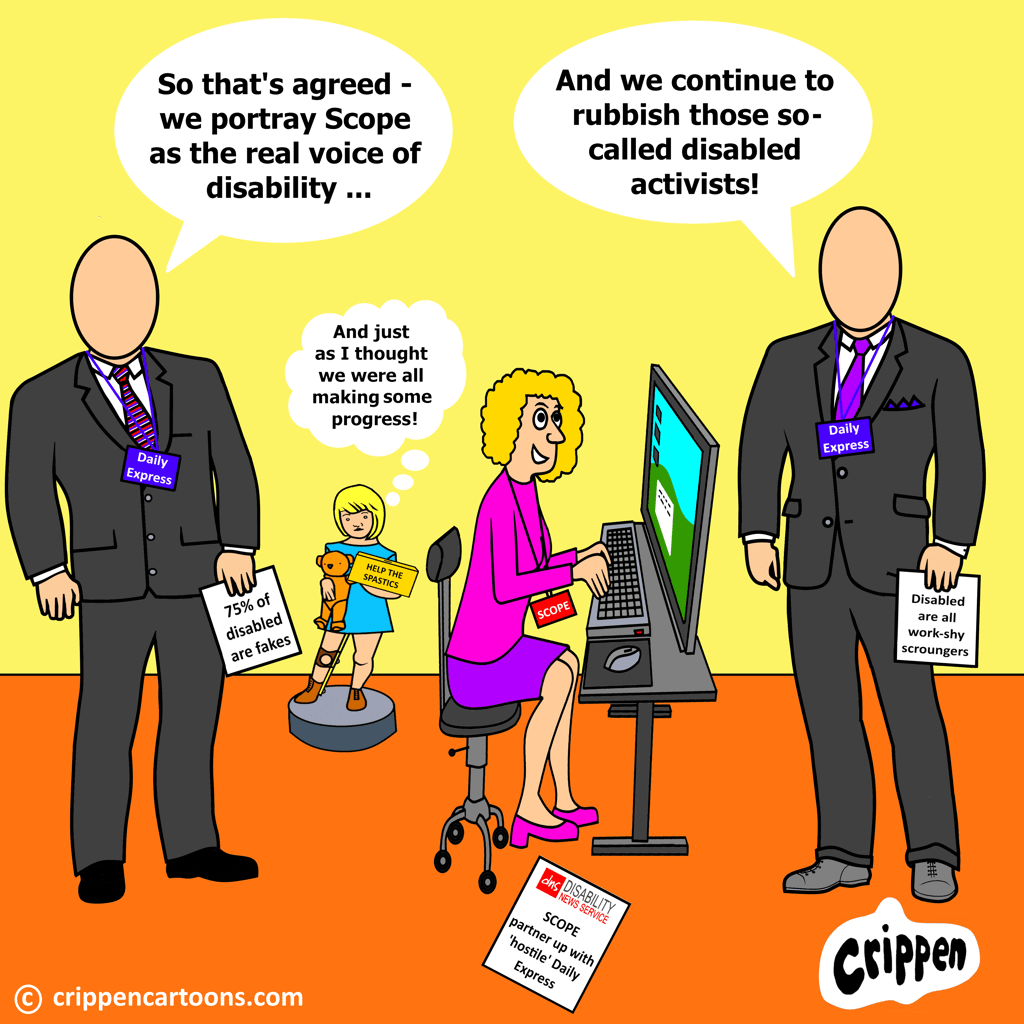
Crippen asks why has Scope partnered with ‘hostile’ Daily Express?

I suppose I shouldn’t really be surprised when I read that Scope, formerly The Spastic Society, has partnered with a “scaremongering” national newspaper notorious for its hostile coverage of disabled people and other marginalised groups.

The Daily Express has been listed as the official partner for Scope’s second Disability Equality Awards, which took place in London recently. This came just days after the right-wing newspaper horrified many disabled people with its front-page headline: “PM tells sick note Britain: Get a grip and a job.”

The Express was a particular focus for anger during the early austerity years, with headlines such as “Sick benefits: 75 per cent are faking”, and the impact of its disablist coverage was highlighted in reports published by disabled people’s organisations such as Disability Rights UK and Inclusion London.

Yen Godden, a disability advocate, commented:

“I am shocked that Scope has chosen to partner with the Daily Express … Scope has a section on their website about reporting disability hate crimes and incidents yet seems to miss the glaringly obvious fact that the Daily Express has consistently stirred up hatred and mistrust towards disabled people and continues to do so.”

Disability advocate Sara Westrop added that, as a disabled non-binary person, they were surprised to hear of the partnership:

“Considering the numerous ways they have contributed towards the increasingly hostile environment in the UK directed towards disabled people and trans people. The Express also regularly shares articles painting disabled people as drains on society, resources and money … also showing support for Sunak’s barbaric reformation of disability benefits.”

Accessibility consultant Julia Peyser Gutiérrez Anstey was also critical of the partnership. They said:

“The Daily Express has and continues to directly harm the disabled community by framing us as benefit scroungers and wasters of NHS money. The fact that they are partnering with Scope does not take back any of the immense harm they have done to disabled people.”

Asked why the charity thought it was appropriate to partner with the Express when it had a long history of discriminatory, hostile and disablist coverage, a Scope spokesperson said:

“We work with journalists from across the political spectrum … because of the influence they have on our society. Having the Express spotlight stories from our nominees allows us to reach new audiences, and bring positive messages about disability to people that we would otherwise be unable to reach.”

Makes you wonder if the people at Scope have actually read the Daily Express?!

For the full story please read the Disability News Service report.

Description of cartoon for those using screen reading software

Two faceless, white males in grey suits and with ‘Daily Express’ name badges around their necks, are standing either side of a smiling white woman who is typing at a computer wearing a Scope name badge. The two men are also holding pieces of paper with ‘75% of disabled are fakes’ and ‘Disabled are all work-shy scroungers’ on them. On the floor at their feet is a copy of Disability News Service with the headline: ‘Scope partner up with hostile Daily Express’. The first man is saying: “So that’s agreed – we portray Scope as the real voice of disability …”. The second man adds: “And we continue to rubbish those so-called disabled activists!” In the background is one of Scope’s old plaster collection figures – a young girl wearing a leg brace and a collection box with ‘Help the Spastics’ printed upon it. She is thinking: “And just as I thought that we were making some progress!”.

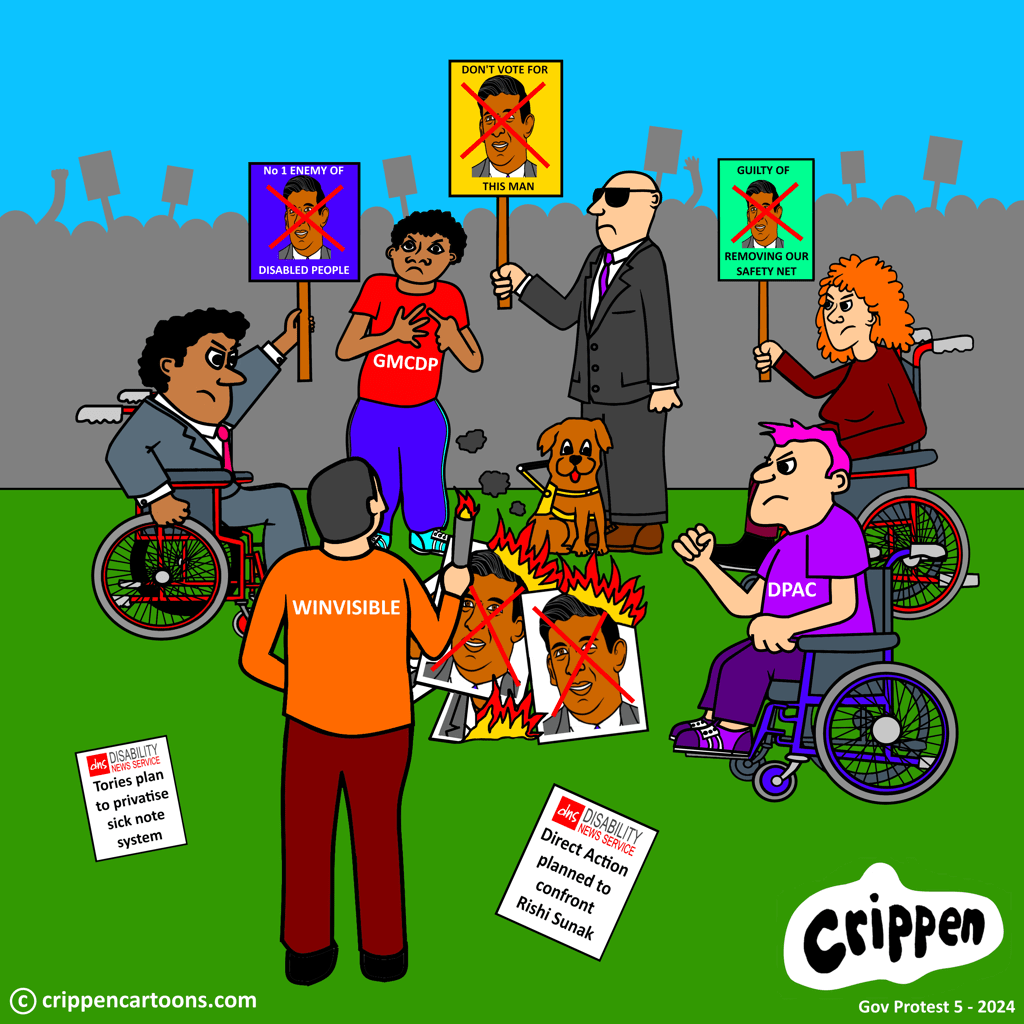
Crippen supports DPAC’s call for Direct Action

At an online emergency meeting organised by Disabled People Against Cuts (DPAC), there was a call to fight the government’s “fundamental” assaults on disabled people’s rights.

At the meeting, over a hundred “determined and angry” disabled activists pledged to use direct action protests to “put a stake through the heart” of the idea that disabled people can be used as scapegoats in the run-up to general elections.

The meeting was called after the prime minister announced a series of reforms that are set to weaken the social security safety net, with his speech described by one disabled writer as designed to “drip feed a nation with an extremely ableist rhetoric intended to radicalise, scapegoat and ostracise”.

Rishi Sunak announced plans for new cuts to personal independence payment, a faster rollout of universal credit to disabled people – despite serious concerns about the potential threat to the “safety and well-being” of disabled people – and an end to what he called a “sicknote culture”, as well as other reforms (see previous blog post).

Disabled activists, including DAN, DPAC and other grassroots groups of disabled people, have been fighting successive Conservative-led governments over repeated austerity cuts for the last 14 years, vowed to continue that fight, particularly with a general election imminent.

Andy Greene, a member of DPAC’s national steering group, said:

“When it comes to direct action, I think we really need to start upping our game. I think we need to put a stake through the heart of this idea that you can constantly come back to us as the ‘whipping boy’ and talk about us as a vote-winner … Direct Action needs to drive these arguments back into the dark … We are re-emerging as a mass movement, and Direct Action has always been the cutting edge of our movement.”

Ellen Clifford, another member of DPAC’s national steering group and award-winning author of The War on Disabled People, told the meeting:

“What we really need is some direct action … Conservative politicians are trying to win the next election by directly attacking disabled people … We need to show them what we think of them.”

John McDonnell, Labour’s former shadow chancellor and a long-standing DPAC member, also spoke at the meeting:

“I think the scale of this attack is worse than in 2010 now. I think it has gone beyond that because this is much more fundamental an assault on basic rights for disabled people, and that’s why DPAC was founded [in 2010].

“We are a resistance movement, and we resist attacks, and in resisting those attacks we give a vision and hope for the future. I am worried about people being scared and anxious about this attack, because of the scale of it, but to balance that out we are within six months maximum of a general election.

“We have to get back to Direct Action as well. We have to get back onto the streets!”

McDonnell added that he did not believe many people – particularly within parliament – realised the scale of the attack on disabled people. He committed himself and his staff to supporting efforts to oppose the reforms, including through parliamentary questions, early day motions, debates and events within parliament.

As well as DPAC activists, others at the meeting included representatives from the disabled women’s organisation WinVisibleInclusion London, and DPAC Northern Ireland, and union activists from PCS, Unite Community and the National Union of Journalists (NUJ).

Natasha Hirst, NUJ president and a long-standing disabled activist, told the meeting that she was leading on the union’s work to support journalists to improve how they report on disability and social policy. She said:

“I know that there’s an awful lot of reporting at the moment that is absolutely abhorrent, that is appalling, and I’m working really hard with my colleagues to try to educate journalists.”

She said she was also keen to put together information that would show activists how to challenge poor reporting.

The meeting also heard of other ways that disabled people could fight back against the government’s reforms, including writing to MPs and mainstream media, contributing to local radio discussions, and posting on social media.

Claire Glasman, from WinVisible, who also attended, said the meeting showed that “everyone is determined to resist this attack on our benefit rights”. She added:

“In WinVisible, many of us are living with mental distress due to abuse, rape, war and other trauma. We are asylum-seekers, refugee, immigrant and UK-born women, and some of us are LGBTQI+. In the face of Rishi Sunak scapegoating sick and disabled people; the government wanting to give the DWP surveillance powers on the bank accounts of 22 million claimants, including pensioners; and the passing of the Rwanda bill, effectively ending the right to seek asylum and protection in the UK, we are more determined than ever to fight for our survival.”

She also said there were concerns that the government planned to privatise the fit note system, and she called on the British Medical Association to oppose any such plans, which would lead to “profiteer companies” making decisions, as with the “brutal disability benefit assessments” that have been carried out by Maximus, Atos and Capita.

*Anyone who wishes to be involved in DPAC’s work to oppose the government’s attacks on disabled people should email them.

Read more about DPAC’s emergency meeting in Disability News Service (DNS)

Description of cartoon for those using screen reading software

A large crowd of angry disabled activists are gathered to protest over the plans outlined by Rishi Sunak. These involve more changes to the benefits systems, the privatisation of the ‘sick note’ system, and more penalties aimed at people experiencing mental illness. The protestors are carrying banners with an image of Sunak on them, along with a large red cross across his face. Slogans include ‘Don’t vote for this man’, No 1 Enemy of disabled people and ‘Guilty of removing our safety net’. On the ground are copies of Disability News Service with ‘Direct action planned to confront Sunak’ and ‘Tory’s plan to privatise sick note system’. Large pictures of Sunak are piled in the centre and have been set alight as part of the protest.

Crippen learns of Sunak’s full-on assault on disabled people

Describing it as a “moral mission” Prime Minister Rishi Sunak has unveiled his plans to impose fresh curbs on benefits.

Apart from proposing a new consultation on Personal Independent Payment (PIP), a non-means-tested benefit that helps with extra costs caused by long-term disability or ill health, he has vowed to significantly reform the benefits system.

Based upon an expected rise in benefits spending which includes an increasing number of people who are claiming PIP for anxiety and depression, Sunak stated that it is no longer sustainable. He therefore intends to introduce a more “rigorous” approach with “greater medical evidence” being required to substantiate a claim.

Mr Sunak also claimed that Britain is suffering from a “sick-note culture” and warned against “over-medicalising the everyday challenges and worries of life”. He revealed new trials will be under way that will put an end to GPs being allowed to sign patients off sick, with the responsibility shifting to “work and health professionals” instead.

Along with this he pledged to “tighten” the Work Capability Assessment (WCA) so that “hundreds of thousands of benefit recipients with less severe conditions will now be expected to engage in the world of work.” He added that if the Tories were to win the election, people who were still out of work after 12 months will have “their benefits removed entirely”. He also spoke about benefits being sanctioned if someone does not comply with conditions set by a work coach.

Disability Rights UK’s head of policy Fazilet Hadi accused the government of targeting disabled people for a failing economy. She said:

“The Prime Minister’s approach to systemic inequalities caused by government policies and underfunding of public services, is to further penalise, punish and threaten disabled people living on inadequate benefits.”

Mind chief executive Dr Sarah Hughes said that with mental health services at breaking point after years of underinvestment …

“[It is] insulting to the 1.9 million people on a waiting list to get mental health support, and to the GPs whose expert judgment is being called into question.”

Dr Katie Bramall-Stainer, chairwoman of the BMA’s GP committee, accused Mr Sunak of pushing “a hostile rhetoric,” with Unison general secretary Christina McAnea stating:

“Lengthy waits for NHS operations and treatment have left people languishing at home, too sick or injured to work. Threatening to remove benefits and forcing sick and disabled people further into poverty is most definitely not the way to increase the health of our sick nation.”

Note: Government figures show that £69 billion is currently being spent on benefits, however a Policy in Practice report released last week found that over £23bn worth went unclaimed in the last year, excluding disability benefits.

Description of cartoon for those using screen reading software

An Asian male in a self propelled wheelchair is sat facing two large dogs. The dogs are snarling with one of them having a ripped piece of the disabled man’s suit in it’s mouth. He has also torn a chunk out of the wheel of the wheelchair and left the man covered in cuts and bruises. A PIP application form and a medical sick note lay ripped apart on the floor. Around the dogs neck’s are two discs. One carries the initials ‘DWP’ whilst the other reads ‘Sanctions’. Standing behind the dogs is the PM Rishi Sunak who is saying to the disabled man: “You won’t be needing benefits – with the system we’ve created there’s now every incentive for you to seek work!”

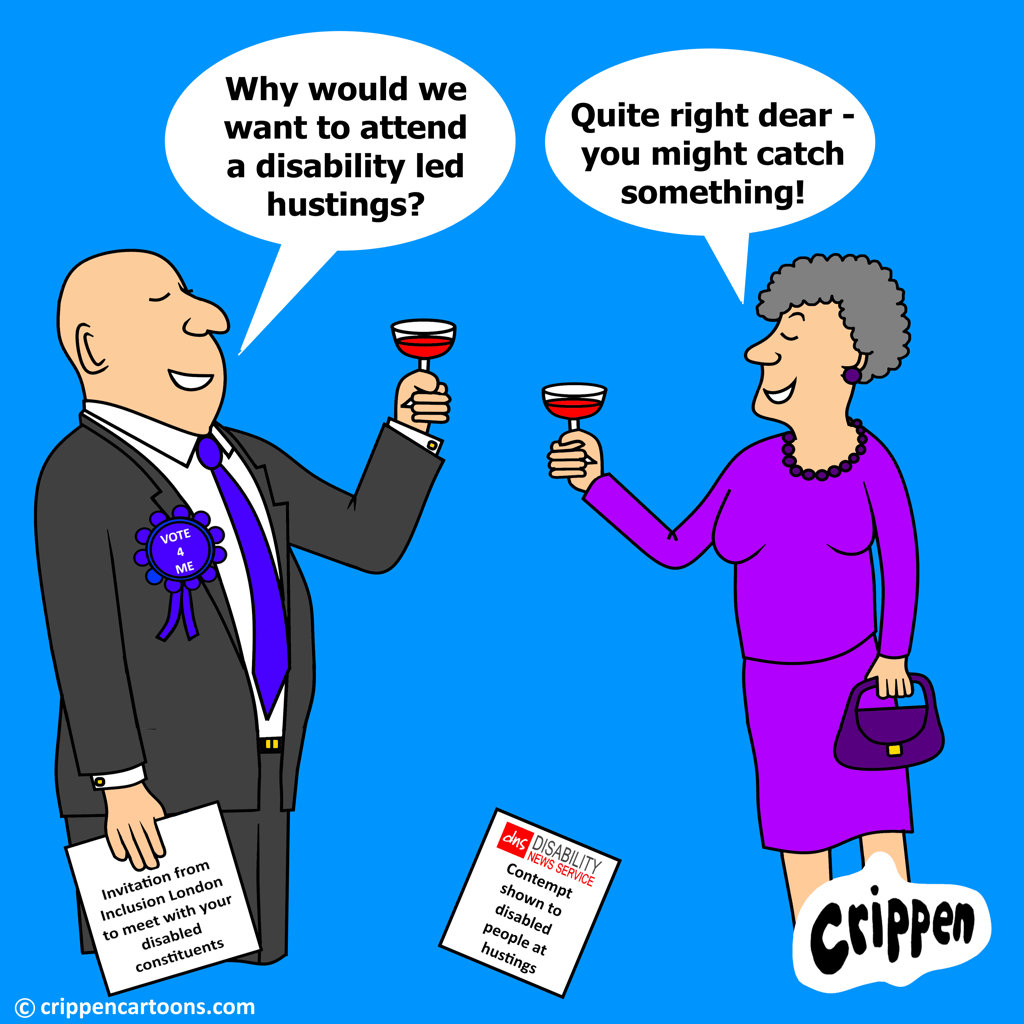
Crippen and the No Shows

Our friends at Inclusion London have launched a a #NoMoreNoShows campaign to ensure that candidates for the upcoming general election attend disability hustings, rather than sending replacements or not turn up at all!

This followed an event when three candidates to be the next mayor of London refused to explain why they failed to turn up to a packed hustings event that would have allowed disabled people from across the capital to question them on their policies.

Just one of the four candidates invited, Zoë Garbett, for the Green Party, turned up to answer questions at the sold-out event, with more than 100 people attending, and about another 100 watching or listening online.

Svetlana Kotova, Inclusion London’s director of campaigns and justice, told the event as it began that she and her colleagues were “deeply disappointed” at the failure of the three candidates to attend. She said:

“We did everything we could to convince them to come … we’re really, really concerning for the democratic process; we think it’s really important that candidates talk to disabled people and hear from disabled people.”

Inclusion London’s co-chair, Adam Gabsi, who was chairing the hustings event, told Disability News Service (DNS) afterwards that Hall, Khan and Blackie had been invited in “numerous ways” but had still not attended. He said:

“Hustings are an integral part of the democratic process and ignoring disabled people gives us the impression that our concerns are not worthy of being listened to and our votes are not important. This is an election year and disabled people deserve better treatment.”

Laura Vicinanza, policy and stakeholder engagement manager for Inclusion London, added:

“We are deeply disappointed that of the four parties represented at hustings, only the Green Party sent their mayoral candidate … our rights as disabled people must be valued and upheld by all our elected representatives.

Read the full story on the Disability News Service website.

Description of cartoon for those using screen reading software

A corpulant white man in a grey suit is standing holding a glass of wine and an invitation from Inclusion London to attend a disability led hustings. He is also sporting a blue rosette with ‘Vote for me’ printed upon it. Opposite him is an older white woman wearing a purple top and dress with matching beads, earings and handbag. She is also holding a glass of wine. The man is saying: “Why would we like to attend a disability led hustings?”. The woman replies: “Quite right dear – you might catch something!”