Posts Tagged ‘crippen cartoons’

Mo Stewart asks: “Safeguarding vulnerable claimants – how?” 

A guest blog by Mo Stewart, Research Lead of the Preventable Harm Project.

“As the House of Commons returns to Parliament following the Christmas break, the select committees are back in action. The new Work and Pensions Committee (the Committee), chaired by the Labour MP Debbie Abrahams, was taking evidence on 8th January for their ongoing ‘safeguarding vulnerable claimants’ inquiry.

“Significant evidence was provided by the first panel representing Women’s Aid, the mental health charity Mind, the National Autistic Society and the Child Poverty Action Group. These professionals testified to the suffering created by the Department for Work and Pensions (DWP) for benefit claimants with various needs and stressed the negative impact of the DWP on benefit claimants.

“The next person to give evidence to the Committee was Dr Gail Allsopp, the DWP Chief Medical Advisor (CMA) appointed sixteen months ago, following the failure of the DWP to appoint a CMA for over five years.

“The evidence provided by Dr Allsopp left a lot to be desired after the Chair invited her view on ‘the actual scale of the deaths of claimants’. Dr Allsopp claimed her main concern regarding deaths of DWP disability benefit claimants was in the very rare Prevention of Future Deaths reports provided by coroners, identifying that something at the DWP ‘had gone wrong.

“However, the hundreds of confidential internal process reviews (IPR) investigating DWP related deaths was downplayed. The Chair did advise Dr Allsopp that the Committee believed that the IPRs were ‘probably the tip of the iceberg’ regarding the deaths and serious harm linked to DWP actions, but they both failed to acknowledge the thousands of deaths of chronically ill and disabled benefit claimants following a disability benefit assessment.

“Whilst the DWP created the Serious Case Panel (the Panel), which Dr Allsopp attends, following concerns regarding the numbers of deaths linked to disability benefit assessments, the Panel is not independent and the minutes are limited and totally inadequate. This researcher believes it is past time to adopt an Independent Advisory Panel for DWP Related Deaths, similar to the Independent Advisory Panel for Deaths in Custody, which is linked to the Ministry of Justice, is totally independent and offers very detailed reports of their findings, which is a suggestion brought to the attention of the Attorney General, Lord Kermer KC.

“A letter to Dr Allsopp attracted a reply claiming she could not add ‘any further advice’ as I was in contact with the Minister for Disability, Sir Stephen Timms MP.  However, this researcher’s letter to the CMA didn’t invite any advice, but simply provided evidence that, as the CMA, she should be made aware of. It remains unclear to this researcher why the CMA claims to be responsible for clinical governance across the DWP given that the WCA continues to disregard all clinical need. Any disability assessment that disregards diagnosis, prognosis, past medical history and prescribed medicines is dangerous and guarantees preventable harm to many, regardless of any possible improved clinical governance of the staff who conduct the assessment.” 

Mo Stewart

Research Lead

Preventable Harm Project

Description of cartoon for those using screen reading software

Seated at a desk under a sign that reads ‘New Work and Pensions Committee’ are Dr Gail Allsopp and Debbie Abrahams MP. The front of their desk has a sign that reads ‘Safeguarding vulnerable clients enquiry’. Two sets of documents lay discarded on the floor. One is ‘Coroners report – the prevention of future deaths’ and the other (which is in a bin marked rubbish) is ‘internal process reviews’. Standing opposite them are three people, representatives of the national autistic society, MIND and woman’s aid. In front of them is a large placard that reads ‘our collective evidence points to unnecessary suffering created by the DWP for disabled benefit claimants’. Another piece of paper is on the floor reads ‘thousands of deaths of chronically ill after assessment’. Dr Allsopp is saying to the group: “I’m afraid that we don’t have time for that – we can only concentrate on any future deaths!” Each of the charity reps looks suitably stunned.

Crippen discovers that DWP paid half a BILLION pounds to deceased pensioners

Ah, now it’s starting to make more sense …

Blundering civil servants in the Department for Work and Pensions (DWP) mistakenly sent more than half a BILLION pounds to deceased people in just five years, official figures reveal. And apparently there’s no legal obligation for families to return the money.

So, these exagerated claims by the DWP that disabled people are ripping off the benefits system is nothing more than a fabrication, designed to cover up their own costly incompetence. Who best to blame when the books don’t balance? Why, disabled people of course!

As usual the DWP declined to comment! 

Description of cartoon for those using screen reading software

A group of people are standing around an open grave as a vicar reads the sermon. An open newspaper on the ground reads ‘DWP pay out 1/2 billion to pensioners who have recently died!’. Also standing alongside the grave is a man in a suit identified as being a ‘bailiff’ and another man as being with the DWP. The bailiff is saying to the vicar: “If the DWP don’t get their money back, we’re going to have to repossess the coffin!”

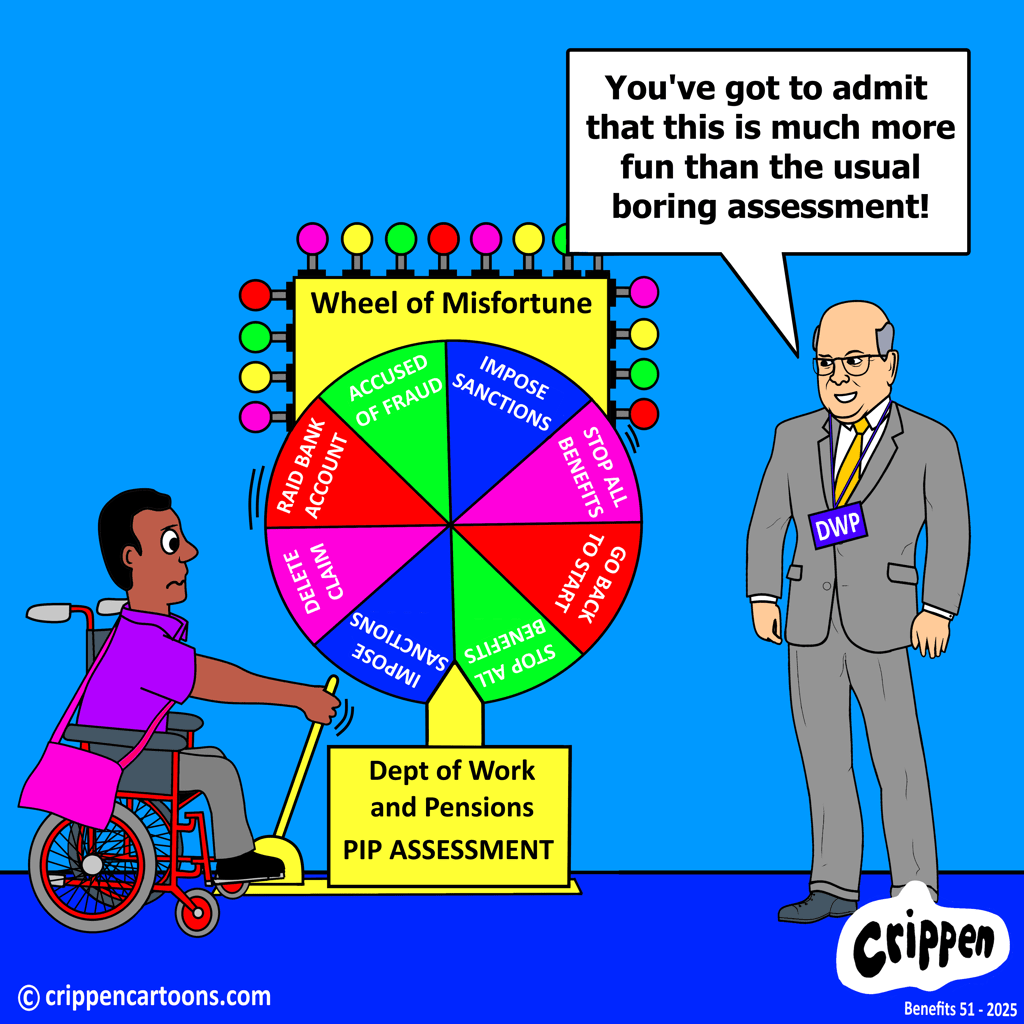
Crippen looks at the latest figures regarding the stoppage of PIP to disabled claimants

An article in the Lancs Live online newsletter states that an estimated 628,000 people receiving Personal Independence Payment (PIP) for disabilities and long-term physical and mental health conditions have had their claims stopped. Over the same period, a further 300,000 have seen their benefits reduced.

The Department for Work and Pensions (DWP) apparently reviews all PIP claims after a predetermined period set at the time of each application being approved. Additional unscheduled reviews can be conducted if there is a reported change in circumstances, typically when an individual’s health deteriorates due to an existing impairment or a new medical issue arises.

Currently, around 3.6 million people in the UK receive PIP from the DWP, with awards approved for a specific period – ranging from nine months to 10 years – before a review is carried out to determine whether it will stop, reduce, increase or continue at the same level.

DWP data reveals that during the eight years from 2016, 628,000 claims were stopped following an end-of-award review or change-of-circumstances review. For those whose claims were up for review after a fixed term, 277,000 claimants lost their PIP after a new assessment, and a further 35,000 were informed their PIP was being cancelled because they failed to attend the appointment.

A further 250,000 people had their PIP stopped based on the forms they completed, without being asked to attend a new health assessment, reports Birmingham Live. Furthermore, 264,000 claimants experienced a reduction in their PIP payments following a review, while just over 500,000 were granted a higher amount and nearly 1.4 million maintained the same level of PIP.

In October 2024 alone – the most recent month for which data is available – more than 5,250 individuals had their PIP discontinued after a review of their claim, and 1,796 saw their payments reduced, while almost 5,600 were informed they would receive a higher amount and 34,000 people experienced no change in their award.

With complaints raised about these reassessments being “dehumanising” and “distressing”, the DWP is facing calls to make improvements. Campaigners are asking for an end to “repeat assessments” and say continued entitlement to PIP “should be a medical decision, not a cost-saving exercise.”

Sir Stephen Timms, Minister for Social Security and Disabilities, advised that the application and assessment processes were being reconsidered with a view to improvements as part of the “fundamental reforms” to health and disability benefits to be set out by the Labour Government in spring 2025. However, this could include restrictions on eligibility for PIP.

You’ll remember from an earlier blog that I quoted a statement from Anela Anwar, chief executive of anti-poverty charity Z2K who said: “We need to see a health and disability benefits system that provides security and support, not one that pushes disabled people into deep poverty and leaves them at risk of sanctions.”

You can read the full story here.

Description of cartoon for those using screen reading software

A wheelchair user is sat alongside a giant spinning wheel with rows of flashing lights around it. The face of the wheel has been split into segments which are marked as ‘impose sanctions’, ‘stop all benefits’, ‘go back to start’, ‘accused of fraud’, ‘Raid bank account’ and ‘deleted claim’. The wheel has the name ‘wheel of misfortune – department of work and pensions PIP assessment’ printed upon it. The disabled person is holding a lever which, when pulled, will spin the wheel until it stops with a large pointer aimed at one of the segments. Standing alongside is a man in a grey suit wearing a name tag with DWP printed upon it. He is saying: “You’ve got to admit that this is much more fun than the usual boring assessment!”

Crippen discovers AI is showing a negative bias towards disabled claimants

An artificial intelligence system used by the Department for Work and Pensions (DWP) to detect welfare fraud is showing bias according to people’s age and disability, it has been revealed by the Guardian newspaper.

An internal assessment of a machine-learning programme used to vet thousands of claims across England found it incorrectly selected people from some groups more than others when recommending whom to investigate for possible fraud.

The admission was made in documents released under the Freedom of Information Act by the Department for Work and Pensions (DWP). The “statistically significant outcome disparity” emerged in a “fairness analysis” of the automated system for universal credit advances carried out this year.

The emergence of the bias comes after the DWP this summer claimed the AI system “does not present any immediate concerns of discrimination, unfair treatment or detrimental impact on customers”.

Campaigners responded by accusing the government of a “hurt first, fix later” policy and called on ministers to be more open about which groups were likely to be wrongly suspected by the algorithm of trying to cheat the system.

“It is clear that in a vast majority of cases the DWP did not assess whether their automated processes risked unfairly targeting marginalised groups,” said Caroline Selman, senior research fellow at the Public Law Project, which first obtained the analysis.

“DWP must put an end to this ‘hurt first, fix later’ approach and stop rolling out tools when it is not able to properly understand the risk of harm they represent.”

By one independent count, there are at least 55 automated tools being used by public authorities in the UK potentially affecting decisions about millions of people, although the government’s own register includes only nine.

Description of cartoon for those using screen reading software

Alongside of a sign that reads ‘Department for Work and Pensions (DWP) – Disabled Claimants AI Scrutiny’, a large robot is sat at a table working through a pile of PIP claim forms from disabled people. It has marked every form with a large red ‘Rejected’ stamp. The robot has a face mask bearing the likeness of Iain Duncan Smith, former Tory minister for the DWP. A voice from the side is saying: “It’s been a lot happier since we gave it the personality of Duncan Smith!”

Crippen heralds the return of ‘active resistance’ to DWP cuts

Disabled activists have announced a fightback against a series of “horrific” government social security reforms and have called for “active resistance” to the plans.

Commencing with a national day of action for Monday 4th March, two days before the spring budget, this will include a protest in London, and – it is hoped – other protests organised by local groups around the country, while DPAC will also suggest ways that disabled activists can take part from home.

Ellen Clifford, of Disabled People Against Cuts (DPAC) and the UK coalition of Deaf and disabled people’s organisations that monitors the implementation of the UN disability convention, told Disability News Service that disabled people were now faced with “another set of horrific proposals in the pipeline” after 14 years of their lives becoming “harder and harder” under Conservative-led governments.

A meeting in parliament this week heard that disabled people would not wait for the general election, because there was no guarantee that a Labour government would reverse the government’s proposals. Instead, they called for a return to street protest, led by DPAC, to resist Conservative plans to cut out-of-work disability benefits and introduce other harmful social security reforms.

Among DPAC’s concerns are government plans to intensify the conditions and sanctions imposed on benefit claimants, and to tighten the work capability assessment (WCA). They also point to proposals that will eventually scrap the WCA, and rely instead on the personal independence payment (PIP) assessment.

Paula Peters, a member of DPAC’s national steering group, told the meeting that “We need to build a united campaign that speaks loudly to say that these changes are completely unacceptable, and we need to demand instead a social security system that is fair for all, one that provides a social safety net that affords a decent living, one that we can access without having our mental health destroyed, and one that doesn’t kill us.”

Andy Greene, a member of DPAC’s national steering group, who has played a crucial role in past DPAC direct action, told the meeting: “I think there is a real need just to get back on the streets… and make sure we’re a street presence again, because I think that is where our strength came from previously.

“I think that re-establishing that commitment to street politics is important for any campaign.”

John McDonnell, the Labour MP, DPAC member and former shadow chancellor, who hosted the meeting, said he believed the event was about the “relaunch of a resistance movement on disability” after years of “cuts, austerity, stigma, threats, and to be frank, abuse”. He said it was vital to “demonstrate we are back again” and that disabled people needed to “mobilise” and “ruthlessly pursue” their demands.

Read the full story in Disability News Service.

Description of cartoon for those using screen reading software

In the foreground of the cartoon a large group of disabled people can be seen protesting in front of a larger crowd in the background. Several are holding placards that read ‘We demand an end to benefit sanctions’ and ‘Stop Tory attacks on disabled people’. They are chanting: “What do we want? … An end to oppression … When do we want it? … NOW!”

Crippen remembers Vicky Waddington (1948-2024)

Our dear friend and fellow campaigner Victoria (Vicky) Waddington has died peacefully, at home after a long illness.

Vicky will be remembered for her dedication to the fight for accessible public transport. She was one of the founder members of the Campaign for Accessible Transport (CAT) as well as supporting other disabled activists in their fight for an equal society.

Due to a gradual deterioration in her health over the years, Vicky was unable to continue taking an active part in direct protest. However, with the support of her partner, disabled artist and activist Allan Sutherland, she continued to keep herself informed and involved with the UK disabled people’s movement.

Vicky will be sadly missed by many of us who campaigned with her through the 1980’s and 90’s. Her sense of humour, and her concern for the welfare of those who campaigned with her helped set the safe-guarding parameters for future protest.

Description of cartoon for those using screen reading software

A caricature of Vicky Waddington is seen standing in front of a large green bus and holding a large sign that reads ‘Campaign for Accessible Transport’. She is saying: “We will ride!”