Written by Bob Williams-Findlay October 2024
“In this post, I want to cover a number of tensions and contradictions which I believe run through ‘disability politics’. As ever, I define disability politics as being the social and political action required to end the imposition of disablement and its prime agency, disablism. Together they create the conditions whereby disabled people are excluded from and/or marginalised within mainstream social activity. Hence our Movement argued that we are ‘disabled by society’. I share this slick mantra, but at the same time believe we need greater clarity.
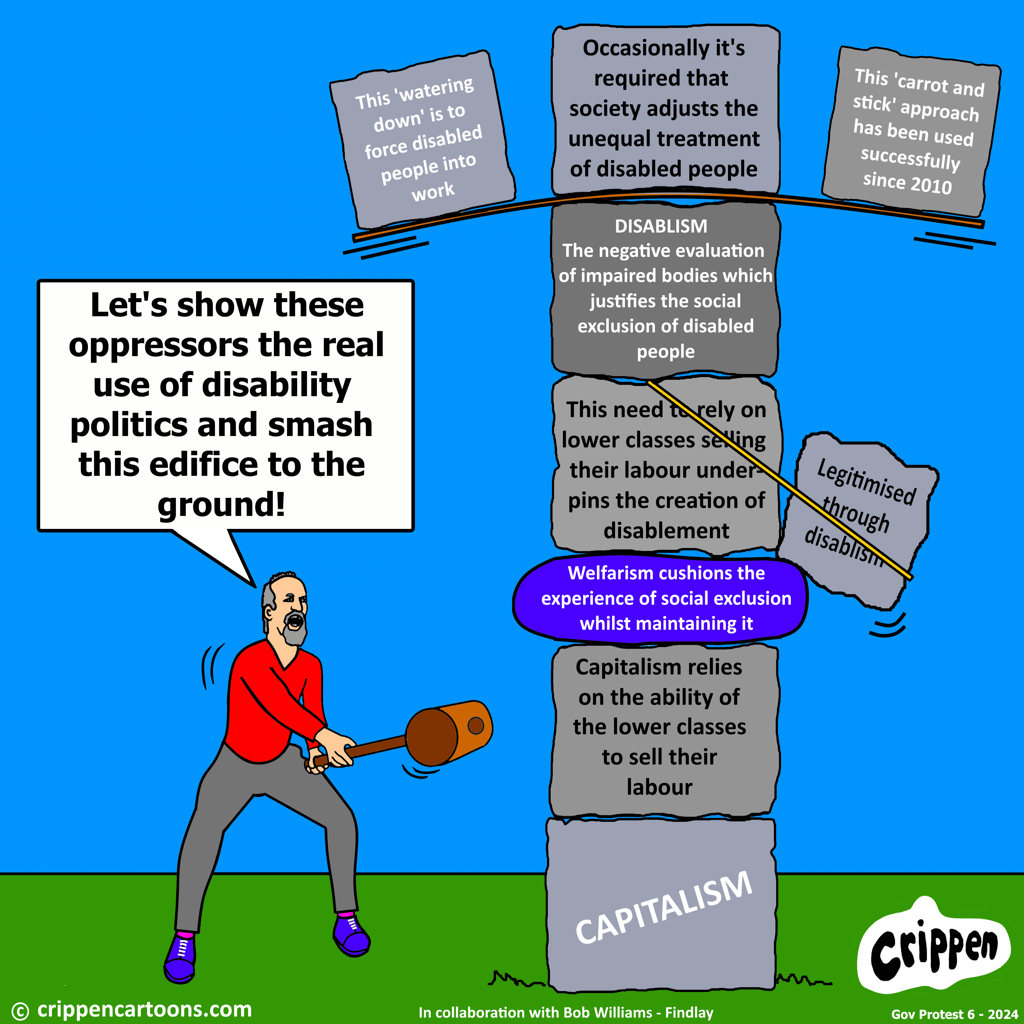
“I have previously argued that one of the biggest contradictions within early disability politics and more modern times is that disabled people want to be included in a society which actively excludes them. Capitalism is directly responsible for disablement, however, at differing points the needs of Capital requires society to adjust the unequal and differential treatment disabled people encounter. Here is another contradiction: welfarism cushioned the experience of social exclusion, on the one hand, whilst maintaining it on the other.
“It is understandable that disabled people have pushed for deinstitutionalisation and social inclusion; but to what extent is that feasible? Capitalist social relations rely heavily on the ability of the lower classes to sell their labour. Disabled Marxists tend to argue that this ‘need’ underpins the creation of disablement and the legitimising of it through disablism – the negative evaluation of impaired bodies which justified our social exclusion. Yet, as I have stated already, at times these evaluatons are watered down to encourage or force more groups of disabled people into the labour market. The neoliberal agenda since 2010 has adopted the carrot and stick approach.
“There is much to discuss about ‘work’, what it is, alongside exploring the various benefits and detriments involved. I can’t address these issues here. There is a view that ‘work’ means a degree of security, improved health for some and greater spending power. For me the issue is not about whether or not disabled people can/should work, but rather the impact of disablism on people who are of working age – how are they being both judged and treated.
“In the film, “When Barbara Met Alan”, one of the slogans heard was: ‘we want, what you got’. This raises many issues in my opinion and relates to what I call the ‘disability dialectic’. Disabled people cannot fit into the status quo; if we could, then we would not be ‘disabled by society’. So we fight to ‘transform’ society which means going up against the interests of Capital. We have always fought for ‘betterment’; making our lives better, but only through overthrowing the status quo will it be possible to build an inclusive society.
“So the last contradiction I want to pose is: what does ‘nothing about us, without us’ actually mean in the context of opposing discrimination and oppression? Some want a seat at Liz Kendall’s Taskforce table; to do what exactly? Disabled people were not included in the agenda setting; it is highly unlikely that agenda will address institutional disablism in the labour market. When Rachel Hurst and I promoted political coproduction [the meaning of NAU,WU] it was not only agitational, it was underpinned by the demand for a shift in power relations. As a Trotskyist, I view ‘nothing about us, without us’ as a transitional demand because it challenges the existing oppressive relationships we are subjected to.
“I am not conviced the current disability politics practiced by today’s activists adequately address the structural nature of disablement when they go cap-in-hand demanding “Rights”. Rights are meaningless without the power to enforce them.
“The reason I co-founded DPAC was the unquestionable belief that we, disabled people, had to build a new social movement, foster a sense of community, and build alliances with allies. Over the last 15 years we have not made serious inroads because disability politics have lost their radical vision. Equally does not mean ‘sameness’; it is about people’s lives having ‘equal value’ and capitalism can never deliver that.”
Description of cartoon for those using screen reading software
A caricature of Bob Williams-Findlay stands alongs side a large stone edifice wielding a large sledge hammer. The edifice comprises of large stone blocks, each block representing the points he has made in the accompanying article about oppression by capitalism. Bob is saying: “Let’s show these oppressors the real use of disability politics and smash this edifice to the ground!”
 Crippen Cartoons