Posts Tagged ‘politics’

Mo Stewart asks: “Safeguarding vulnerable claimants – how?” 

A guest blog by Mo Stewart, Research Lead of the Preventable Harm Project.

“As the House of Commons returns to Parliament following the Christmas break, the select committees are back in action. The new Work and Pensions Committee (the Committee), chaired by the Labour MP Debbie Abrahams, was taking evidence on 8th January for their ongoing ‘safeguarding vulnerable claimants’ inquiry.

“Significant evidence was provided by the first panel representing Women’s Aid, the mental health charity Mind, the National Autistic Society and the Child Poverty Action Group. These professionals testified to the suffering created by the Department for Work and Pensions (DWP) for benefit claimants with various needs and stressed the negative impact of the DWP on benefit claimants.

“The next person to give evidence to the Committee was Dr Gail Allsopp, the DWP Chief Medical Advisor (CMA) appointed sixteen months ago, following the failure of the DWP to appoint a CMA for over five years.

“The evidence provided by Dr Allsopp left a lot to be desired after the Chair invited her view on ‘the actual scale of the deaths of claimants’. Dr Allsopp claimed her main concern regarding deaths of DWP disability benefit claimants was in the very rare Prevention of Future Deaths reports provided by coroners, identifying that something at the DWP ‘had gone wrong.

“However, the hundreds of confidential internal process reviews (IPR) investigating DWP related deaths was downplayed. The Chair did advise Dr Allsopp that the Committee believed that the IPRs were ‘probably the tip of the iceberg’ regarding the deaths and serious harm linked to DWP actions, but they both failed to acknowledge the thousands of deaths of chronically ill and disabled benefit claimants following a disability benefit assessment.

“Whilst the DWP created the Serious Case Panel (the Panel), which Dr Allsopp attends, following concerns regarding the numbers of deaths linked to disability benefit assessments, the Panel is not independent and the minutes are limited and totally inadequate. This researcher believes it is past time to adopt an Independent Advisory Panel for DWP Related Deaths, similar to the Independent Advisory Panel for Deaths in Custody, which is linked to the Ministry of Justice, is totally independent and offers very detailed reports of their findings, which is a suggestion brought to the attention of the Attorney General, Lord Kermer KC.

“A letter to Dr Allsopp attracted a reply claiming she could not add ‘any further advice’ as I was in contact with the Minister for Disability, Sir Stephen Timms MP.  However, this researcher’s letter to the CMA didn’t invite any advice, but simply provided evidence that, as the CMA, she should be made aware of. It remains unclear to this researcher why the CMA claims to be responsible for clinical governance across the DWP given that the WCA continues to disregard all clinical need. Any disability assessment that disregards diagnosis, prognosis, past medical history and prescribed medicines is dangerous and guarantees preventable harm to many, regardless of any possible improved clinical governance of the staff who conduct the assessment.” 

Mo Stewart

Research Lead

Preventable Harm Project

Description of cartoon for those using screen reading software

Seated at a desk under a sign that reads ‘New Work and Pensions Committee’ are Dr Gail Allsopp and Debbie Abrahams MP. The front of their desk has a sign that reads ‘Safeguarding vulnerable clients enquiry’. Two sets of documents lay discarded on the floor. One is ‘Coroners report – the prevention of future deaths’ and the other (which is in a bin marked rubbish) is ‘internal process reviews’. Standing opposite them are three people, representatives of the national autistic society, MIND and woman’s aid. In front of them is a large placard that reads ‘our collective evidence points to unnecessary suffering created by the DWP for disabled benefit claimants’. Another piece of paper is on the floor reads ‘thousands of deaths of chronically ill after assessment’. Dr Allsopp is saying to the group: “I’m afraid that we don’t have time for that – we can only concentrate on any future deaths!” Each of the charity reps looks suitably stunned.
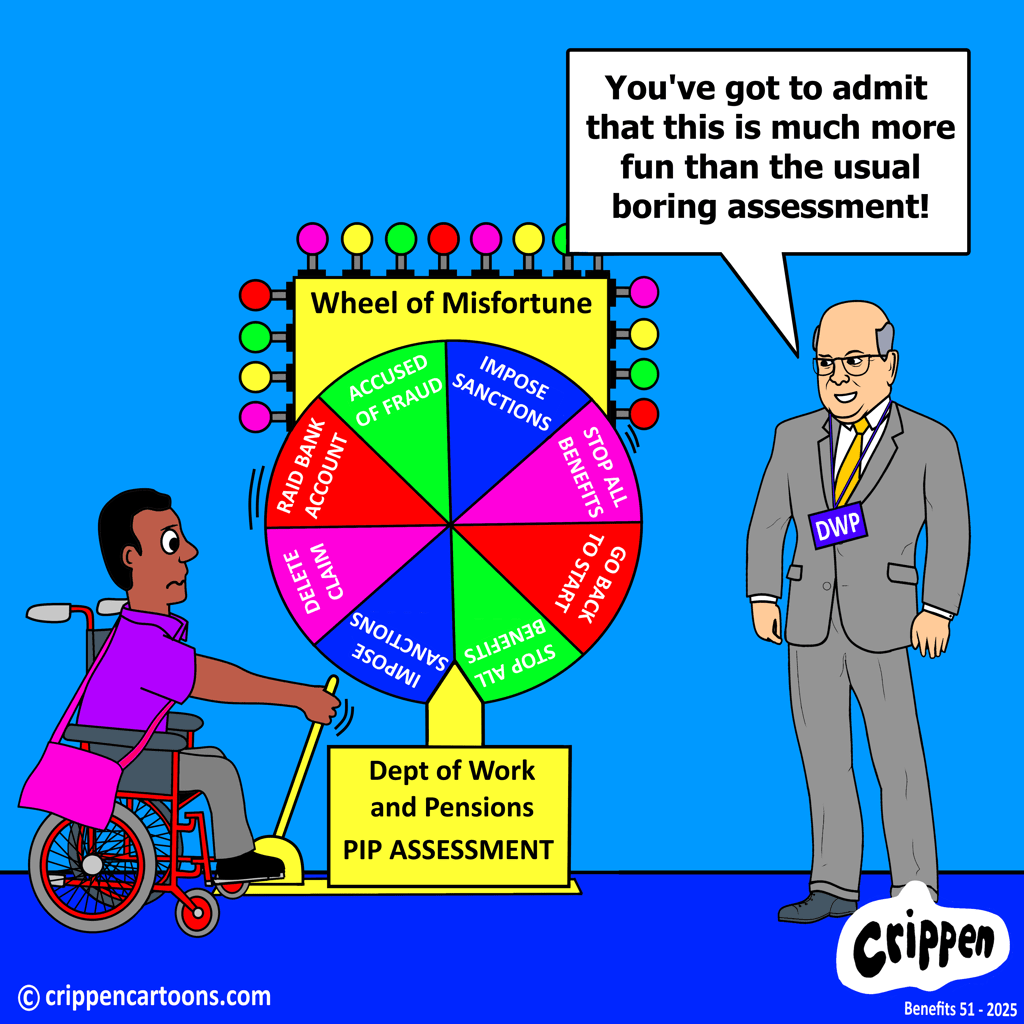
Crippen looks at the latest figures regarding the stoppage of PIP to disabled claimants

An article in the Lancs Live online newsletter states that an estimated 628,000 people receiving Personal Independence Payment (PIP) for disabilities and long-term physical and mental health conditions have had their claims stopped. Over the same period, a further 300,000 have seen their benefits reduced.

The Department for Work and Pensions (DWP) apparently reviews all PIP claims after a predetermined period set at the time of each application being approved. Additional unscheduled reviews can be conducted if there is a reported change in circumstances, typically when an individual’s health deteriorates due to an existing impairment or a new medical issue arises.

Currently, around 3.6 million people in the UK receive PIP from the DWP, with awards approved for a specific period – ranging from nine months to 10 years – before a review is carried out to determine whether it will stop, reduce, increase or continue at the same level.

DWP data reveals that during the eight years from 2016, 628,000 claims were stopped following an end-of-award review or change-of-circumstances review. For those whose claims were up for review after a fixed term, 277,000 claimants lost their PIP after a new assessment, and a further 35,000 were informed their PIP was being cancelled because they failed to attend the appointment.

A further 250,000 people had their PIP stopped based on the forms they completed, without being asked to attend a new health assessment, reports Birmingham Live. Furthermore, 264,000 claimants experienced a reduction in their PIP payments following a review, while just over 500,000 were granted a higher amount and nearly 1.4 million maintained the same level of PIP.

In October 2024 alone – the most recent month for which data is available – more than 5,250 individuals had their PIP discontinued after a review of their claim, and 1,796 saw their payments reduced, while almost 5,600 were informed they would receive a higher amount and 34,000 people experienced no change in their award.

With complaints raised about these reassessments being “dehumanising” and “distressing”, the DWP is facing calls to make improvements. Campaigners are asking for an end to “repeat assessments” and say continued entitlement to PIP “should be a medical decision, not a cost-saving exercise.”

Sir Stephen Timms, Minister for Social Security and Disabilities, advised that the application and assessment processes were being reconsidered with a view to improvements as part of the “fundamental reforms” to health and disability benefits to be set out by the Labour Government in spring 2025. However, this could include restrictions on eligibility for PIP.

You’ll remember from an earlier blog that I quoted a statement from Anela Anwar, chief executive of anti-poverty charity Z2K who said: “We need to see a health and disability benefits system that provides security and support, not one that pushes disabled people into deep poverty and leaves them at risk of sanctions.”

You can read the full story here.

Description of cartoon for those using screen reading software

A wheelchair user is sat alongside a giant spinning wheel with rows of flashing lights around it. The face of the wheel has been split into segments which are marked as ‘impose sanctions’, ‘stop all benefits’, ‘go back to start’, ‘accused of fraud’, ‘Raid bank account’ and ‘deleted claim’. The wheel has the name ‘wheel of misfortune – department of work and pensions PIP assessment’ printed upon it. The disabled person is holding a lever which, when pulled, will spin the wheel until it stops with a large pointer aimed at one of the segments. Standing alongside is a man in a grey suit wearing a name tag with DWP printed upon it. He is saying: “You’ve got to admit that this is much more fun than the usual boring assessment!”

Crippen discovers AI is showing a negative bias towards disabled claimants

An artificial intelligence system used by the Department for Work and Pensions (DWP) to detect welfare fraud is showing bias according to people’s age and disability, it has been revealed by the Guardian newspaper.

An internal assessment of a machine-learning programme used to vet thousands of claims across England found it incorrectly selected people from some groups more than others when recommending whom to investigate for possible fraud.

The admission was made in documents released under the Freedom of Information Act by the Department for Work and Pensions (DWP). The “statistically significant outcome disparity” emerged in a “fairness analysis” of the automated system for universal credit advances carried out this year.

The emergence of the bias comes after the DWP this summer claimed the AI system “does not present any immediate concerns of discrimination, unfair treatment or detrimental impact on customers”.

Campaigners responded by accusing the government of a “hurt first, fix later” policy and called on ministers to be more open about which groups were likely to be wrongly suspected by the algorithm of trying to cheat the system.

“It is clear that in a vast majority of cases the DWP did not assess whether their automated processes risked unfairly targeting marginalised groups,” said Caroline Selman, senior research fellow at the Public Law Project, which first obtained the analysis.

“DWP must put an end to this ‘hurt first, fix later’ approach and stop rolling out tools when it is not able to properly understand the risk of harm they represent.”

By one independent count, there are at least 55 automated tools being used by public authorities in the UK potentially affecting decisions about millions of people, although the government’s own register includes only nine.

Description of cartoon for those using screen reading software

Alongside of a sign that reads ‘Department for Work and Pensions (DWP) – Disabled Claimants AI Scrutiny’, a large robot is sat at a table working through a pile of PIP claim forms from disabled people. It has marked every form with a large red ‘Rejected’ stamp. The robot has a face mask bearing the likeness of Iain Duncan Smith, former Tory minister for the DWP. A voice from the side is saying: “It’s been a lot happier since we gave it the personality of Duncan Smith!”

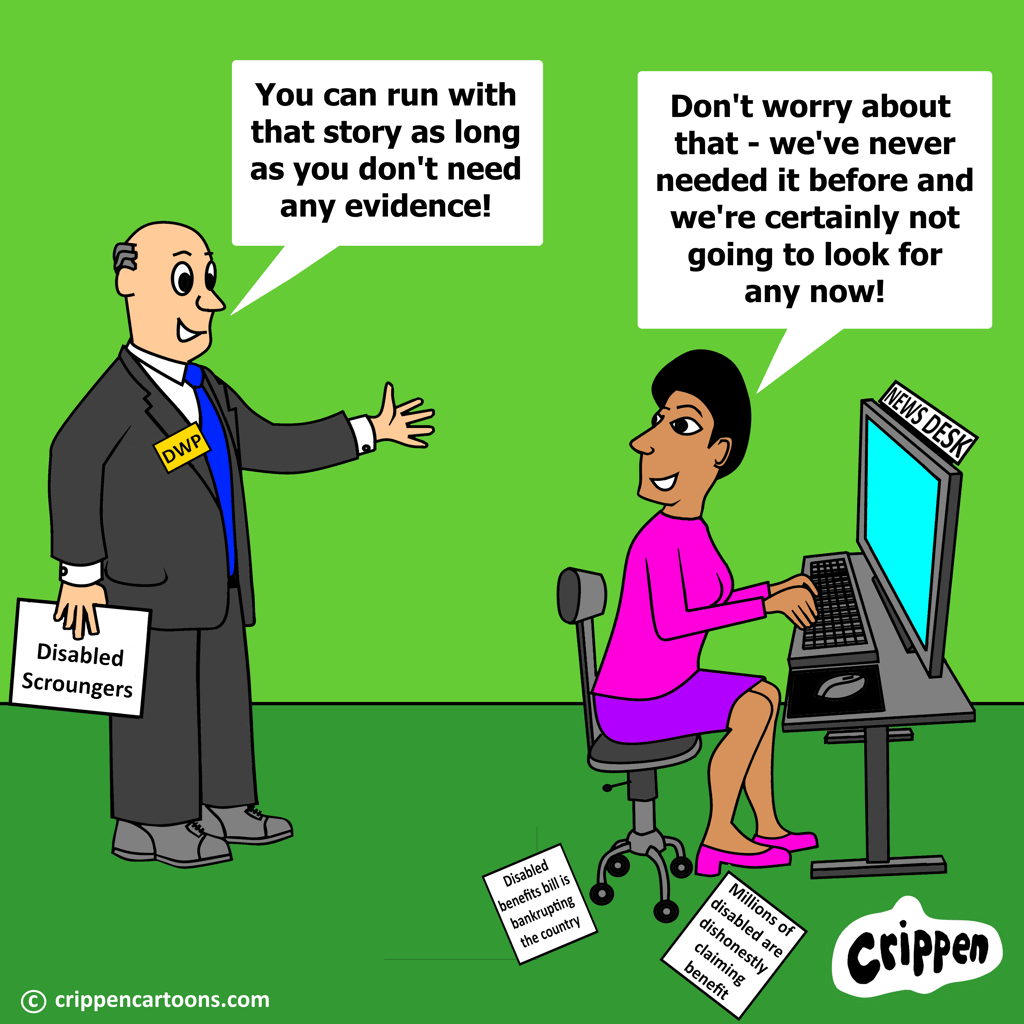
More unsubstantiated claims that “millions” of disabled people are falsely claiming benefits

Not content with pillorying disabled people in the House of Commons, it is claimed that the Labour government along with the Department for Work and Pensions (DWP) are continuing to encourage the press and television to portray us all as work shy scroungers.

John McArdle, co-founder of Black Triangle Campaign, claims that the DWP was “emphatically” behind the “false narrative” displayed in a string of recent newspaper articles and television programmes. He pointed out that the last 14 years had shown that this hostile rhetoric always increased before major disability benefit reforms were announced. And it’s no coincidence that this comes as the new Labour government prepares its own reforms of the disability benefits system, which are set to be published in a green paper in the spring. John added: “They are trying to say the benefits bill is bankrupting the country and it’s simply not the case.”

Damaging Articles

So, what are these damaging articles and programmes that disabled people are up in arms about? Well, if we take a look at the more recent examples, there’s an article in the Mirror newspaper this month by journalist Paul Routledge who describes that “millions” of disabled people are dishonestly claiming out-of-work benefits.

He writes that “millions of people who could, and should be in work, sign on for long-term sickness benefits”. He also claimed that mental health was “the ‘bad back’ of the 21st century” because it was “easy to self-diagnose, virtually impossible to disprove”. He provided no evidence for either of his claims.

Disabled journalist and author Rachel Charlton-Dailey said she was “sickened” by Routledge’s column. She said: “The media hostility towards disabled people has been an infuriating thing to try and combat … [but] I’m especially sickened by seasoned columnists using us as a punching bag when they should know better than to publish unsubstantiated lies about benefits claimants that can cause a lot of harm and add to the public’s distrust of us.”

Dr Natasha Hirst, the disabled president of the National Union of Journalists (NUJ), who has frequently spoken out about discriminatory reporting in the media, said: “There are a multitude of barriers that prevent disabled people from accessing the labour market. The impact of long Covid, and lack of timely health services, plays a significant role, as well as negative attitudes from employers and lack of accessible transport and housing”.

Damaging Programmes

Three days later a Channel 4 Dispatches documentary on disability benefits was aired. It claimed to expose the “scandal” of the disability benefits system that can “drive people towards benefits rather than work”, and that the costs of supporting disabled people who cannot work “threaten to derail the government’s hopes of economic growth”, and it asked the question: “Are we getting sicker? Or lazier?”

There were multiple concerns about accuracy and unevidenced claims in the Dispatches programme, while the radical working-class media organisation The Canary pointed out that the presenter Frazer Nelson – former editor of the right-wing magazine The Spectator –  had failed to state he was on the advisory board of the Centre for Social Justice (CSJ), the right-wing thinktank that devised Universal Credit.

The film for Channel 4’s Dispatches caused outrage among many disabled people who watched it. One user-led mental health group Recovery in the Bin (RiTB) described the new documentary, Britain’s Benefits Scandal, as an “atrocity”.

Rick Burgess, an RiTB spokesperson, said: “We see what this is, it is a cycle repeated endlessly of government working with media to ready the way for another round of DWP abuse. Shame on everyone involved.”

Read the full story about both the Mirror article and the CH4 documentary in Disability News Service (DNS). Both articles are written by disabled journalist John Pring who’s recently published book The Department is described as a thoroughly researched exposé of the bureaucratic violence and hostility of the Department for Work and Pensions (DWP) over the last 30 years.

Description of cartoon for those using screen reading software

A bald DWP manager in a grey suit is standing alongside a female journalist who is typing on a computer keyboard. Above the monitor a sign declares that this is the ‘News Desk’. The DWP manager is holding a piece of paper with ‘disabled scroungers’ printed upon it. Around the feet of the journalist are other pieces of paper with ‘disabled benefits bill is bankrupting the country’ and ‘millions of disabled are dishonestly claiming benefit’ printed upon them. The DWP manager is saying: “You can run with the story as long as you don’t need any evidence!”. The journalist replies: “Don’t worry about that – we’ve never needed it before and we’re certainly not going to look for any now!”

Crippen and the DWP’s terrible and inexcusable treatment of disabled people

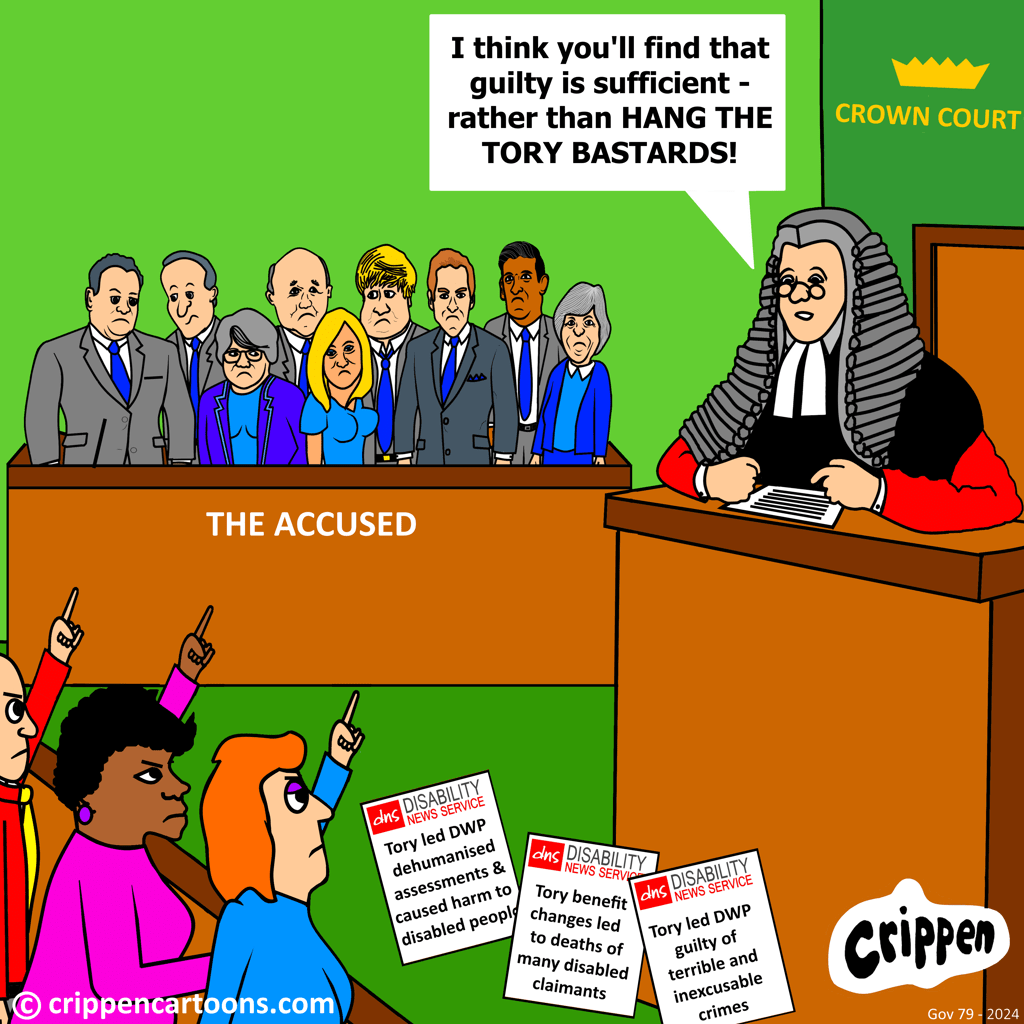
The way the Department for Work and Pensions (DWP) has treated disabled people in the last 15 years “will go down in history as a terrible and inexcusable crime”, MPs were told this week during a debate on the new government’s budget.

Independent MP Apsana Begum told fellow MP’s during a debate on the Labour government’s budget that there was “extensive evidence about the serious harm caused to people subjected to dehumanising assessments and sanctions, including reports of deaths (as highlighted in John Pring’s book ‘The Department’) directly related to the social security regime”.

She called for a “long-term overhaul of the social security system”, which she said was “not fit for purpose”.

Begum was not the only MP to refer to the impact of the last government’s welfare reforms on disabled people.

Labour’s Emily Darlington, MP for Milton Keynes Central, reminded MPs on Monday that under previous Conservative governments, disabled people had taken their own lives due to welfare reform.

She said that 14 years of “failure” had also led to “three million people using food banks, more than 700,000 children plunged into poverty, mortgage costs nearly doubled, the worst pay rises since the 1950s… mental health worse than at any time on record, more people sleeping rough and more families without their own home”.

She said the Conservative party continued “to deny, to justify and to refuse to apologise to those people right across the country and in my constituency”.

You can read the full story in the Disability News Service article by John Pring

Description of cartoon for those using screen reading software

The setting is the Crown Court with all of the Tory MP’s who have been associated with DWP benefit changes crammed into the dock. On the floor in front of the judge and the jury are copies of Disability News Service. They each bare a headline telling of Tory and DWP complicity in subjecting disabled claimants to dehuminising assessments, sometimes leading to their deaths. Members of the jury are pointing at the ‘the accused’ with angry expressions. The judge is saying to them: “I think you’ll find that guilty is sufficient – rather than HANG THE TORY BASTARDS!!

Crippen asks again “Fraud – What Fraud?!”

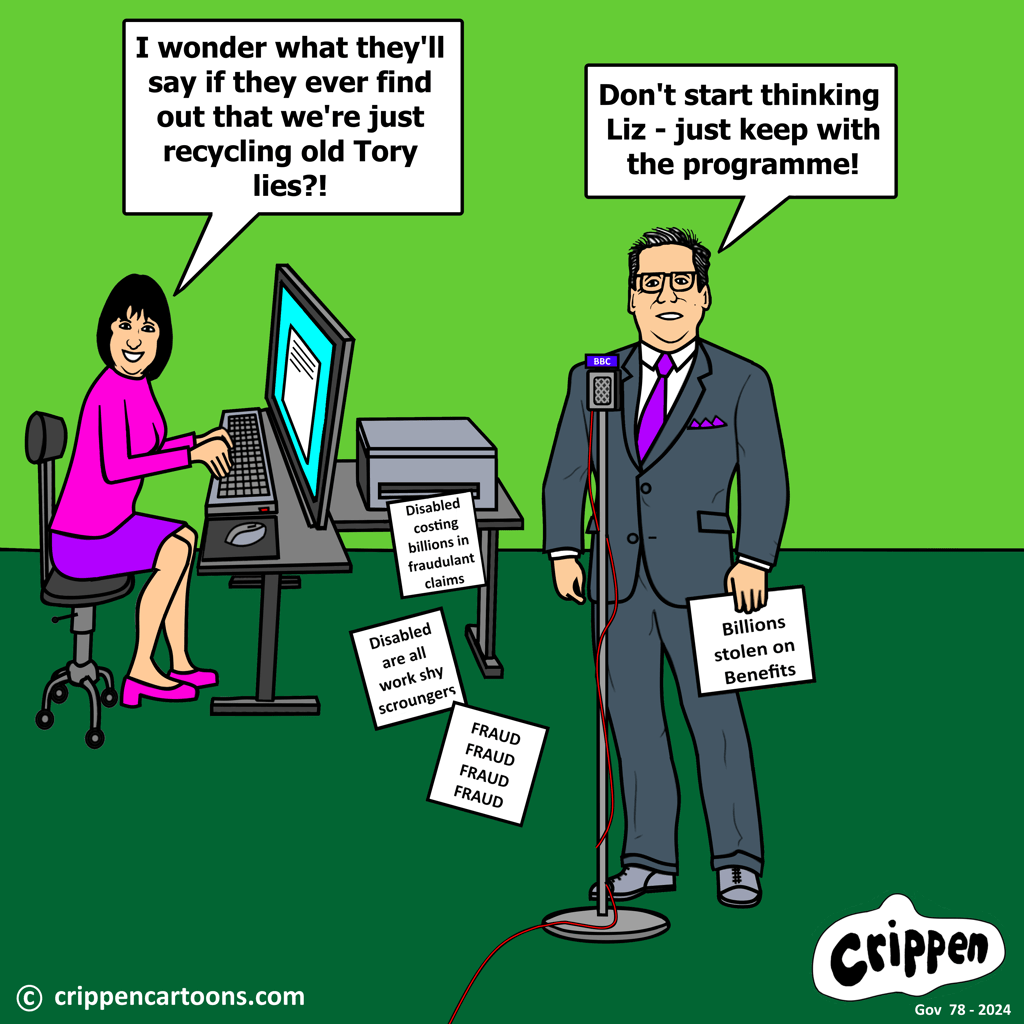
They’re at it again, claiming that billions of pounds are being lost to fraudulant benefit claims, which includes those by people on long term sick and those who are disabled.

Where they get these figures from is a real mystery as the last government’s own figures showed that benefit fraud was at its lowest ever at less than 3.5%, much of which could be attributed to DWP error.

And you’ll remember it was ex-PM Rishi Sunak who claimed that millions were being  fraudulantly claimed through Personal Independent Payments (PIP) at the same time that DWP figures, released just days before Rishi Sunak called a general election, showed that overpayment of PIP due to fraud had dropped to Zero per cent, a fall from 0.2 per cent the previous year. 

So, where are they getting this misleading information from? Or, are they just making it all up? But why?

Perhaps it’s something about finding a scapegoat for the shambles that exists called ‘government’ and the billions of pounds that are lost, mis-appropriated or mis-managed by initially the Tory party and then the Labour party. The two words ‘piss-up’ and ‘brewery’ come to mind!

Or is it, as has been recently announced by Labour, just an excuse to access the bank accounts of all those who claim benefits? Just another example of the carrot being replaced by the stick once again?

Description of cartoon for those using screen reading software

Keir Starmer is standing behind a BBC microphone holding in his hand a script with the words ‘Billions stolen on benefits’. Other pieces of paper are spewing out of a printer behind him with ‘Fraud, fraud, fraud’, ‘Disabled are all workshy scroungers’ and ‘disabled costing billions in fraudulant claims’. Sitting at a computer is Labour MP Liz Kendall who is saying: “I wonder what they’ll say if they ever find out that we’re just recycling old Tory lies?!”. Starmer replies: “Don’t start thinking Liz – just keep with the programme!”.

Crippen shares an article by Bob Williams Findlay

Written by Bob Williams-Findlay October 2024

“In this post, I want to cover a number of tensions and contradictions which I believe run through ‘disability politics’. As ever, I define disability politics as being the social and political action required to end the imposition of disablement and its prime agency, disablism. Together they create the conditions whereby disabled people are excluded from and/or marginalised within mainstream social activity. Hence our Movement argued that we are ‘disabled by society’. I share this slick mantra, but at the same time believe we need greater clarity.

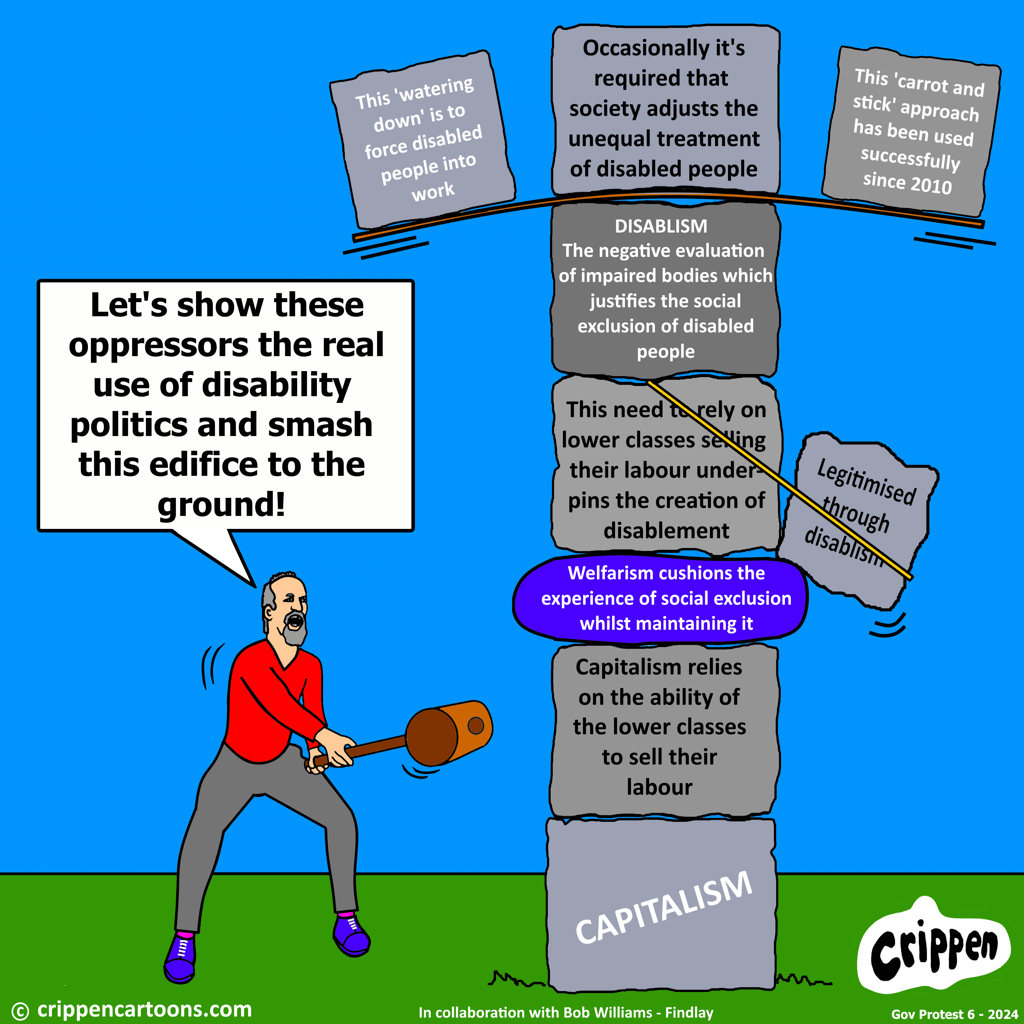
“I have previously argued that one of the biggest contradictions within early disability politics and more modern times is that disabled people want to be included in a society which actively excludes them. Capitalism is directly responsible for disablement, however, at differing points the needs of Capital requires society to adjust the unequal and differential treatment disabled people encounter. Here is another contradiction: welfarism cushioned the experience of social exclusion, on the one hand, whilst maintaining it on the other.

“It is understandable that disabled people have pushed for deinstitutionalisation and social inclusion; but to what extent is that feasible? Capitalist social relations rely heavily on the ability of the lower classes to sell their labour. Disabled Marxists tend to argue that this ‘need’ underpins the creation of disablement and the legitimising of it through disablism – the negative evaluation of impaired bodies which justified our social exclusion. Yet, as I have stated already, at times these evaluatons are watered down to encourage or force more groups of disabled people into the labour market. The neoliberal agenda since 2010 has adopted the carrot and stick approach.

“There is much to discuss about ‘work’, what it is, alongside exploring the various benefits and detriments involved. I can’t address these issues here. There is a view that ‘work’ means a degree of security, improved health for some and greater spending power. For me the issue is not about whether or not disabled people can/should work, but rather the impact of disablism on people who are of working age – how are they being both judged and treated.

“In the film, “When Barbara Met Alan”, one of the slogans heard was: ‘we want, what you got’. This raises many issues in my opinion and relates to what I call the ‘disability dialectic’. Disabled people cannot fit into the status quo; if we could, then we would not be ‘disabled by society’. So we fight to ‘transform’ society which means going up against the interests of Capital. We have always fought for ‘betterment’; making our lives better, but only through overthrowing the status quo will it be possible to build an inclusive society.

“So the last contradiction I want to pose is: what does ‘nothing about us, without us’ actually mean in the context of opposing discrimination and oppression? Some want a seat at Liz Kendall’s Taskforce table; to do what exactly? Disabled people were not included in the agenda setting; it is highly unlikely that agenda will address institutional disablism in the labour market. When Rachel Hurst and I promoted political coproduction [the meaning of NAU,WU] it was not only agitational, it was underpinned by the demand for a shift in power relations. As a Trotskyist, I view ‘nothing about us, without us’ as a transitional demand because it challenges the existing oppressive relationships we are subjected to.

“I am not conviced the current disability politics practiced by today’s activists adequately address the structural nature of disablement when they go cap-in-hand demanding “Rights”. Rights are meaningless without the power to enforce them.

“The reason I co-founded DPAC was the unquestionable belief that we, disabled people, had to build a new social movement, foster a sense of community, and build alliances with allies. Over the last 15 years we have not made serious inroads because disability politics have lost their radical vision. Equally does not mean ‘sameness’; it is about people’s lives having ‘equal value’ and capitalism can never deliver that.”

Description of cartoon for those using screen reading software

A caricature of Bob Williams-Findlay stands alongs side a large stone edifice wielding a large sledge hammer. The edifice comprises of large stone blocks, each block representing the points he has made in the accompanying article about oppression by capitalism. Bob is saying: “Let’s show these oppressors the real use of disability politics and smash this edifice to the ground!”

Crippen hears how Mo Stewart informs the new Advisory Board

Remember how Labour decided to ignore disabled people when it sent out invitations for people to join their new Labour Market Advisory Board?

Well, our good friend disabled researcher Mo Stewart has now been invited to provide information to the Advisory Board regarding the identified public health crisis and preventable harm created by UK social policy primary legislation. Certainly a step in the right direction eh?!

The sort of information that Mo will be providing is well documented, mostly from her own work as research lead of the preventable harm project and from her many publications including ‘The public health crisis created by UK social policy reforms’.

Mo addresses her concerns to Professor Paul Gregg, Chair of the new Advisory Board and also Professor of Economic and Social Policy in the Dept of Social and Policy Sciences, University of Bath. She has kindly shared these concerns with me, which, with her permission I will now share with you.

Mo notes that the Advisory Board boasts significant members but no disabled member, and certainly no one with any expertise regarding the identified government induced public health crisis now ongoing in the UK. This crisis is negatively impacting on the health, wellbeing and survival of many of the chronically ill and disabled community who are unable to work.

It is also linked to a disturbing number of suicides of some of those in greatest need following relentless intimidation by the Department for Work and Pensions (DWP) when adopting the politics of fear using the fatally flawed Work Capability Assessment (WCA) to restrict disability benefit access. This was also identified by Professor Jonathan Portes as ‘one of the biggest social policy failures in the past 20-30 years.’

She also notes that Liz Kendall, the Secretary of State for Work and Pensions for the Labour administration, has invited the involvement of the new Advisory Board when working towards her planned White Paper. However, her comments since taking office demonstrates the same disturbing commentary as the previous Conservative administration regarding the numbers of people who claim disability benefits. This continuing demonisation of chronically ill and disabled people who are not in paid employment, is based on fake news and right-leaning ideology.

Mo tells Professor Gregg that, whilst she fully comprehends that he has a job to do, he should also consider that there has never been any evidence of vast numbers of fake disability benefit claims. That the hostile political rhetoric attacking disability benefit claimants adopted since 2010 by the various governments has worked well, as indicated by the rise in prosecuted disability hate crimes which climbed by 213% during the Coalition government‘s term in office (2010-15). All this of course aided by the tabloid press.

Mo concludes by reminding Professor Gregg that we are living in very dark and dangerous times since the adoption of neoliberal politics in the UK. This, coupled with the influence of corporate America with UK social policy reforms since 1992, and the adoption of social policies introduced using a fiscal priority whilst disregarding the health, wellbeing and survival of those in greatest need, has guaranteed that many people would be ‘killed by the state’ with no-one held to account.

Further, there is a disturbing history of preventable harm against those in greatest need created by successive UK neoliberal administrations and identified by a multitude of academics from a variety of universities, which is detailed in published evidence routinely disregarded by the DWP.

Well, that should give Professor Gregg and his colleagues on the Advisory Board food for thought. … Let’s see what they do with it?

NB: What’s also worrying is that years later, Sir Iain Duncan Smith, the former Secretary of State for Work and Pensions for the Coalition administration is still attacking the disabled community ‘languishing on benefit’ in his column in the Telegraph, without providing any evidence. It would appear that this man has a habit of using false statistics to gain attention to his hostile rhetoric and has even been challenged by the UK Statistics Authority who identified his many claims advising that they were ‘unsupported by the official statistics’. It’s also worrying that he now appears to be an advisor to the Labour government.

Description of cartoon for those using screen reading software

Professor Paul Gregg, Chair of the new Labour Market Advisory Board is sat at a large table. He is wearing informal clothing and is holding a document that says ‘Preventable harm project’ whilst on the table in front of him are other documents reading ‘Killed by the state’ and ‘High rate of suicide’. Alongside of him are a suited man and a woman and also Iain Duncan Smith (IDS) who is wearing an ID badge with ‘DWP Advisor’ printed upon it. Gregg is asking: “So is someone going to tell me who this Mo Stewart is?!”. The man and the woman are both saying; “Er …” whilst IDS is thinking: “Oh shit!”

Crippen asks “Fraud – What Fraud?!

You may remember back in April of this year I ran a blog article about the DWP hiring more covert surveillance officers to track down disabled people who were fraudulently claiming benefits. At the time the government’s own figures showed that benefit fraud was at its lowest ever at less than 3.5%, much of which could be attributed to DWP error.

Well, having got rid of the Tory’s, we now have a labour government that has decided to continue with the harmful rhetoric that the DWP continue to pump out to a gullible public through the national press. But how did this attack against disabled people start, especially those claiming benefits because they cannot find accessible employment?

You’ll remember the Coalition administration elected in 2010? Well, it was this administration that started to change the public’s perception of disabled people. They vehemently challenged the integrity of the chronically ill and disabled community and routinely accused disability benefit claimants of fraud while failing to produce evidence to support their claims. Their often hostile rhetoric encouraged a 213 percent increase in prosecuted disability hate crimes, with successive administrations disregarded the thousands of deaths directly linked to the Work Capability Assessment (WCA).

And what with recent stats from the Home Office revealing that disability hate crime has risen by 43%. It doesn’t take much of a leap to connect this to the vitriol being pumped out by the DWP.

If you’ve read Mo Stewart’s book you’ll know how the WCA “ … was adopted using a discredited and dangerous biopsychosocial model of assessment to restrict access to long-term disability benefit. Influenced by corporate America since 1992, the UK social policy reforms guaranteed that many of those in greatest need were destined to die when, covertly, killed by the State.”

Sounds a bit dramatic, doesn’t it? “Killed by the state”. But this has exactly what has been happening since Margaret Thatcher started her devotion to neoliberal politics, which is the ideology that supports free market competition with an emphasis on minimal State intervention, would eventually be identified as being at ‘the root of all our problems’ (Monbiot, 2016).

Thatcher’s well-documented insistence that the welfare state was an unacceptable financial burden on the public purse, opened the door to the influence of corporate America with UK social policy reforms and the ‘planned demolition of the UK welfare state’ (Stewart, 2016).

Incidentally, every 30 years confidential Cabinet Papers from past UK governments are released into the public domain. In 2012, the 1982 Cabinet Papers from the first Thatcher administration (1979–83) were released, offering evidence demonstrating the political expectation to eventually demolish the UK welfare state, including the National Health Service (NHS).

It’s all there folks, you just have to dig for it as John Pring, disabled Editor of Disability News Service (DNS) and Mo Stewart, disabled researcher and lead on the Preventable Harm project, have done. Mo writes:

“Thatcher’s social policy right-leaning neoliberal legacy has been continued by every successive administration. This included introducing American corporate influence for the development of UK social policy reforms by the Major administration (1990–97) (Stewart, 2018); the adoption of American social and labour market policies by the Blair administration (1997–2007) (Daguerre, 2004Daguerre and Taylor-Gooby, 2004); the adoption of the Work Capability Assessment in 2008 to limit access to the new Employment and Support Allowance (ESA) disability benefit by the Brown administration (2007–10) (Gentleman, 2011); and the increased use of sanctions, which removed all income to successfully intimidate disability benefit claimants, and to starve some of them to death (Pring, 2020a), by the Cameron-Clegg Coalition administration (2010–15).”

In the Independent Living review of John Pring’s book they comment that: “As demonstrated in the ‘Department’, a disturbing number of chronically ill disability benefit claimants committed suicide, linked in no small measure to persecution by the DWP, and to the fear instilled by the relentless threat of sanctions that meant the total loss of their only income which guaranteed destitution.”

Description of cartoon for those people using screen reading software

The PM Keir Starmer and a Civil Servant are standing each side of a large Labour Part Press Release statement hung on the wall. It reads ‘Disabled benefits claimants are all work-shy scroungers with most of them fiddling the system and taking your hard earned money!’ On a table in front of them are four other cards. One reads: ‘Benefit fraud at its lowest rate ever’, another reads: ‘PIP fraud at zero!’, the third one reads ‘Disability hate crime up 43%’, and the final card reads: ‘DWP ignores research re 600 suicides linked to WCA’. The civil servant is asking the PM: “But Sir – what about the facts?!” whilst pointing at the cards upon the table. Starmer replies: “Facts – when have they ever played a part in politics?!”

Crippen hears that Labour has sidelined disabled people from DWP ‘inactivity’ board

Remember when Labour’s general election manifesto stated that it was “committed to championing the rights of disabled people and to the principle of working with them, so that their views and voices will be at the heart of all we do”.

Well, you’ll be forgiven for thinking that another party won the election because everything that they claimed to do on our behalf seems to have gone right out of the window!

As reported in Disability News Service (DNS), Disabled Rights activists have criticised the Labour government’s “hugely disappointing” and “exclusionary” decision to set up a board of experts to examine “economic inactivity” without appointing a single representative of a disabled people’s organisation.

Work and pensions secretary Liz Kendall appears to have failed to appoint any disabled experts to the Labour Market Advisory Board, even though she made it clear that its key aim was tackling the “spiralling inactivity” caused by a record number of people out of work due to long-term sickness.

But the eight members of the board, labour market experts from across business, industrial relations and academia, do not appear to include any disabled experts and certainly do not include representatives of any disabled people’s organisations (DPOs).

Disabled researcher Stef Benstead, author of Second Class Citizens, which describes the harm caused to disabled people by a decade of cuts and reforms, said: “It should not be thinkable for any modern government department to have an advisory board that does not include representatives of the community impacted by the policy proposals.”

Dan White, policy and campaigns officer for Disability Rights UK, said it was “hugely disappointing that not one disabled people’s organisation or disabled people’s expert representative” was on the board, despite Labour’s past commitments to involving disabled people in developing policy. Would any other group be left out of an expert board that is focused on their future?”

Inclusion London said it was “extremely concerned” that disabled people were “once again missing from an important forum where programmes targeting us will be shaped” with their senior policy and campaigns manager Julia Modern adding that:

“Under the UN Convention on the Rights of Persons with Disabilities, the government is obliged to consult with disabled people”.

You can read the full article in DNS.

Description of cartoon for those using screen reading software

Labour politicians Starmer, Reeves and Kendall are attending the Labour Party Conference 2024. Reeves is holding a card that reads ‘Disabled are scroungers’. Starmer’s card reads ‘Recycled Tory Speeches’ whilst Kendall’s card reads ‘DWP work not welfare’. Two disabled activists representing GMCDP and DPAC are in front of them looking angry. One is holding a card that reads ‘UN Convention – Government is obliged to consult with disabled’ whilst the other one is saying: “So not only DON’T they consult with us – they’re also peddling the same Tory lies about us!”