People call me an old cynic when it comes to having any trust in this government to do what’s best for disabled people.
In the past when we were locked away in residential homes and the only way that the general public knew of our existence was when a ‘special’ bus, carrying disabled people to a sheltered workshop was stopped at the traffic lights, we weren’t really a problem. Out of sight, out of mind was the acceptable status quo.
However, ever since we decided that enough was enough and that ‘rights not charity’ would be our rallying cry, we’ve been a thorn in the governments side. In fact, the only real way that they could re-establish control over us was to introduce draconian measures through the benefits system. And it’s mainly been the distrust based around the workings of the Department of Works and Pensions (DWP) that has brought us to the place we now find ourselves in.
Add to this the encouragement given to doctors and health care professionals to push the ‘do not resuscitate’ mantra and recommending that vital life-saving equipment is only to be given to those most likely to recover, has added to the suspicion that the Tory government are jumping on this opportunity to rid society of its useless eaters and scroungers.
So, do I trust the government to do what’s best for the disabled community? What do you think!
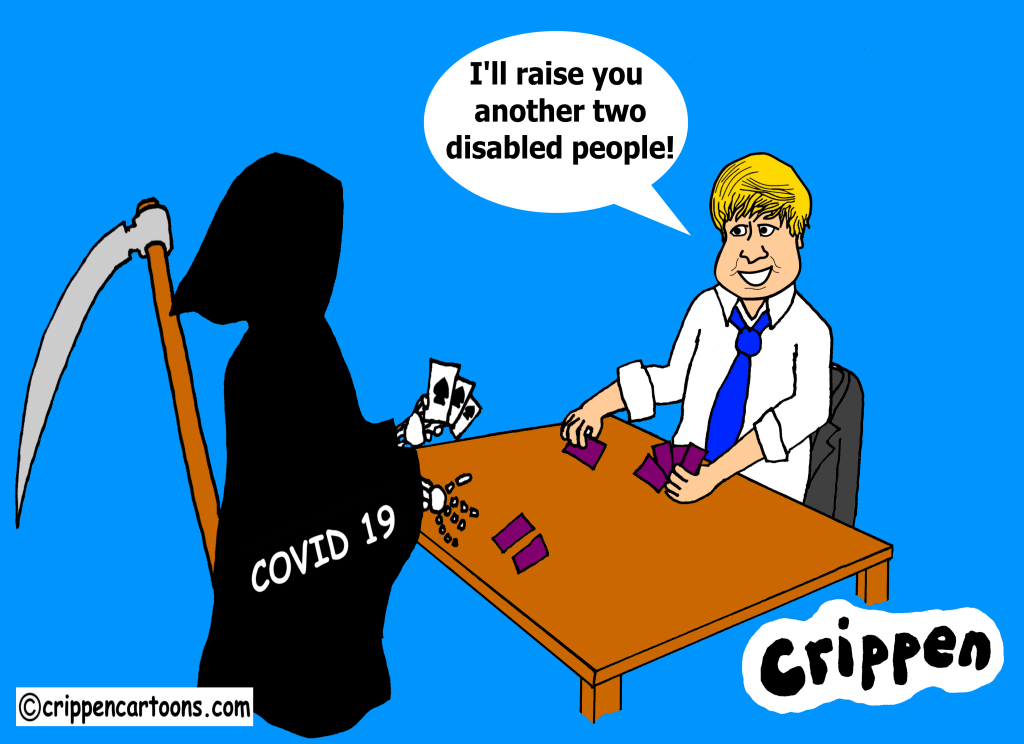
Description of cartoon for those people using screen reading software
Boris Johnson is playing cards with the Grim Reaper who has ‘Covid 19’ printed on its side. Boris is saying: “I’ll raise you another two disabled people!”
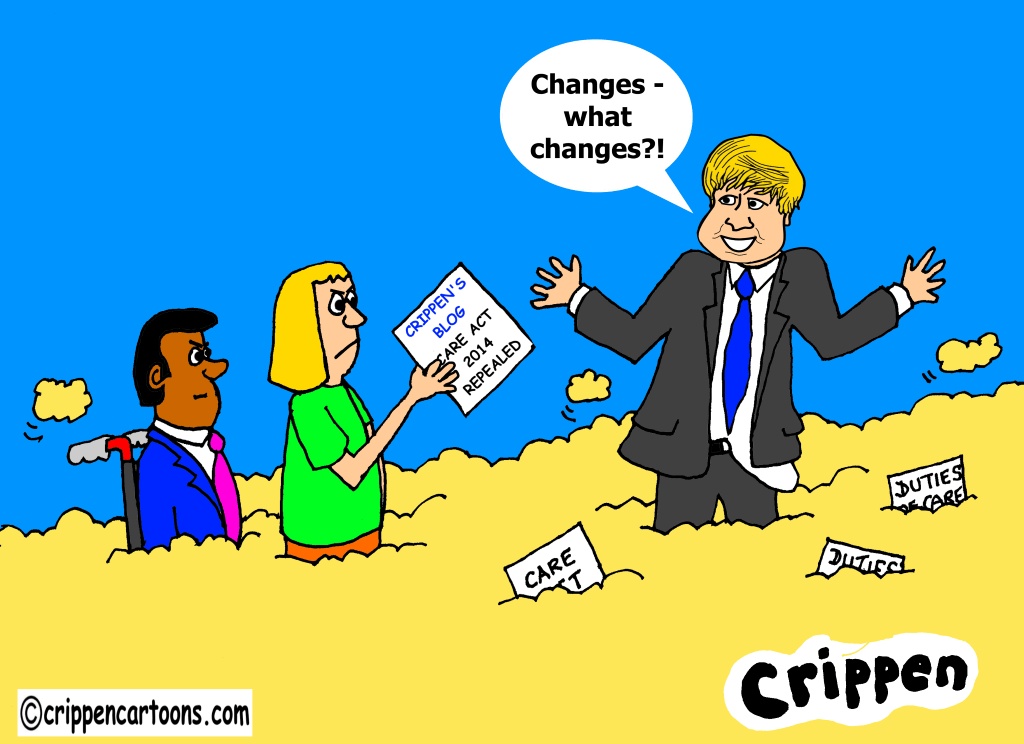
There’s an expression called ‘the fog of war’. This is where the smaller, but vital issues are missed or forgotten, overwhelmed by the larger picture.
In our case, Boris Johnson is relying on the fact that the confusion of the Coronavirus is taking our attention away from changes he is making to the legislation that impacts on our life. It’s an old tried and tested means of getting through the sort of changes that would in ‘normal’ times bring unwelcomed challenges from the opposition parties. The Coronavirus Bill having the same subtlety as the Patriots Act that the American government have used to bludgeon aside many human rights laws.
Talk to most people and they remain blissfully unaware that the Coronavirus Bill has enabled Boris to do away with a large part of the Care Act 2014, suspending every duty to meet the needs of disabled people (section 18) and carers (section 20).
As mentioned in a previous Crippen Blog, under the Corona Virus Bill, Local Authorities will only have to provide care ‘if they consider it necessary’ for the purposes of avoiding a breach of the European Convention of Human Rights (ECHR).
There is also the proposed abolition of the European Convention on Human Rights (ECHR) following Brexit which Boris still has tucked up his sleeve. And let’s not forget his commitment to cut funding for resourcing learning disability and autism services as outlined in the Conservative Manifesto.
It’s therefore up to us as disabled people to focus the attention of our MPs on these life-threatening changes. As individuals and as part of a user led group or organisation, we need to keep the pressure up by emailing or writing about our concerns.
There are a lot of Crips out there who are willing to share their skills and experience. In fact, if you leave a comment at the end of this blog stating that you wish to join the fight, along with your email address, I’ll get you in touch with your nearest disabled activist or group.
Together we can clear away this fog!
Description of cartoon for those people using screen reading software
Boris Johnson is standing thigh deep in a yellow fog. Standing with him are two disabled people one of whom is holding up a piece of paper that reads ‘Crippen’s Blog Care Act 2014 repealed’. In the fog are the tips of papers reading ‘duties of …’ Boris is saying: “Changes – what changes?!”
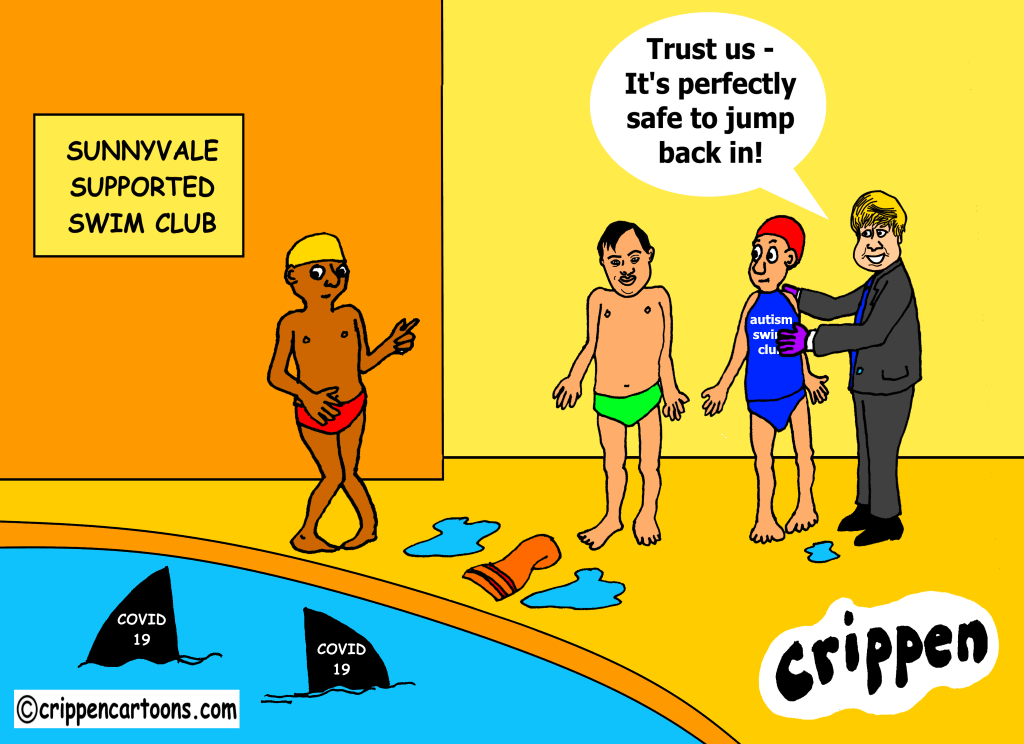
We seem to have a Catch-22 situation regarding autistic and learning- disabled people who, due to a successful legal challenge about the lock-down and social distancing rules, can now apparently ignore them.
Covid 19 rules breached @ crippencartoons.com
It came about when some carers involved with autistic and learning- disabled people successfully challenged the government about the lock-down and social distancing rules. They claimed that the rules were discriminatory and that one of the children they represented, whose conditions mean it was necessary for them to leave the house more than once a day for their wellbeing, was being discriminated against.
Their lawyers argued that the ‘inflexible policy’, which also says people should stay two metres apart from anyone outside of their household, disproportionately impacted those with certain health conditions and was ‘therefore unlawful and discriminatory’.
I can understand that some people who fall into this category would find it difficult to have their routines disrupted and those who rely on close, personal contact in order to feel safe and supported would feel isolated and alone. But doesn’t the protection against this deadly disease takes priority?
And surely this new ruling can only work if the systems to ensure they were properly shielded from the virus were in place already. They’re not. We hear that support workers don’t have Personal Protection Equipment (PPE) and that doctors are effectively saying learning disabled people come lower down the life-saving pecking order by placing ‘Do Not Resuscitate (DNR)’ notices above their beds. It can be safely said that the response from this government to coronavirus for learning disabled people has been a complete and utter shamble.
“In an ideal world, PPE would be readily available, maximum testing and tracing would be done and other measures would be in place to limit the spread of coronavirus. This would mean the relaxing of the social isolation rules for learning disabled people would be a measured response. But in Tory Britain, where the response to the pandemic has been wilfully neglectful, it could sadly prove deadly.”
Description of cartoon for those people using screen reading software
The scene is a swimming pool identified as the ‘Sunnyvale Supported Swimming Club’. Around the pool are several people wearing swim wear who are looking apprehensively at the water. One of the people has downs syndrome and another has ‘Autism Swim Club’ on their swim suite. In the pool are two large shark fins with COVID-19 printed on them. Boris Johnson, wearing purple disposable gloves, has his arm around one person and is saying to them: “Trust us – It’s perfectly safe to jump back in!”
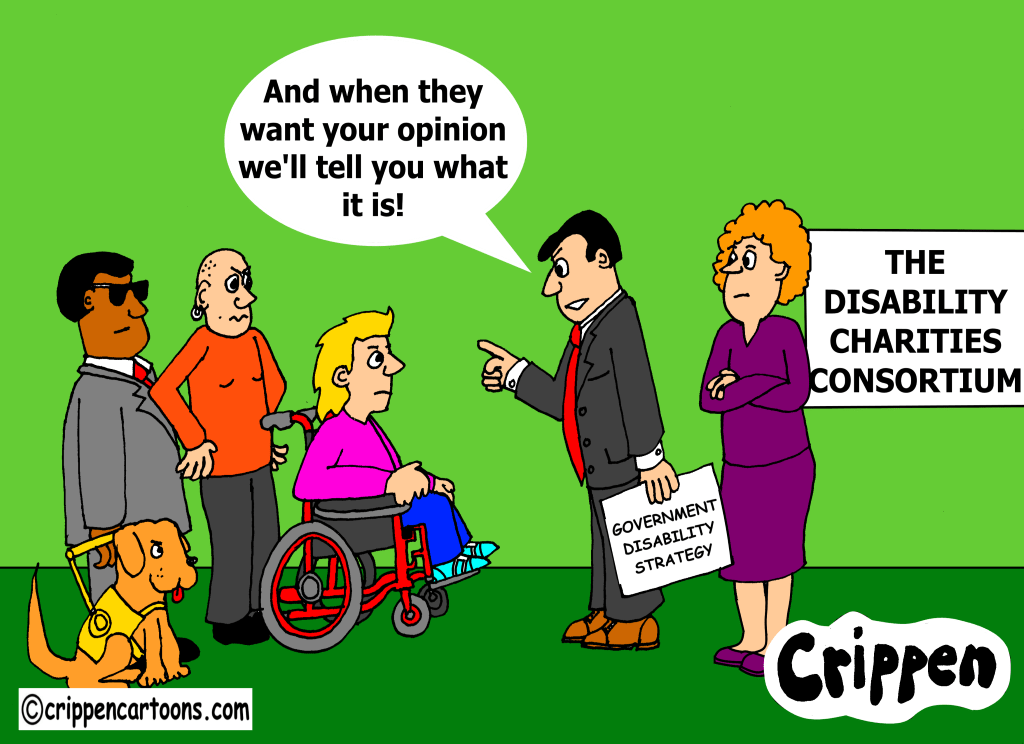
It’s well documented that this government consistently fails to involve disabled people when planning its disability strategies. It will argue that it does, although this is usually with those organisations that are not user-led or with those individual tame Crips who are only in it for themselves.
So, when we hear thatthe government’s new Disability Unit has announced that it was engaging with disabled people on developing its National Strategy for Disabled People, why are we not surprised when they announced that it had been holding meetings with the 10 disability charities that make up the Disability Charities Consortium (DCC).
The DCC is almost entirely made up of non-user-led charities including Mencap, the National Autistic Society, Mind, Leonard Cheshire, Scope, Action on Hearing Loss, RNIB, Sense, and the Business Disability Forum.
So, it’s the same old, same old … no change there then!
We shouldn’t need to remind the government that they signed up to the UN Convention on the Rights of Persons with Disabilities (UNCRPD)*
and agreed that they would only engage with Disabled People’s Organisations (DPOs) when planning anything relating to disabled people. Indeed, the UN stated: “We don’t think that the disability charities and members of the DCC … are either representative or can speak on behalf of disabled people.”
On second thoughts, perhaps we do need to remind them!
*The UNCRPD makes it clear when developing laws and policies relating to disabled people, governments “must closely consult with and actively involve persons with disabilities, including children with disabilities, through their representative organizations”.It defines “representative organizations” as those that are “led, directed and governed by persons with disabilities”, a definition which the UN committee on the rights of persons with disabilities included in general comment number seven.
Description of cartoon for those people using screen reading software
A small group of disabled people with diverse ethnic and impairment issues are facing two suited figures representing the Disability Charities Consortium. One of the consortium representatives is holding a document that reads ‘government disability strategy’. He is saying to the disabled people: “And when they want your opinion, we’ll tell you what it is!”
More and more the language around the coronavirus pandemic is being framed around the ethos of ‘survival of the fittest’.
fittest @ crippencartoons.com
“Most people recover and it’s only the chronically sick and disabled that are more likely to die” says the media dismissively. It’s a sentiment that I’ve heard constantly over the past few weeks, as though it’s an acceptable outcome; our lives aren’t as valuable as everyone else’s.
In a culture where prejudice against disabled people is rife, this dismissal of our rights to equal treatment due to the lack of available equipment, is compounding the belief that we are worthless and not viable members of society.
“If the wider public is complacent about the virus harming disabled and older people, they’re less likely to be vigilant of their responsibility to help contain it, through simple measures such as regular handwashing. This goes for the medical profession, too. Early reports warned that the “weakest NHS patients” could be denied lifesaving support if ventilators need to be rationed in the event of a severe coronavirus outbreak.”
Meanwhile, a leading former nurse, Professor June Edwards has stated a coronavirus pandemic “Would be quite useful” in clearing “bed-blockers”, because (some) people “would be taken out of the system” (she later said her comments were “ironic”).
What next. We must all wear some form of marker to identify whether we’re viable members of society?
Hmmm, wonder where that idea came from?!
Description of cartoon for those people using screen reading software
A group of disabled people of mixed ethnicity and impairment have all been given large stars to wear on their front. A piece of paper at their feet reads ‘lack of equipment to treat Covid 19’. A white woman in a blue suit is handing out the stars and is saying: “It’s just to indicate that you’re special when it comes to deciding what treatment we provide for you!” Behind her back she is holding a piece of paper with a star on it and the words ‘identifies bed blockers’.
What the Covid-19 pandemic has done, whether those in power wish to acknowledge it or not, is that it has laid bare the terrible conditions that many support workers and personal assistants must endure.
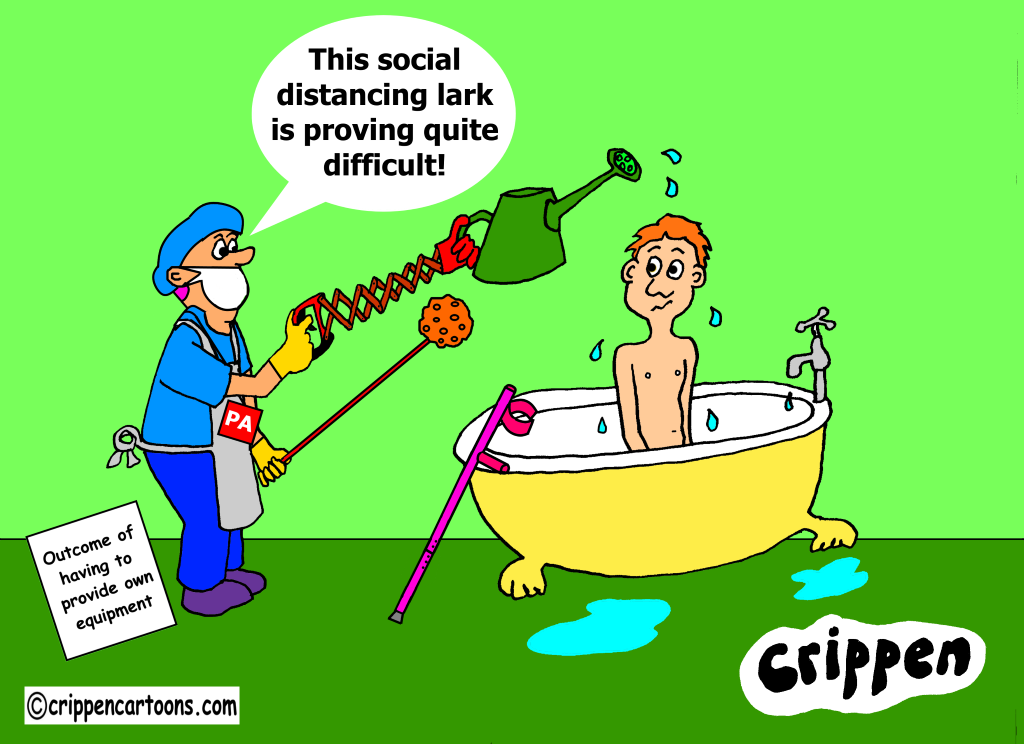
social distancing @ crippencartoons.com
It may appear strange to raise the issue of the working conditions of support workers and personal assistants at a moment when so many Disabled people are so troubled by what is happening and how it might impact upon them from a variety of perspectives, but we believe they are deeply interrelated.
Over the last decade or so Disabled people’s ability to exercise self-determination has been undermined by the closure of the Independent Living Fund, privatisation and marketisation of so called, ‘Social Care’, and the tightening criteria for support. Now is not the time or place to unpack all these issues however taken altogether they do help shape the current situation we find ourselves in.
Both the crisis within Social Care provision and the present dangers around the Covid-19 pandemic have combined to place Disabled people, support workers and personal assistants in vulnerable situations. For many Disabled people their very survival, let alone independence, is dependent upon the assistance available to them and over the last few weeks this has been put at risk by the government’s incompetence and woeful inaction.
At this moment in time our concern and solidarity must be given to Disabled people of all ages, support workers and personal assistants irrespective of whether or not they are living or working in the community or within local authority or private facilities.
Support workers often work in close proximity to Disabled people and therefore the guidelines around social distancing are generally pretty meaningless. Disabled people are at higher risk of contracting coronavirus because of “barriers accessing preventive information and hygiene, reliance on physical contact with the environment or support persons, as well as respiratory conditions caused by certain impairments”, according to the International Disability Alliance (IDA). Oliver Lewis wrote:
“By ‘institutional settings’ I include psychiatric hospitals, social care homes, elderly person’s homes, group homes and prisons. People with disabilities are particularly vulnerable to infection in these facilities given the risk of contamination of many people living together in a congregated way.”
The evidence over the last few weeks has clearly shown that our government has failed to plan or taken appropriate measures to protect people. It was only under pressure that guidelines for care homes were belatedly released; this is only the tip of a scandalous iceberg, however. Two major areas of concern persist for frontline workers – the lack of testing for the Coronavirus and the issuing of personal protection equipment (PPE). People are outraged that there is a lack of testing and issuing of PPE for NHS staff, but support workers and personal assistants are also frontline staff.
There should be an outcry that support workers and personal assistants are being expected to work with hands tied behind their backs. As Lewis points out in his article, if the Coronavirus enters an institution it can run riot. What is also evident is that Disabled people at this present time are unlikely to be admitted to hospital unless it is deemed absolutely necessary; under these conditions support workers and personal assistants will be implicitly expected to offer ‘care’ without the necessary training or support.
Then there are the implications of the Coronavirus itself. Staff shortages and the lack of resources has been a common feature in many places over the last decade, but the Coronavirus has compounded this further. Staff are being pressured to work longer hours and do overtime; this includes foregoing rest days. If staff members are overworked, then health and safety issues are brought into play not just for them and those they support, but also their families.
Most support workers and personal assistants are low paid women workers and therefore the lockdown has asserted additional pressures on them. The well-being of support workers and personal assistants should be understood as being integral to our own. We should take their concerns onboard and look at ways of raising them alongside developing acts of solidarity.
These are frightening times and it’s too easy for people to get divided. There are three hashtags we believe Disabled people should be promoting right now:
#They Care, So Should We
#No One Expendable
#Valued Workers Deserve Better
Sandra Daniels and Bob Williams-Findlay
Description of cartoon for those using screen reading software
A naked young man is sitting in a bath. A crutch is leaning up against it and pools of water cover the floor. Standing to one side is a support worker wearing rubber gloves, an apron and a face mask. The PA is holding an extending arm with a watering can on the end, hanging over the bath. Water is dripping from the can. In the PA’s other hand is a long stick with a sponge on it. At their feet is a piece of paper with ‘Outcome of having to provide own equipment’. The PA is saying: “This social distancing lark is proving quite difficult!”
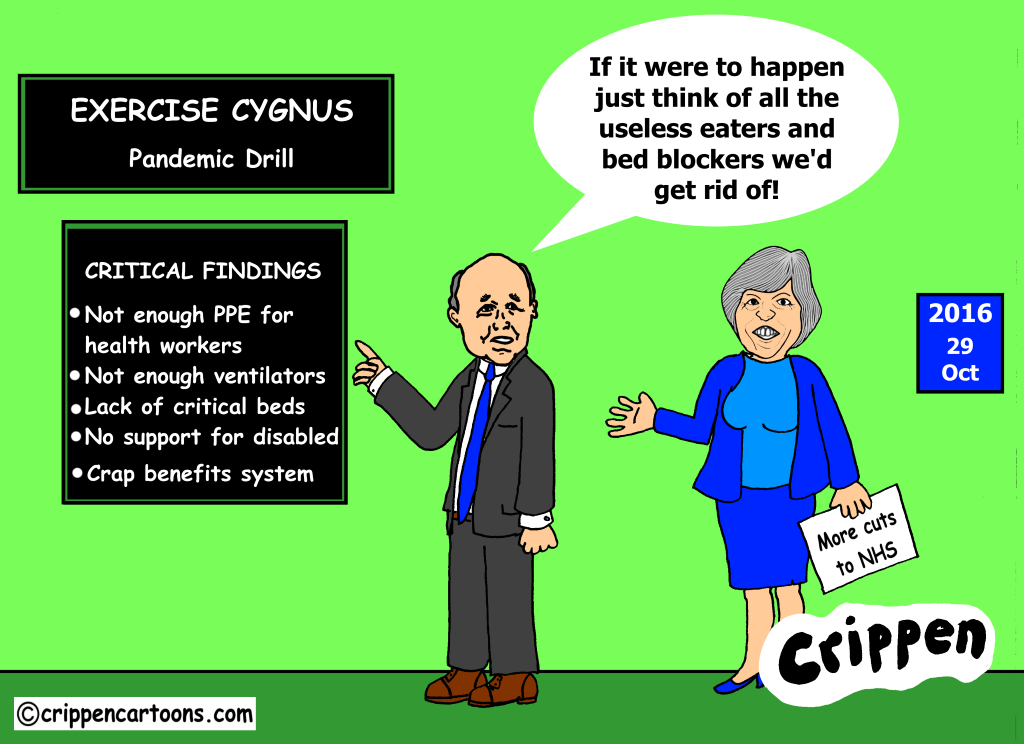
They found that there was not enough personal protective equipment (PPE) for the nation’s doctors and nurses. The NHS was about to “fall over” due to a shortage of ventilators and critical care beds and morgues were set to overflow. They would also be made aware that they would need to build in additional support for disabled people, older people and those with underlying health issues.
The only significant difference between the test drill and the pandemic we now face is that Cygnus was assumed to be the H2N2 influenza virus, while Covid-19 is a coronavirus. Both spread rapidly and kill by causing acute respiratory illness.
There is one other difference. While the real Covid-19 epidemic is being played out in public, the report detailing the findings of Exercise Cygnus have never seen the light of day. A senior former government source with direct involvement in the exercise said they were deemed “too terrifying” to be revealed.
Others are more critical. A senior academic directly involved in Cygnus and the current pandemic said: “These exercises are supposed to prepare government for something like this – but it appears they were aware of the problem but didn’t do much about it.
Description of cartoon for those people using screen reading software
The setting is an office used for Exercise Cygnus on 29th October 2016. Iain Duncan Smith (IDS) MP and Prime Minister Theresa May are stood in front of a large black board. On the board is written ‘Exercise Cygnus – pandemic drill critical findings’. There is also a list which reads ‘not enough PPE for health workers, not enough ventilators, lack of critical beds, no support for disabled and crap benefit system’. Theresa May is holding a piece of paper with ‘more cuts to NHS’ printed on it. IDS is saying to her: “If it were to happen just think of all the useless eaters and bed blockers we’d get rid of!”
UNIVERSAL Credit claimants could face online queues of more than 30,000 people when attempting to make a claim during the coronavirus crisis.
IDS – UC designer @ crippencartoons.com
Thousands of ‘ordinary’ people (sic) are suddenly being confronted with the issues that disabled people have been faced with ever since Iain Duncan Smith, former head of the Department of Works and Pensions (DWP) took a sledge-hammer to the benefits system. This left many of us struggling to make ends meet, with some deciding that the only solution was to end our lives.
Speaking to Chancellor Rishi Sunak in the Commons on Tuesday, Mr Esterson said: “When I mentioned that the Universal Credit system was overwhelmed, the minister may not have quite taken on board the point I was raising.
“A self-employed worker sent me a screenshot of their attempts to use it just yesterday. There were 33,383 people ahead of them in the queue to use the claim section of the website.
Welcome to the real world of disabled people folks. Now you know what we’ve been complaining about for the past several years!
DDescription of cartoon for those people using screen reading software
Iain Duncan Smith is seen standing with his arms held open wide with a questioning look on his face. At his feet are two newspapers with headlines that read ‘benefit system overwhelmed’ and ‘virus closes places of work’. He is saying: “But I deliberately designed Universal credit to cull the disabled – how was I to know that ordinary people would end up needing it?!”
I’m sure we all wish Boris a speedy recovery, but there must be quite a few of us who are pleased that the government’s lack of preparedness has come around to bite him in the proverbial. Karma I think it’s called!
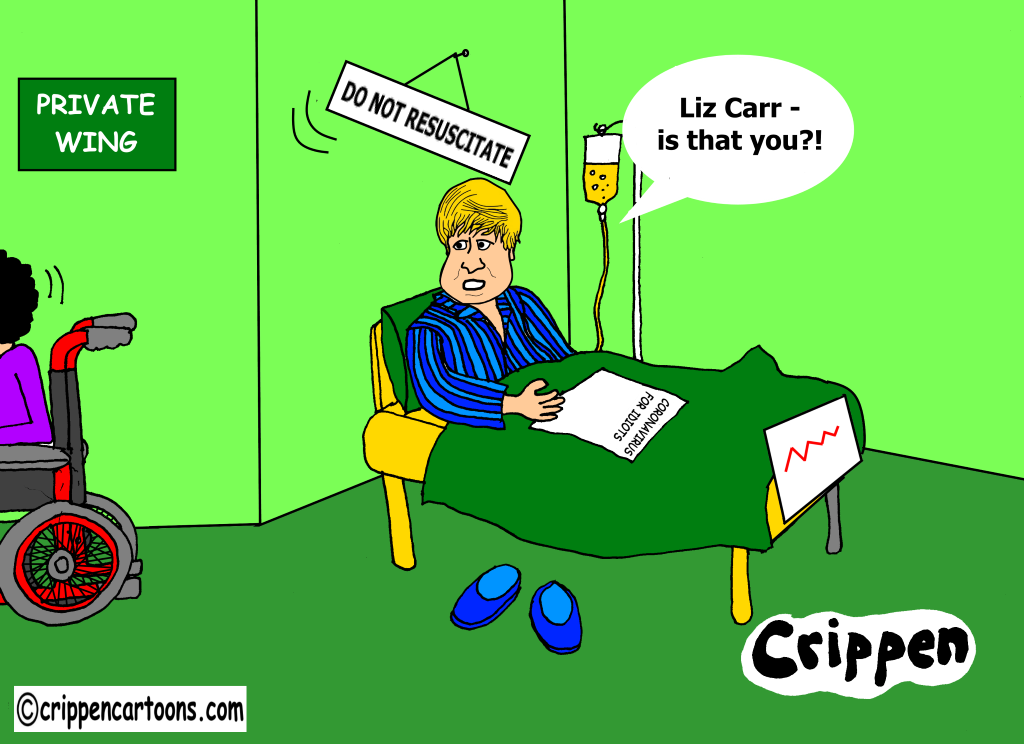
Get well soon Boris @ crippencartoons.com
Get well soon anyway Boris. You are a cartoonist’s dream and we’d all miss you terribly if you succumbed to this horrible virus.
Description for those using screen reading software
Boris Johnson is sat in a hospital bed in the private wing of a hospital wearing striped blue pyjamas. On the bed is a paper that reads ‘coronavirus for idiots’. Above his bed is a sign that reads ‘do not resuscitate’ which has just been put up and is still swinging. The back of a wheelchair user with curly black hair is seen leaving the room. Boris is saying: “Liz Carr – is that you?!”
Disabled activists Liz Carr and Dennis Queen have joined with other disabled people in expressing their outrage at the ‘frailty scoring system’ which is being used to determine whether disabled people who are admitted to hospital with Covid-19 are to be offered the same level of care as non-disabled people.
Issued by the National Institute for Health and Care Excellence (NICE) as part of their updated guidelines for the government and NHS, the scoring system will take into account “comorbidities and underlying health conditions”.
They suggest that those with a score as low as five – those seen as “mildly frail”, who often need help with transportation, heavy housework and medication (nine represents someone who is terminally ill) – might not be considered appropriate for intensive care treatment and might be steered towards end-of-life care instead if their condition deteriorated. The guideline said that decisions to admit patients for “critical care” should be based on how likely they were to recover.
Liz Carr said on Twitter that the guideline suggested she and many other disabled people would be “pretty much denied [the] same access to ventilation/critical care support as non-disabled people based on the fact we require some assistance in our daily life, because we’re disabled”.
She added that this was “terrifying and discriminating”.
Dennis Queen told NICE: “It’s not just about how we feel – you are denying us our basic human rights.”
Description for those using screen reading software
Disabled activists Dennis Queen and Liz Carr are seated in wheelchairs alongside a large sign that reads ‘Frailty scoring system – denying basic human rights for disabled people!’. Alongside of Liz is a placard that reads ‘Not dead yet’. Dennis is saying: “We need more people to wake up to this latest threat to our existence!” Whilst Liz is saying: “Make no mistake – this is a terrifying and discriminating step aimed at us all!”.



 Crippen Cartoons