Crippen remembers Sinead O’Connor 1966 – 2023

This following cartoon addresses the sensitive subject matter of child abuse, the Press and the Catholic Church. Please only scroll down if and when you feel comfortable to do so. Take care of yourself when you do. If and when you do choose to view this cartoon, we recommend you read in private rather than a public space and give yourself time and space during and after to reflect. Hold some space for yourselves. If you need to put in place some safety then do what works well for you. Take care of yourself.

Scroll down to view the cartoon.

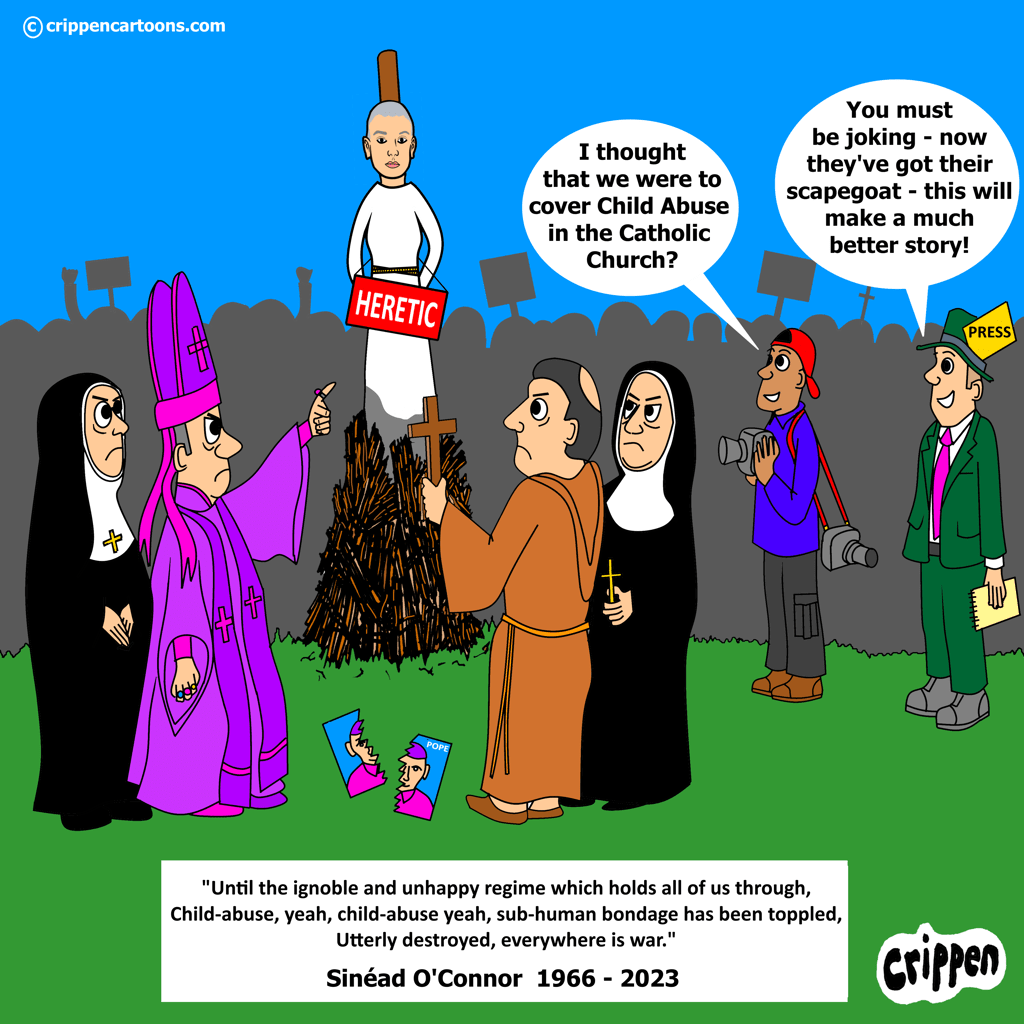
Note: The quote in the cartoon is from Sinéad’s interpretation of Bob Marley’s song ‘War’. This is a video of her version of Bob Marley’s WAR

Sinéad ended her set by tearing up a picture of the Pope and saying “Fight the real enemy!”

Crippen asks, are you sitting comfortably? Then I’ll begin.

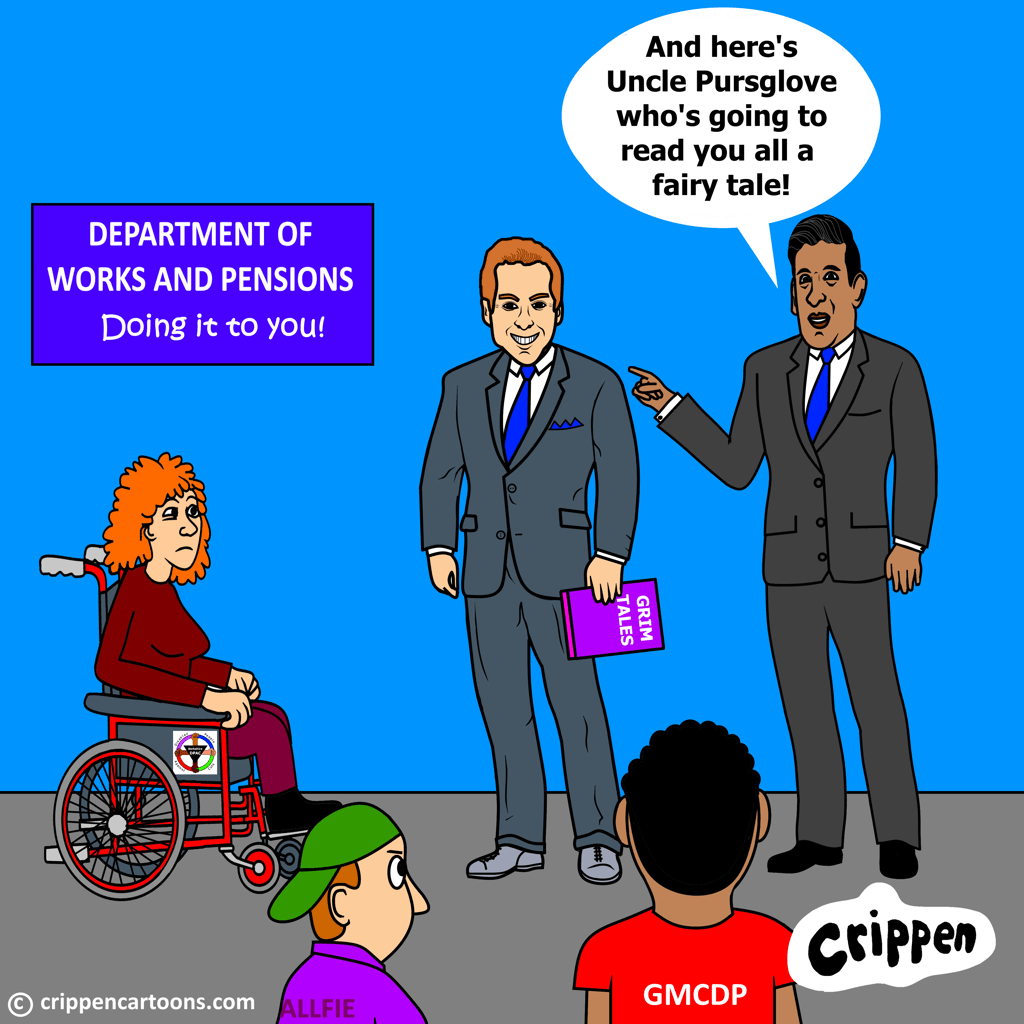
Once upon a time in a land not too far away lived a Pursglove. No one was sure what he actually was but felt that with his gleaming white smile and honest open face he was the ideal thing to represent the darker side of the organisation he worked for. They’d tried various other creatures in this role, but despite trying really hard, nothing they did stopped the darker side of the organisation from continuing to ooze through.

This foul darkness that emanated from the organisation was as a result of many years of hard work by the more senior creatures that controlled it. Together they had evolved cruel and unnatural practices that that had squeezed the last drop of hope from those that were depended on them for their very existence.

“What we want you to do for us” they told the Pursglove, “is to raise the hopes and expectations of these minions, so that just when they start to think that they can see a light at the end of the tunnel, we smash them back down again, thus saving ourselves billions of pounds in unclaimed benefits! This statement was accompanied by evil laughter as they complimented each other on a strategy well thought out.

So, the Pursglove made an announcement to the effect that he was launching a new action plan that he claimed would help transform the minion’s everyday lives for the better. And not only that, but it would also lay the foundations for longer-term change.

His gleaming smile and round honest face convinced many of the minions that what he said was the truth, and they began to allow a glimmer of hope to raise again. But others, who could see the dark traces of the organisation floating around the Pursglove, recommended caution.

Getting into his stride now, the Pursglove told the minions that not only would he be transforming their lives, but that he would be launching a review, along with setting up a new webpage, drawing up two sets of guidance and two feasibility studies, and also carry out awareness-raising, including the creation of a new badge for businesses to give their staff to show they have received approved “awareness” training! And all before breakfast!

The Pursglove rounded this off by saying that this was the “immediate action” the organisation plans to take in 2023 and 2024 to move towards making the country “the most accessible place in the world for everyone to live, work and thrive”.

By this time the minions had started to tune out the meaningless drivel that was issuing from the Pursglove’s lips. They remembered the many initiatives that the organisation had set up in the past, only to scrap them in a short space of time, and how all of these new Pursglove initiatives had the same feel about them. In fact, they began to recognise that it was just another PR exercise whose main aim seemed to be to create confusion and hide the real task of making more money for the privileged few who benefited from being a part of the organisation.

Strangely enough, in a parallel universe a similar story has unfolded which you will be able to read about in Disability News Service.

Description of cartoon for those using screen reading software

The Prime Minister and the Minister for disabled people are standing alongside of each other. Pursglove is holding a book entitled ‘Grim Tales’. On the wall behind them is a sign that reads ‘Department of Works and Pensions’ with the strap line ‘Still doing it to you!’. Several disabled people representing groups and organisations of disabled people are in front of them looking perplexed.  The PM is saying: “And here’s Uncle Pursglove who’s going to read you all a fairy tale!”

Crippen discovers DWP underpaid benefits claimants by record £3.3bn

Despite the Department for Work and Pensions (DWP) still claiming that benefits fraud is still their biggest problem, the National Audit Office have discovered that benefits claimants in the UK were underpaid by a record £3.3 billion last year, the highest level on record. The figures cover a range of benefits from universal credit, personal independence payment, to pension credit.

The DWP also admitted that as many as 330,000 people, some of whom have since died, may have missed out on as much as £1.5bn of valuable state pension entitlement – a disclosure that prompted some commentators to warn of a new scandal. Steve Webb, the former pensions minister, said:

“The scale of these errors is huge. It is shocking that so many have been underpaid so much money. This makes it essential that things are put right as a matter of urgency.”

The DWP’s annual report and accounts for 2022-23 also disclosed that the national insurance records for 10 million people claiming universal credit have not been updated properly. The disclosures prompted Whitehall’s spending watchdog, the National Audit Office, to announce it had once again qualified the department’s accounts, meaning money has not been spent as it should have been. It said:

“This is the 35th year in which DWP’s accounts have been qualified due to material fraud and error.”

The personal independence payment (PIP) – which helps people deal with the extra living costs caused by long-term disability or ill health – is the benefit with the highest underpayment rate. However, in their defence the DWP claimed that the increase was mostly due to “claimant error” – for example, where an individual’s medical condition worsened but they did not inform the department.

The DWP and HMRC said that they were working together to find people affected and correct their records so they receive the correct amount of benefits. Later this year, HM Revenue and Customs (HMRC) will embark on an exercise to try to track down as many of those affected as possible. They told the Guardian newspaper.

“HMRC and DWP will correct the national insurance records and update state pension entitlement as quickly as possible.”

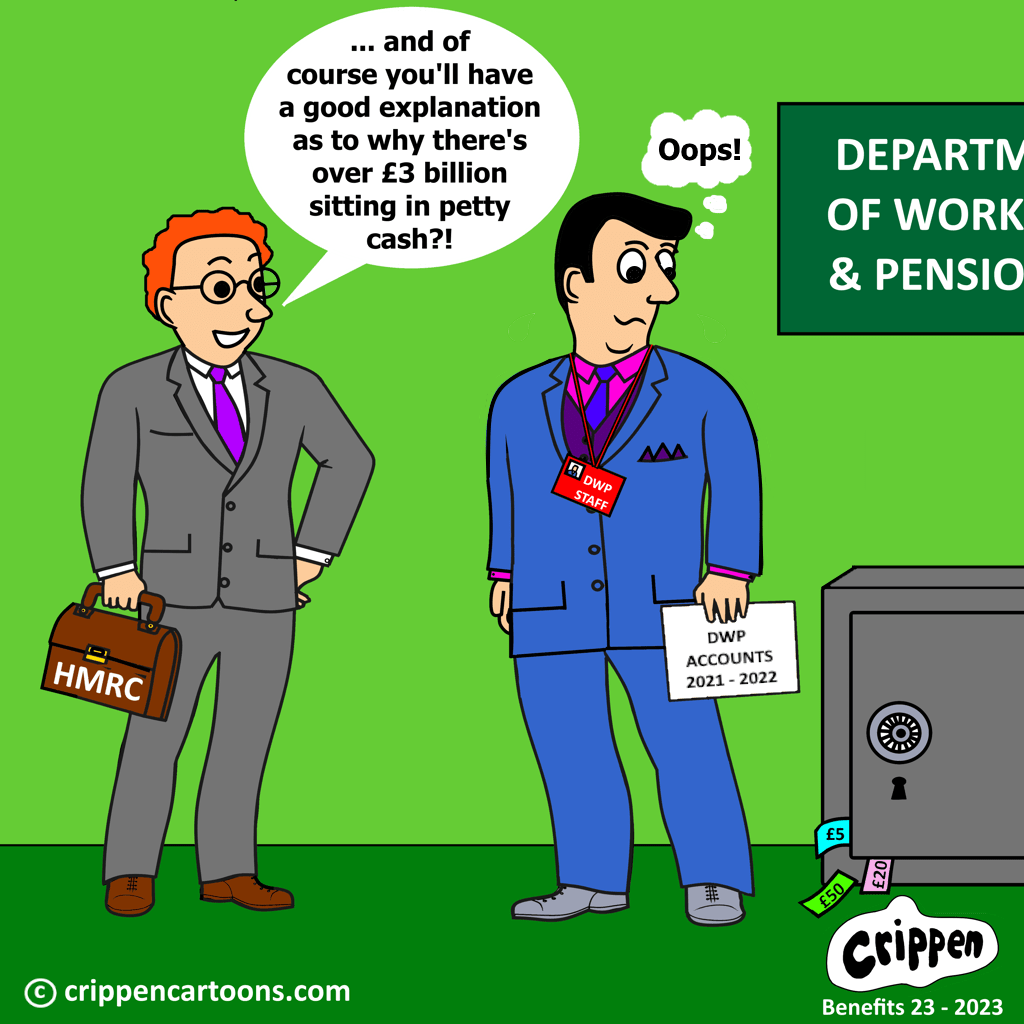
Oh, so that’s alright then?! The DWP submits financial records which are not maintained in accordance with Generally Accepted Accounting Principles (GAAP) and they don’t get so much as a smack on the wrist! Also, why is nobody remotely interested in where the £3.3 billion went?

Description of cartoon for those using screen reading software

A white male in a grey business suit and carrying a briefcase with HMRC is looking at a staff member of the DWP. Beside him is a safe with notes spilling out of the door. The HMRC man is saying: “ … and of course you’ll have a good explanation as to why there’s over £3 billion sitting in petty cash?!” The DWP man is thinking: “Oops!”

Crippen’s cartoon t-shirts now available online

I’ve finally found an ethical T-shirt manufacturer and printer who ticks all of the environmental boxes, and then some.

They are called Teemill and surprisingly they have their head office located just down the road from me on the Isle of Wight. They also provide all of Greenpeace’s T-shirts which is an endorsement in itself.

Part of my agreement with them is that I can set up an online store, displaying T-shirts for men, women and children and also special one-off commissions for people. I’ve selected about 20 of my most popular cartoons to start the process off but can add to this as the store develops. I’m also hoping to get mouse mats, mugs and other merchandise online as soon as I can.

Price wise the T-shirts retail at £19.00 plus postage and packaging which some might consider to be at the more expensive end of the market. However, when you consider that the T-shirts are not produced in an Asian sweat shop as so many items of clothing are, that in itself is a big bonus.

Also, all profits from the sale of the T-shirts are going into my Crippen Cartoon Resurrection Project where I’m recreating all of the grey scale cartoons I produced back in the 1980’s and 90’s.

So, stuck for a unique gift for a friend or looking for something to enhance your own wardrobe that is not only good quality but also sustainable, then look no further. You can also send me a photograph of the T-shirt being worn and I’ll post it up on the store front.


You can visit Crippen’s online T-shirt store here.


Description of image for those using screen reading software

A photograph of Crippen – disabled cartoonist, wearing one of his T-shirts. The T-shirt is black and has a full coloured cartoon portraying the notorious charity collector Captain Pratt. Confronted by a wheelchair user holding a large sign that reads ‘Rights not Charity’ Captain Pratt is saying: “What IS your problem?!”

Crippen joins the battle for our NHS

After 75 years since its inception the NHS continues to be sold off piece by piece, generating profit for the greedy few and no longer able to provide even basic care for the many in some parts of the country.

Twelve years ago, it was rated as the best healthcare system in the world. But now, after many years of government cuts, our NHS is in crisis and about to fulfil Thatcher’s ‘dark legacy’. Last year, 120 patients a day died before an ambulance reached them. Millions are waiting over two weeks to see a GP. People are being forced to pay out of their own pocket for operations or suffer while they wait. And it’s getting worse.

NHS staff are now at breaking point with doctors and nurses having to work double shifts to cover the shortfall caused by a major staff shortage (which is caused in turn by thousands leaving the profession before they completely burn out).

And don’t let them try to convince you that private health care is the way forward. Apart from the fact that without the NHS they would have no trained staff, the private sector cherry pick their patients, often turning away those with pre-existing conditions or those of an age or with long term impairments no longer considered viable or should that be ‘profitable’. Also, the private sector in this country does not provide an Accident and Emergency service.

So, what can we do to stop this? Well, there is a major online petition now circulating, which I invite you all to please sign and share with as many people as possible. Created by Dame Emma Thompson, Joe Lycett and Aneira Thomas (the first baby born in the NHS), it will be sent to every party’s parliamentary health spokespeople who will be left in no doubt that this is OUR NHS and that we demand that they work together to stop the rot!

 Please sign the petition and share with as many people as possible.

Description of cartoon for those using screen readers

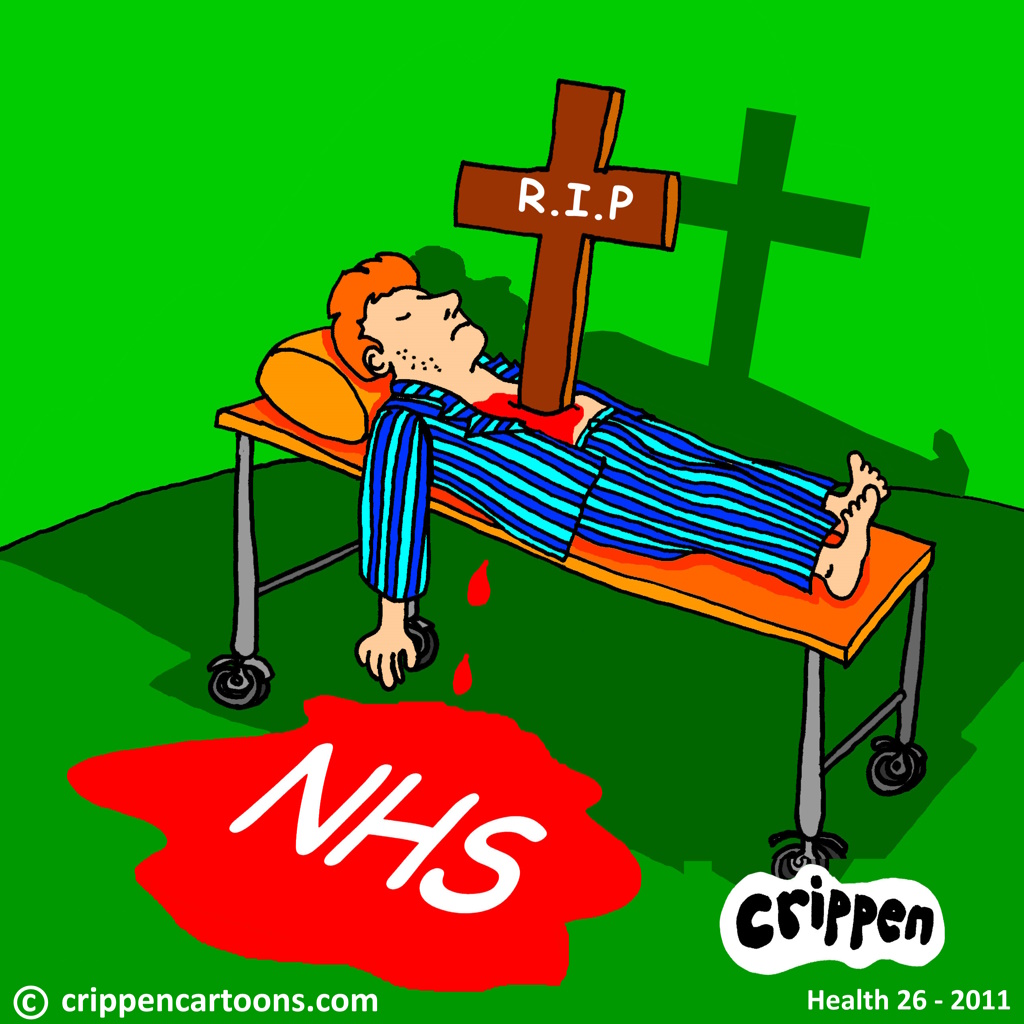
A white male figure wearing blue striped pajamas is laying on a hospital gurney. A large wooden cross is impaled into his chest with ‘RIP’ written upon it. Blood is dripping from him and forming a large puddle beneath the gurney. The letters ‘NHS’ are sitting in the middle of the puddle of blood.

Crippen discovers that we have another opportunity to bring this government to account!

The United Nations Committee on the Rights of Persons with Disabilities (UN CRPD) has issued a call for further evidence that the UK government have (not) acted upon the recommendations that they made following their 2016 investigation.

It’s long been my intention to have a proper read through of the findings of the 2016 United Nations Committee on the Rights of Persons with Disabilities (UN CRPD) following their investigation of the way in which the UK parliament has brought in massive changes to the legislation, policies and measures relating to social security schemes and to work and employment, and the cumulative negative  impact that this has had on disabled people. Most of the factual information written here is taken from the UN report, with a link added to that source at the end of this article.

You’ll recall that the UN investigation happened after the UN CRPD began receiving information about the alleged adverse impact on disabled people following the implementation of a process of reform of legislation and policies by the UK government. The information indicated that the implementation of the welfare reform had introduced significant cuts to social benefits that were affecting several of the rights of disabled people enshrined in the UN Convention.

Serious and Systematic Violations

In April 2013, the Committee received a formal request from a number of disabled people’s organisations (DPOs) alleging that serious and systematic violations of the provisions of the UN Convention were occurring in relation to disabled people. They requested that the UN Committee initiate an investigation into the matters raised in the request.

In 2014, the Committee assessed all the information before it and determined that there was reliable information indicating grave or systematic violations of the rights set forth in the UN Convention. The Committee therefore established an inquiry and appointed two of its members as rapporteurs who visited the UK on 12th to 23rd October 2015 interviewing more than 200 disabled individuals, and several DPOs.

Strangely enough, local authorities and councils chose not to cooperate with this investigation, and the UK government, having agreed to meet the UN investigators on the first day of the visit, postponed to the last day with no explanation forthcoming. Also, despite the UK Parliament acknowledging that the UN Convention is a binding obligation in international law and that they should have given them adequate consideration in decision-making processes, the UN Convention has not been incorporated into UK domestic law and is still not directly justiciable.

To Recap

To recap, the UN investigation found at that time that the Welfare Reform Act 2012 was the main legislative instrument on welfare that applies in England, Scotland and Wales, and the Welfare Reform Act (Northern Ireland) 2007. The Care Act 2014 which came into effect in April 2015, sets forth the provisions relating to care and support for adults and provisions relating to support for carers. The act shifts the duty of local authorities from providing services to meeting needs and providing information amongst other things.

The Welfare Reform and Work Act 2016 makes provision for various aspects of welfare, including reducing the benefit cap; freezing certain social security benefits and taxing credit amounts for four tax years; limiting child tax credit; changing the child element of universal credit; amending the Child Poverty Act 2010; removing the work-related activity component from employment and support allowance; and regulating the limited capability-for-work element of universal credit and its work-related requirements.

Coupled with this, the reform to the legal aid system affected claimants of the welfare system, including disabled people, and narrowed the scope of civil legal aid in England and Wales by excluding the use of legal aid in welfare benefit cases.

The UN investigators found that the UK welfare system has faced a progressive change in conception from the “welfare” of individuals to the economic well-being of the country. The stated goals of the policy being to transform British society from a low-wage, low-employment and high-welfare society to a high-wage, high employment and low-welfare one, which, they claimed, would be fairer to UK tax-payers (conveniently forgetting that many disabled people are tax payers!).

Benefit Fraud

They also claimed that this would put a stop to benefit fraud, perpetuating the myth that disabled people were making a good living out of benefits, committing fraud as benefit claimants, being lazy and putting a burden on taxpayers, who are paying “money for nothing”, although the UN inquiry found no substantiation of the alleged benefit fraud by disabled people.

Ironically, the UK government produced evidence of formal efforts and public awareness campaigns to improve the image of persons with disabilities [sic], despite the UN inquiry collecting evidence that show how disabled people continue to experience increasing hostility, aggressive behaviour and sometimes attacks on their personal integrity.

Impact Assessments

Because of this, various people had expressed concerns about the potentially discriminatory effects of the welfare measures on disabled people and called on the Government to fulfil its duties under the Equality Act 2010. They also called for a cumulative impact assessment to consider the impact on groups with similar characteristics, such as disabled people, and to monitor the post-legislative impact of the measures in the welfare reform.

Public sector equality duty obliges the UK government to carry out impact assessments when they plan to introduce measures, including legislative measures, to ensure that groups with protected characteristics, among them disabled people, are properly consulted and any adverse impact on them is properly justified.

Similarly, a court of law found that the decision to close the Independent Living Fund (ILF) was not in compliance with domestic equality duty, which compelled the authorities of the UK government to carry out another equality assessment before implementing the legislation.

Although the UK government asserted that a cumulative impact assessment of the various policy measures affecting disabled people was not technically feasible or practicable, the evidence collected by the UN inquiry indicates that a cumulative impact assessment could have been conducted with the data and information available.

Domestic Equality Duty

The UK government submitted evidence that it had complied with domestic legal duties for all the intended changes to the welfare system. However, the inquiry collected evidence that a major piece of legislation of the welfare reform, the Welfare Reform Act 2012, was not thoroughly compliant with those requirements. The inquiry also collected evidence that the views of disabled people and their representative organisations that had participated in the few consultations launched by the UK government were not meaningfully taken into account in the decision-making process and had little or no influence on policy decisions.

Retrogressive Impact

The Joint Human Rights Committee of the UK Parliament also warned of the potentially retrogressive impact of the reform on the rights of disabled people, referring to the negative impact of the introduction of personal independence payments (PIP) on the right of disabled people to live independently. It also warned of the risk of discrimination regarding the proposals on employment support allowance and housing benefit and the risk of “destitution”.

This was substantiated by independent studies conducted by academics and research centres, including several DPOs. The UN report detailed many of the issues raised by these studies including more disabled people living in poverty, a risk of social isolation and more reliance on informal and family care and negative stereotyping of disabled people.

Cuts to Funding

Importantly, the UN investigators found reliable information that indicated that up to 2015, public funding of adult social care was reduced by £4.6 billion. Consequently, local authorities reduced their spending on social care and cut community services that had been of importance to disabled people. All these findings were disputed by the UK Government whilst conversely, statements made by them were not supported by any evidence collected during the investigation (Ed: No surprise there then!).

Medical Model

The Committee observes the prevalence of the medical model approach in the assessment procedures for determining the eligibility of disabled people for entitlements. Also, that the main assessment procedure for determining eligibility for out-of-work benefits resulted in the needs of disabled people not being fully understood. The evidence collected from various sources indicates that the needs, views and personal histories of disabled people and particularly those requiring high levels of support, such as persons with intellectual and/or psychosocial impairments, were not properly taken into account or given appropriate weight in the decisions affecting them.

The UN Committee also observed that various pieces of legislation related to recent welfare policies do not fully enforce the international human rights framework related to social protection and independent living. In that connection, it was observed that in the field of social protection, disabled people in the UK have not been properly considered as rights holders and entitled to benefits with regard to their right to social protection.

Lack of Access

The UN inquiry collected evidence indicating that the information, advice and counselling provided to disabled people on the different steps in the assessment processes and decisions on their entitlements were limited, non-existent or not provided in accessible formats and languages. That was coupled with uncertainty about the outcomes of those processes, triggering anxiety, psychological strain and financial hardship. The Committee also collected evidence of how mental health conditions had severely deteriorated as a result of the factors mentioned above.

Lack of representation

The evidence indicates that the UK government have carried out surveys and regularly published statistics about welfare reform. However, there is no evidence of the involvement of disabled people and their representative organisations in periodic monitoring and evaluation activities on the impact of the implementation of the reform measures.

In Conclusion

The evidence collected by the UN and other reputable bodies within the UK make it clear that the UK government is failing the estimated 10 million disabled people currently living in the UK. Not only that, but by presenting unsubstantiated information about so called benefits fraud by disabled people, they are complicit in changing the UK public’s views of disabled people, supporting the view that we are all ‘useless eaters’ and a drain on society.

Unfortunately, the impetus for challenging the UK government by disabled people disappeared in 2020 when the COVID Pandemic arrived, and we all went into lock down. However, this second request for information by the UN is a chance to raise these important matters once again and confront the government about its failure to protect the rights of disabled people in the UK.


Organisations can submit written evidence to inform their follow-up review by 1 August 2023 or can share evidence in-person as part of the oral briefing on 28 August 2023. If you would like more information on this, then please contact the Secretariat for the UN CRPD on Jorge.araya@un.org or by reading the full UN report.  

Description of cartoon for those people who use screen reading software

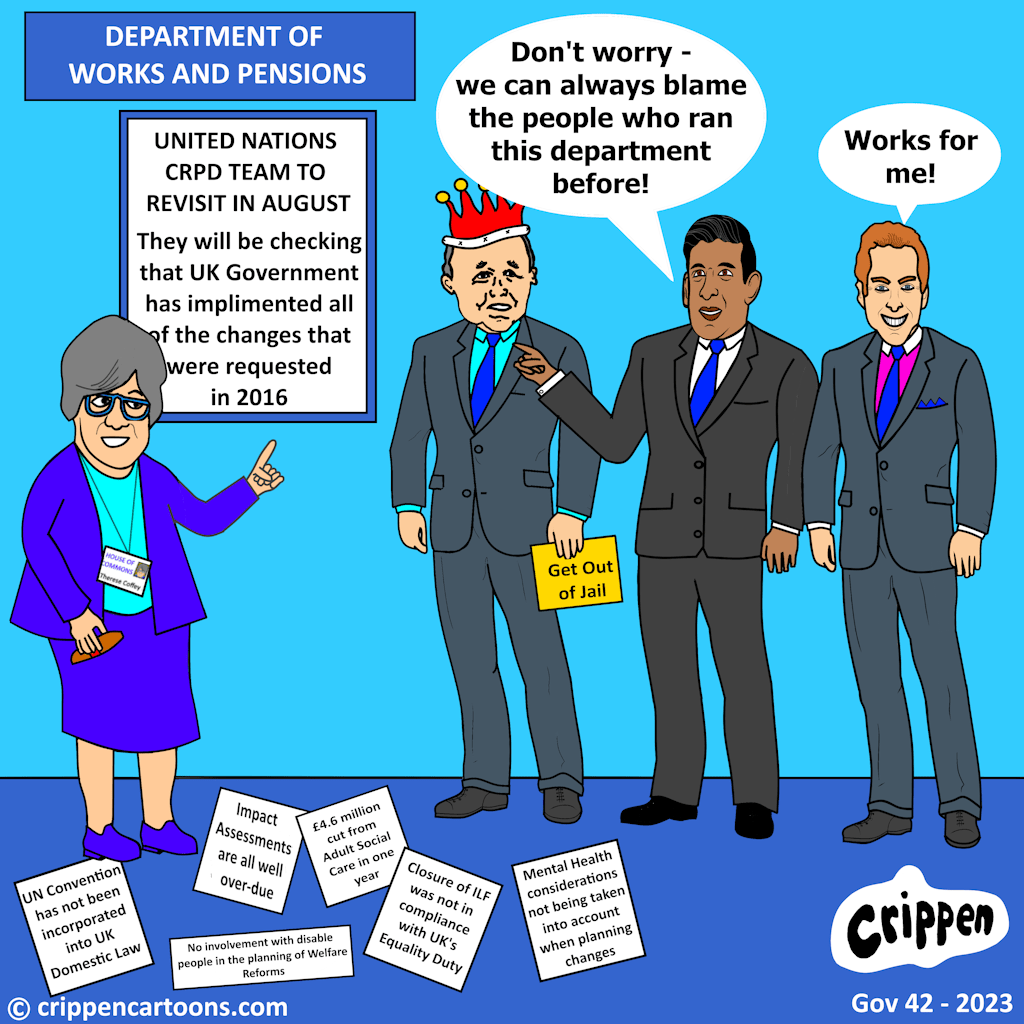
PM Sunak and MP Pursglove are standing side by side in the office of the DWP. Opposite them is Sir Duncan-Smith and MP Coffey both ex-DWP. A sign on the wall reminds them that the United Nations CRPD team are revisiting to check if any of their recommendations have been implemented. On the floor is scattered lots of pieces of paper with examples of the changes that the UN wanted to see made. Sunak is saying: “Don’t worry – we can always blame the people who ran this department before!” Pursglove is saying: “Works for me!” Both Coffey and Duncan-Smith, who is carrying a ‘Get out of Jail’ card are looking at Sunak as if he is making a huge joke.
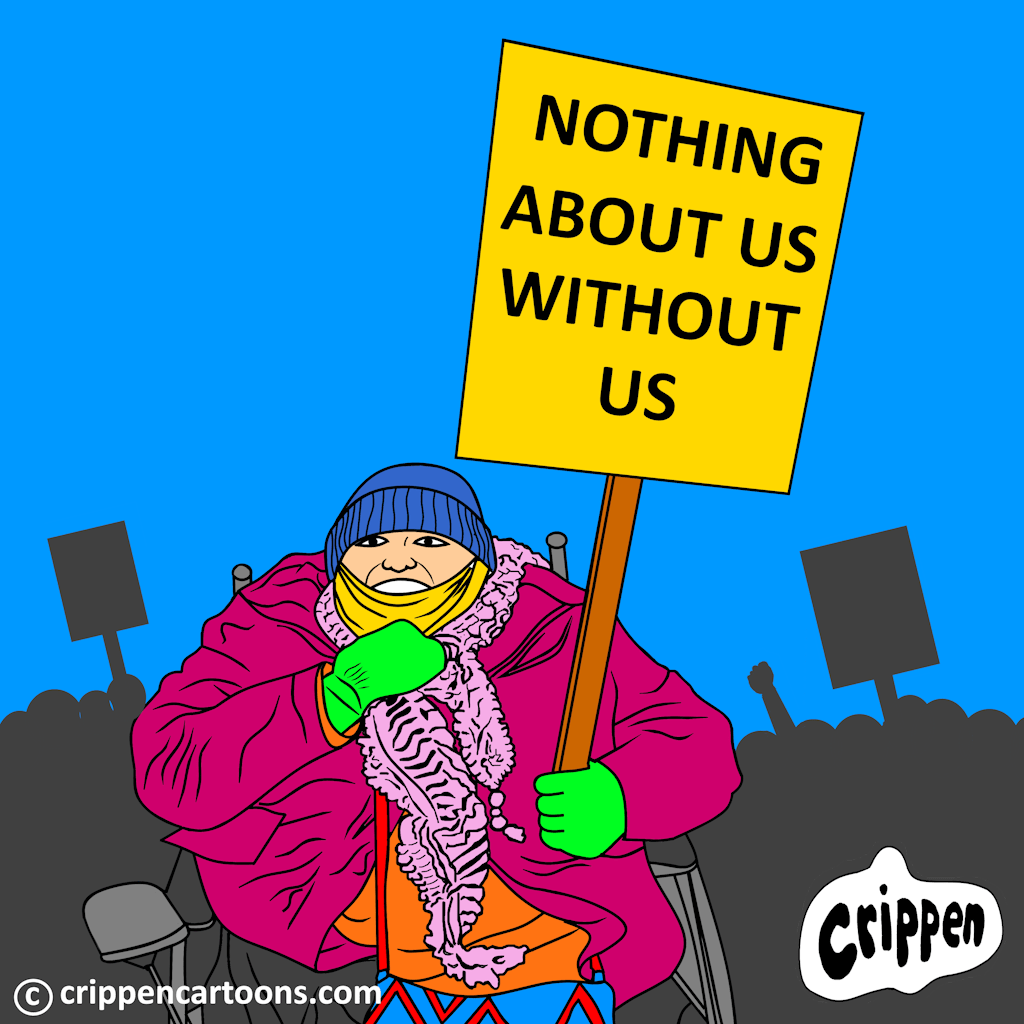
Crippen and the sad news of the death of activist Linda Laurie

We recently received the sad news that long term disability campaigner and activist Linda Laurie has died. Her partner Mike Higgins speaks of her unswerving loyalty as a socialist campaigner as well as fighting for the rights of Disabled People, for inclusive education, the re-nationalisation of the Health Service, anti-sexism, anti-racism and for equality. 

Linda was active in the 1980’s with the Woman’s Peace Camp at Greenham Common, in the anti-apartheid movements both for South Africa and Palestine, the Disabled Peoples’ Direct Action Network (DAN), the Campaign for Accessible Transport (CAT), and with various socialist organisations. She also undertook many small and large actions of solidarity, supporting refugees and asylum seekers, which included the founding of the Group “No Barriers No Borders”, for disabled migrants in Sheffield.

Linda will be buried on Friday 23rd June 2023 with honours under the red flag, at a humanist ceremony. The burial will be in the location Linda chose, which is a woodland near the New Forest in Hampshire. If you plan to attend this event, please dress in whatever is comfortable for you, but try to use colourful and bright clothing, if possible, which reflects and reminds you of Linda.

Mike is also holding an event in London on the evening of Saturday 8th July 2023, to remember and celebrate Linda’s life and her contributions to humanity. Again, there is no dress code, but purple, blue or other bright colourful attire is encouraged. 

If you wish to attend either or both events, then please contact Mike by email: mike.j.higgins@icloud.com or by telephone: 02035792182 | 07956856060.

Description of cartoon for those using screen reading software

The image is a caricature of Linda Laurie sat in her power wheelchair carrying a sign that reads ‘Nothing about us without us’. She is smiling and is wearing a woolly hat, a scarf, gloves and a heavy coat. Behind her is the dark shape of other protesters.                                                                        

Crippen uncovers a bit more history

Since I started the Crippen cartoon resurrection project, where I’m recreating those old cartoons produced in greyscale format from the 1980’s, I keep uncovering bits of our history that I’d completely forgotten about.

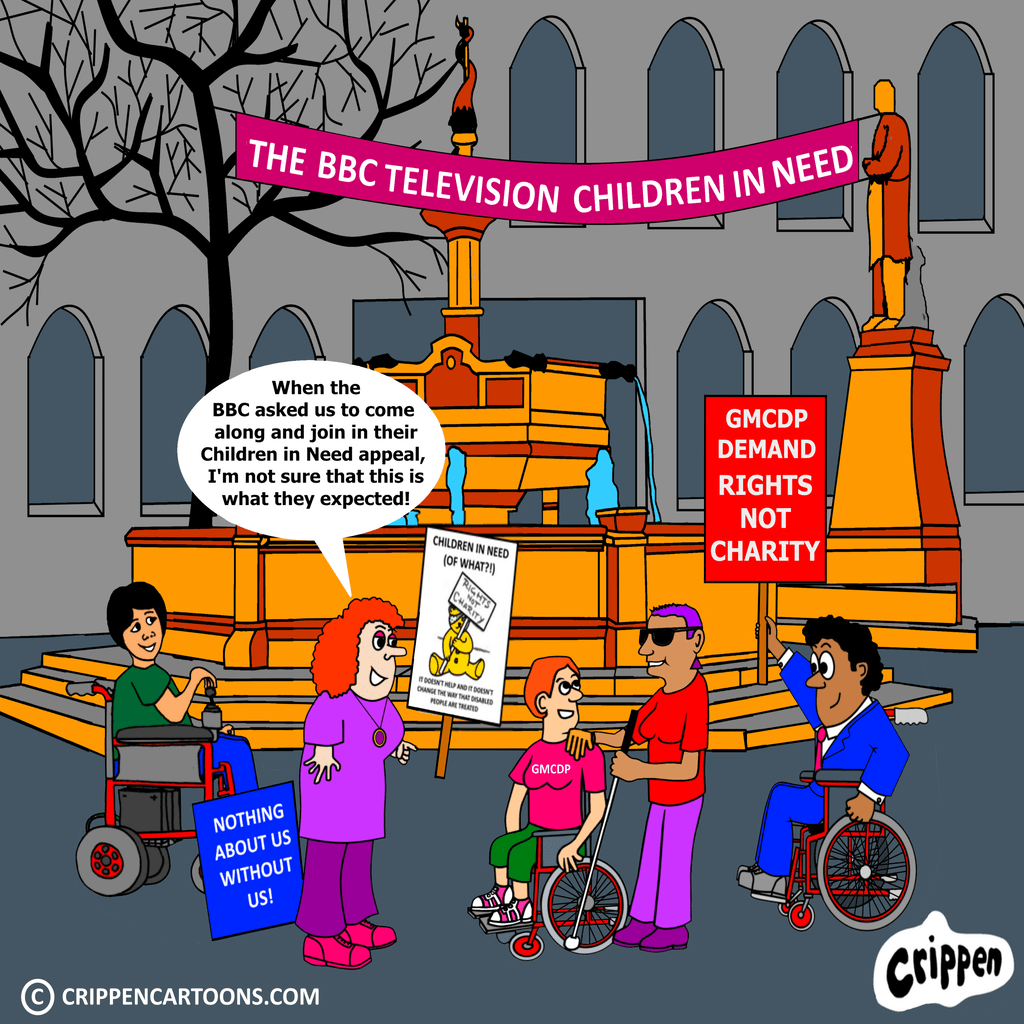
Take the Greater Manchester Coalition for Disabled People (GMCDP) as an example. I remember various groups and organisations protesting about the BBC’s Children in Need (CIN) appeal, but I’d forgotten about the protest that GMCDP held in Manchester City Centre back in 1993.

They’d actually been invited to attend by the BBC who were looking to involve some local Crips in their Pity Fest. What they hadn’t bargained for was a large crowd of GMCDP members turning up carrying banners and shouting about Rights not Charity!

I think that it was mainly down to this particular protest that the BBC took another look at how they were presenting disabled children. They’ve still got a long way to go but at least they’re now involving disabled people and disabled children in their campaign.

But there still remains the underlying issue about disabled people having to rely on charity to get what the non-disabled public take for granted. I would imagine that if they just halved the defence budget for example, the money saved would go a long way to ending our charity focussed society.

Description of cartoon for those using screen reading software

The scene is set around the large fountain in Manchester’s City Centre. A large banner proclaims, ‘The BBC television Children in Need’ appeal. A small crowd of GMCDP members are positioned around the front of the fountain, some carrying banners which read ‘GMCDP demand rights not charity’ and ‘Nothing about us – without us!’. Another sign reads ‘Children in Need – of what?!’ One of the disabled protester is saying to the others: “When the BBC asked us to come along and join in their Children in Need appeal, I’m not sure that this is what they expected!”


You can still contribute to Crippen’s Cartoon Resurrection Project by leaving a donation at his Go Fund Me site where you’ll also find more information about the Project. To add your name to the distribution list for the Project Newsletter then just drop him a line – daveluptoncartoons@live.co.uk

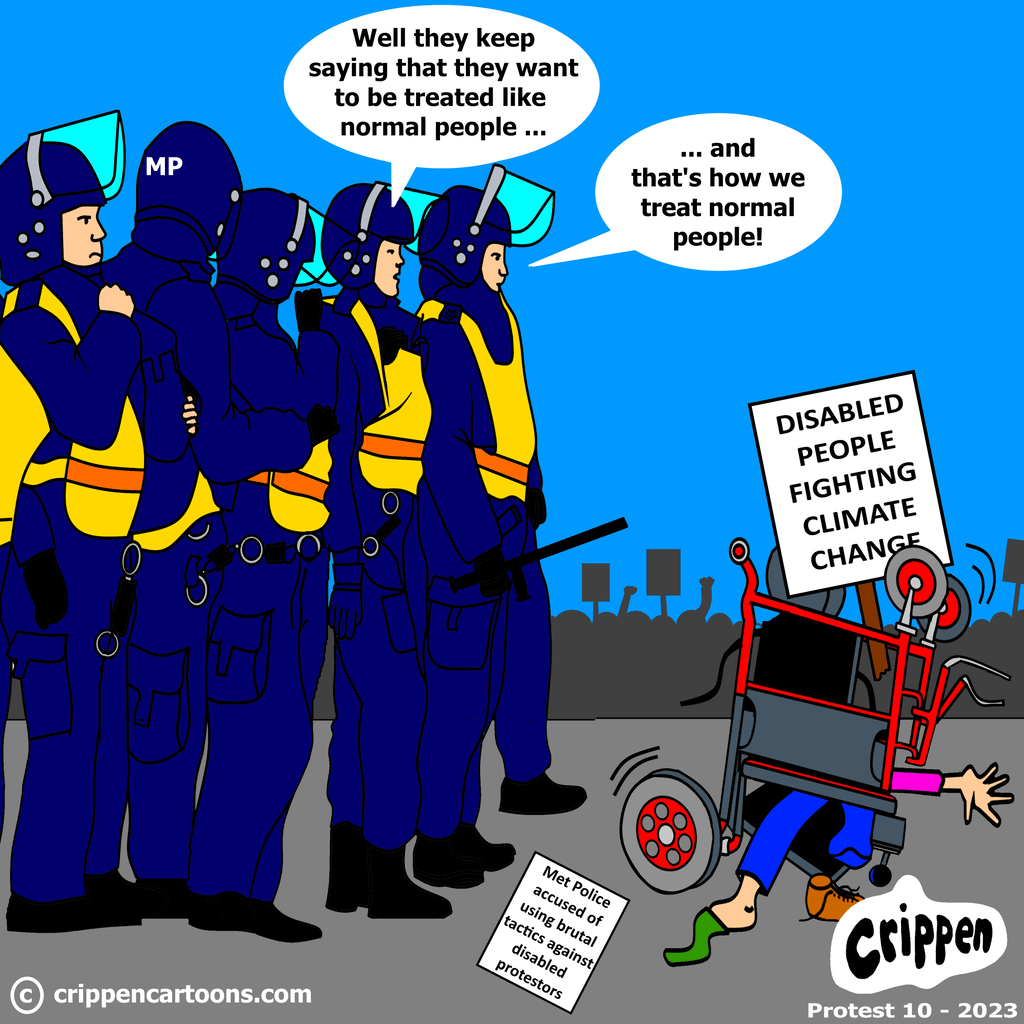
Crippen hears about systemic discrimination by the Metropolitan police against disabled protestors

Netpol, the network for police monitoring is calling on the Metropolitan Police to prevent a repeat of the systemic discrimination towards disabled protesters that was documented in their report ‘Restricting the Rebellion’.

The European Convention on Human Rights, in Article 14, says the exercise of rights including freedom of assembly “shall be secured without discrimination” but over the years, there have been repeated incidents of the targeting, harassment and ill-treatment of disabled campaigners.

This has included the physical assault of wheelchair users, the targeting of a deaf campaigner opposing a fracking site and the sharing of information about disabled protesters with the Department for Work and Pensions, to trigger investigations for alleged benefit fraud.

When Extinction Rebellion held 12 days of protests in London in October 2019, the mistreatment of disabled protesters was so shocking that even members of the Metropolitan Police’s Disability Independent Advisory Group accused it of humiliating behaviour and considered resigning en masse due to the number of stories they heard from individual protesters.

A growing intolerance towards environmental protesters from government ministers and the police has resulted in more new laws and more police powers, but the Met still has a legal duty to protect the right to protest.

Netpol is urging organisations to sign a statement calling for Sir Mark Rowley, the Metropolitan Police Commissioner, to acknowledge that a repeat of this mistreatment would amount to systematic discrimination and to provide public reassurance that the rights of disabled people to freedom of assembly will be respected and protected.

The statement reads:

“In 2019, Netpol’s report ‘Restricting the Rebellion’ highlighted the way Metropolitan Police Officers treated Extinction Rebellion’s disabled protesters in ways that were both degrading and humiliating. Efforts to make it as difficult as possible for disabled campaigners to participate also included arresting drivers delivering disabled-access toilets and confiscating vital accessibility equipment …

“We demand that Metropolitan Police Commissioner Sir Mark Rowley acknowledges that by failing to meet the needs of disabled protesters at forthcoming protests, the force will once again have systematically discriminated against them. We demand public reassurance from him that his officers will respect the rights of disabled people to protest.”

Description of cartoon for those using screen reading software

A solid line of metropolitan police officers are attending a climate change protest. They are clad in full riot gear with one of them holding a large baton. In front of them is a power wheelchair which has been smashed up and is upside down on the body of a disabled protester. A large placard in standing up in the wreckage and reads ‘disabled people fighting climate change’. In the background are lots of other protesters waving banners and their clenched fists in the air. One of the police officers is looking down at the wheelchair and is saying: “Well they kept saying that they wanted to be treated like normal people …” another replies: “,,, and that’s how we treat normal people!”

Crippen joins with ROFA to end the violence and abuse inflicted on disabled people in so-called care homes

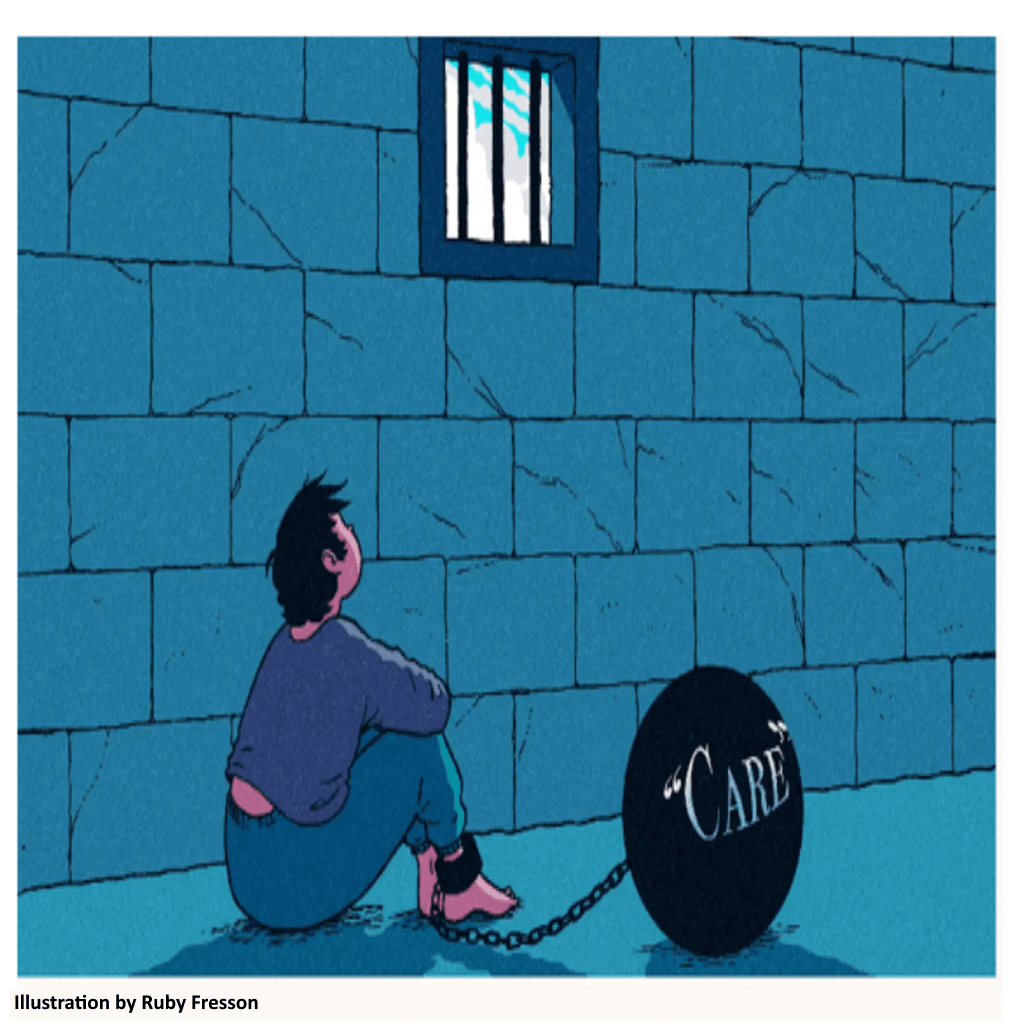
Reclaiming Our future Alliance (ROFA) are holding a campaign planning event to discuss ending the violence and torture of Disabled adults and young people in care.

ROFA claims that while education, health and social care is being underfunded, profits are being made through incarceration and segregated provision in which Disabled people are subjected to tactics of violence, harm and torture.

A recent report in the Guardian newspaper stated that:

“The failures behind the scandals, by contrast, are rooted in systems that are massively opaque. In the case of children’s homes and residential schools, the bodies responsible include Ofsted, local councils and a tangle of profit-making companies … The statistics speak for themselves: The top 20 private providers making £250m+ in annual profits, alongside a 9% cut in funding per pupil”.  

ROFA wants this money to be spent on improving the life chances and opportunities for ALL Disabled people (whilst) the government want to lock them up and pour profits into shareholder returns for corporations! 

Join ROFA’s campaign planning event on Wednesday 10 May 5-7pm via Zoom. BSL interpreters will be available.

Description of cartoon for those using screen reading software

A young person is sat upon the floor in a bare cell gazing up at a barred window high above their head. Around their foot is fastened a ball and chain. The large iron ball has ‘Care’ written on it. The image is provided by ROFA and is created by Ruby Fresson.