Crippen looks at the deaths of patients in MH hospitals

Deaths in mental health hospitals and learning disability units have doubled compared with last year – with 54 of these deaths from confirmed or suspected coronavirus infections.
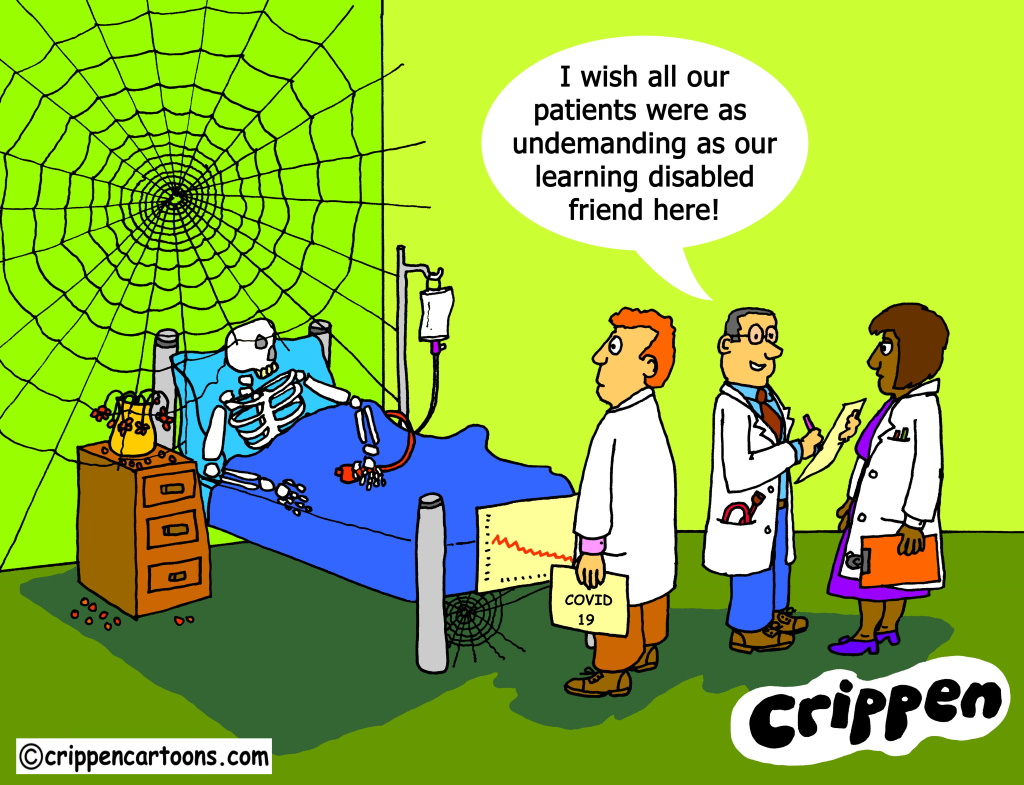
The Care Quality Commission regulator said 106 deaths were recorded between 1 March and 1 May, compared with 51 over the same period in 2019. They have now been warned by the care watchdog that they must take action to protect vulnerable patients.

The figures were published as NHS England separately refused to make public the weekly data it receives from hospitals and learning disability units about the deaths of patients with learning disabilities. It said the data would be published in 2021, sparking outrage from charities and politicians.

Deborah Coles, from the charity Inquest, told The Independent: “The refusal to publish the data points to the historical longstanding failure to provide detailed information about deaths of people in the care of the state in mental health and learning disability settings.

Labour’s shadow care minister Liz Kendall said: “This is extremely worrying and shows Covid-19 has now reached mental health units. Families and the wider public deserve to know what is happening, and why.

Harriet Harman MP, chair of parliament’s Joint Committee on Human Rights, has also written to health secretary Matt Hancock demanding the government publish data on the deaths of people with learning disabilities and autism.

Description of cartoon for those using screen reading software

The scene is a hospital ward with a single bed containing a skeleton. The skeleton is holding an alarm button and a spider has woven a large web across it and the bed. A vase of dead flowers sits on the bedside table with petals all over the floor. Three people in white coats are standing at the foot of the bed. One of them is holding a document called ‘Covid 19’. Another is writing on a clip board and is saying to his colleagues: “I wish all of our patients were as undemanding as our learning disabled friend here!”
Crippen hears from the Disability News Service that Local Authorities have started to reduce services to disabled people

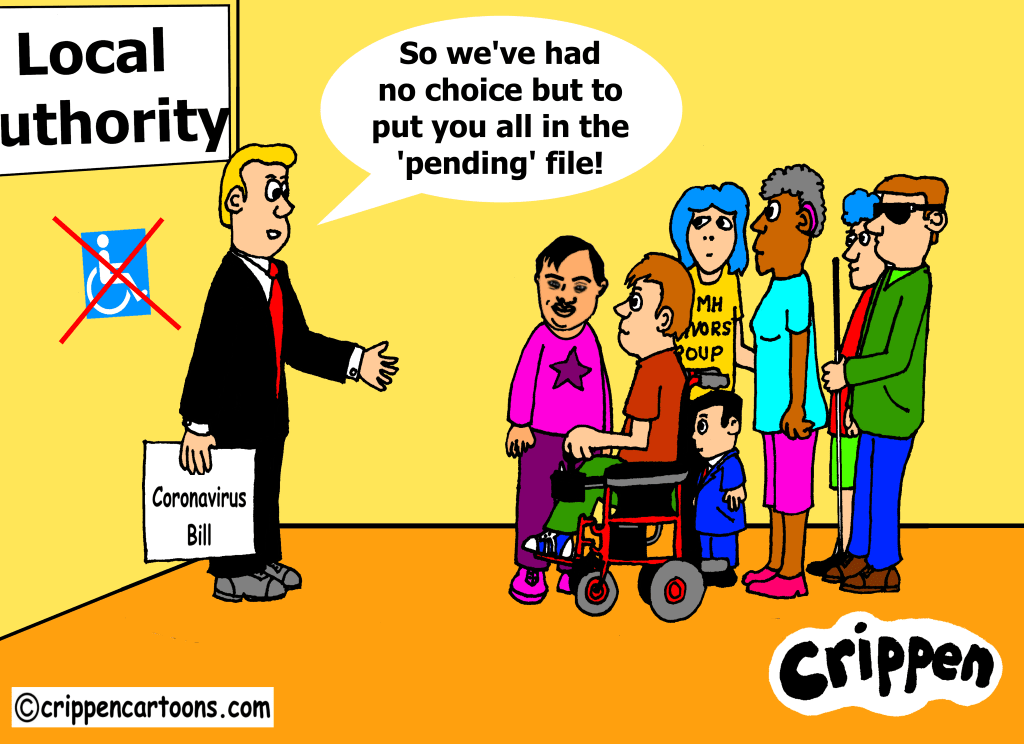
It’s started … Eight local authorities in England have become the first to take advantage of emergency legislation that allows them to reduce their duties under the Care Act (See my earlier Blog in Disability Arts Online).

Reporting in the Disability News Service (DNS), one of the councils – Solihull – has become the first to admit that it is cutting the packages of some service-users as a result of pressures imposed by the Covid 19 pandemic.

The emergency powers were introduced as part of the government’s Coronavirus Bill, and mean councils – if they need to take advantage of the “easements” – no longer have to carry out detailed assessments of disabled people’s care and support needs, and no longer have a legal duty to meet all eligible care and support needs.

Four of the other local authorities – Warwickshire County Council, Middlesbrough Council, Staffordshire County Council and Birmingham City Council – have made changes to how they approach assessments, support plans and annual reviews.

The identities of three other councils that are taking advantage of the easements – Derbyshire County Council, Sunderland City Council and Coventry City Council – have since emerged.

Earlier this month, Disability News Service (DNS) reported that Warwickshire County Council had apparently started taking advantage of the new powers even before they became law on 31 March.

Evidence seen by DNS suggested that the council took a decision to halt all the “usual work” being carried out by its social workers nearly a week before the measures took legal effect.

Business as usual then eh?!

Description of cartoon for those using screen reading software

A group of disabled people representing differing ethnicities and impairments are confronting a white male in a suit. Behind him is a large sign identifying him as belong to the local government. There is also a blue wheelchair symbol with a red cross through it. The man is also holding a document that reads ‘Coronavirus Bill’. He is saying to the disabled people: “So we’ve had no choice but to put you all in the ‘pending’ file!”

Crippen discovers that the DWP provide the main source of oppressive attitudes towards disabled people

Why are we not surprised to hear that people with chronic illness taking part in a recent survey, reported that the main source of oppressive attitudes they faced were when dealing with Department for Work and Pensions staff.

The Energy Impairment and Disability Inclusion report (which is available to download here as a PDF*) found that people with chronic illness face hostility and isolation because of society’s (and the DWP’s apparently!) failure to understand how their impairment affects their lives.

The research concluded that the most “fundamental oppression” experienced by people with conditions such as ME, multiple sclerosis, and fibromyalgia was the “negative attitudes” they faced. The report says that many people with these conditions feel like undeserving frauds because they have “internalised” deeply negative social attitudes.

More than 80 per cent of the more than 2,000 people with chronic illness who took part in a survey for the research believed there was a denial and disbelief about the fatigue they experienced. And 85 per cent said they felt isolated by society’s failure to understand the impact of their condition.

One of those who took part in the research said: “I feel like every day I am battling to prove myself – that I am really this sick, that I am working hard, how exhausted I feel, how difficult things are for me, in order to avoid their judgements.”

To find out more about the survey, please click here to access the full Disability News Service article.

* When you click on the PDF download link, the document should be automatically downloaded onto your device (probably into the ‘downloads’ folder).

Description of cartoon for those people using screen reading software

The scene is set in a staff training room at the DWP. A sign on the wall has a picture of Iain Duncan Smith (IDS) on it along with the wording ‘The teachings of IDS – People with ME are lazy and workshy’. A man in a grey suit is teaching a man and a woman sat at desks. He is saying to them: “And don’t forget when you work here – you leave your humanity at the door!”

Crippen is told that disabled people are disproportionately affected by Covid 19

New research from the Office for National Statistics (ONS) shows the Covid 19 pandemic is having a disproportionate impact on disabled people’s lives (Ed: No shit Sherlock!).

Well, it does not take a crystal ball when you consider disabled people are more likely to be surviving on a low income, are often isolated, and at higher risk from the virus itself due to underlying health issues. We are also struggling with additional food costs and unable to pay for medicine collections or rising utility bills as we shield at home. Many of us have also found that important hospital appointments have been cancelled with no indication of when we will be seen in the future. All this adds to the normal stresses and strains that we experience as disabled people during pre-pandemic times.

Further, if you are disabled AND part of the UK ethnic minority population this increases your chances of being affected by the virus. A recent Guardian analysis found ethnic minorities in England are dying in disproportionately high numbers compared with white people.

Coupled with this, although Universal credit has been increased by £20 since the lockdown to pay for the extra costs of the pandemic, there are millions of disabled people on older out-of-work benefits such as the employment and support allowance (ESA) who will not receive the extra financial support.

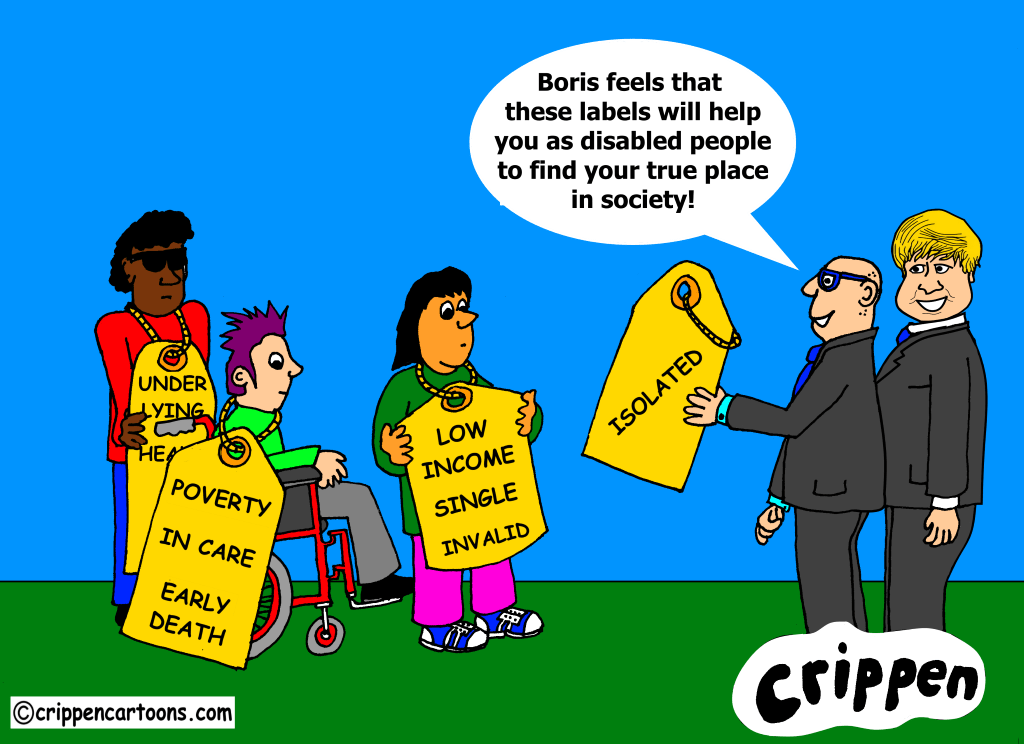
Frances Ryan, who writes for the Guardian newspaper, sums it up nicely in her recent column. She writes:

“The idea that poverty, isolation or even early death is somehow natural for disabled people is still worryingly prevalent. “Underlying health conditions” increasingly feels like a euphemism for those society has quietly given up on. Just look at how we still don’t know how many disabled people have died in care homes … Over the coming weeks, shut behind closed doors in more ways than one, disabled people will be all too easy to forget. The only thing more dangerous than inequality is when that inequality is invisible.”

Description of cartoon for those people using screen reading software

Several disabled people representing a cross section of impairments and ethnicity all have large labels hung around their neck. The labels read ‘Poverty, In care, early death, low income, single, invalid and underlying health conditions. A civil servant is holding out another label which has ‘Isolated’ printed upon it. Alongside of him stands Boris Johnson with a smile on his face. The civil servant is saying to them: “Boris feels that these labels will help you as disabled people to find your true place in society!”

Don’t forget, you can also follow Crippen along with other disabled artists on the Disability Arts Online (DAO web site.

Crippen gives the heads-up for a Parliamentary Survey

Oops, nearly missed this one. Although they have said that people can still respond after the closing date. So, here goes …

A Parliamentary Select Committee have been set up to find out how the measures put into effect regarding the pandemic have impacted on disabled people – although they have used the term ‘people with protected characteristics’ within the survey.

They want to know how you have been affected by the illness, or the response to it. If there have been specific impacts on you due to you having a ‘protected characteristic’ (being a disabled person), and whether there may be unforeseen consequences to measures brought in to ease the burden on frontline staff, for example relaxing the measures under the Mental Health Act and Care Act.

The Government has said current measures will be reviewed in three weeks’ time, and measures in the Coronavirus Bill be voted on again in 6 months’ time.

The results of the survey will allow them to change or improve the current measures which could be acted on in three weeks’ time and what needs to change or improve, which could be acted on in 6 months’ time.

You can comment from a personal, organisational or expert opinion, or a mixture.

They will look to follow-up this work in 12 months’ time to build a more complete picture of how people with protected characteristics have been affected.  

To participate, please click on this link and then go to the bottom of the survey page and press ‘start’.

Please feel free to discuss any questions with the Committee staff on womeqcom@parliament.uk or telephone 020 7219 6123.

Description of cartoon for those people using screen reading software

This is an illustration to accompany the blog content. It consists of several images representing a variety of disabled people with differing impairments and ethnicity are all working on their computers, laptops and smart phones. They are floating on a pale green background. Some of the computer screens have wording visible which states ‘have your say’ and ‘my experience …’

Don’t forget, you can also follow Crippen along with other disabled artists on the Disability Arts Online (DAO web site.

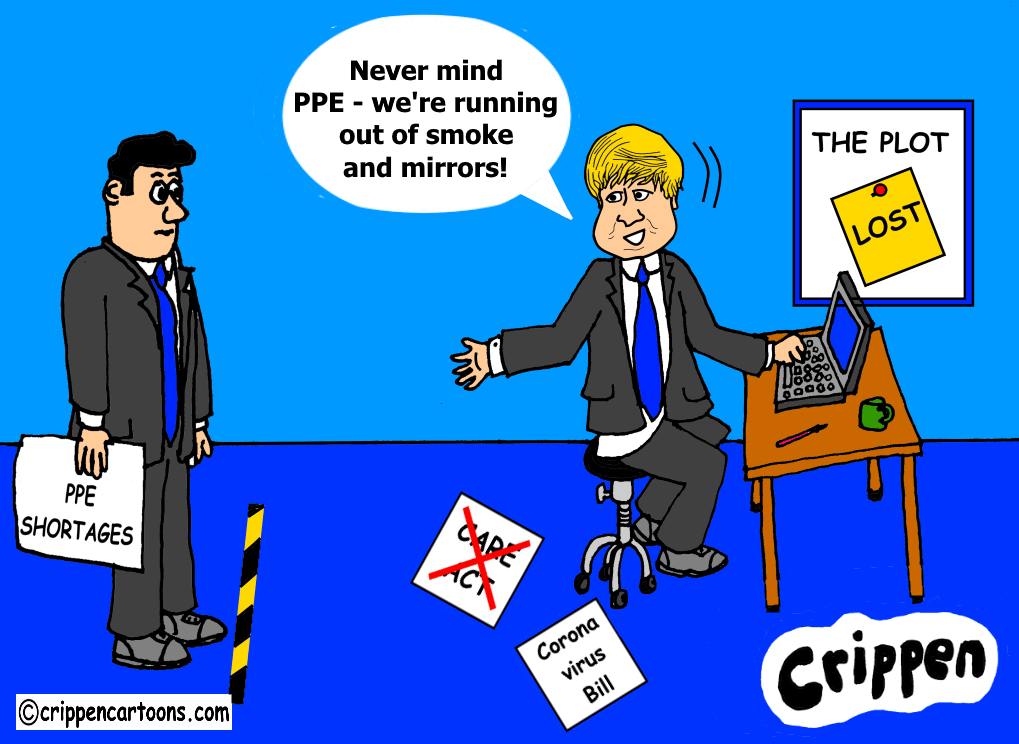
Crippen thinks that Boris is in over his head!

The lack of a joined-up strategy is the least of Boris’ worries. His failure to properly think through the sweeping changes he has made to equality legislation and those affecting disabled people in particular, means that he is currently presiding over a government that appears to be completely rudderless.

Groups like the Alliance for Inclusive Education (ALLFIE) have recently called him out on the changes he has made within the Coronavirus Bill that affect learning disabled children. To date they’ve received no response from him.

Other groups and organisations are also asking him to explain what his long-term plans are for disabled people about employment, housing and social care. Again, a resounding silence!

Boris must dream of the days when all he had to focus on was Brexit. Just feed the gullible public false facts and figures and push through the agenda that would only benefit those able to make a further profit from the situation.

His priority seems to be saving face and throwing more smoke and mirrors at us as he continues to bumble around out of his depth!

Description of cartoon for those people using screen reading software

Boris is sat at a table working on a laptop. On the floor at his feet is a piece of paper with ‘Care Act’ crossed out on it. Another piece of paper reads ‘Coronavirus Bill’. He is turning to look at a civil servant who is holding a piece of paper with ‘PPE shortages’ written on it. On the wall behind him is a notice board with ‘The Plot’ written on it. A yellow note is pinned below the writing with ‘lost’ written on it. Boris is saying to the civil servant: “Never mind PPE – we’re running out of smoke and mirrors!”

Don’t forget, you can also follow Crippen along with other disabled artrists on the Disability Arts Online (DAO web site.

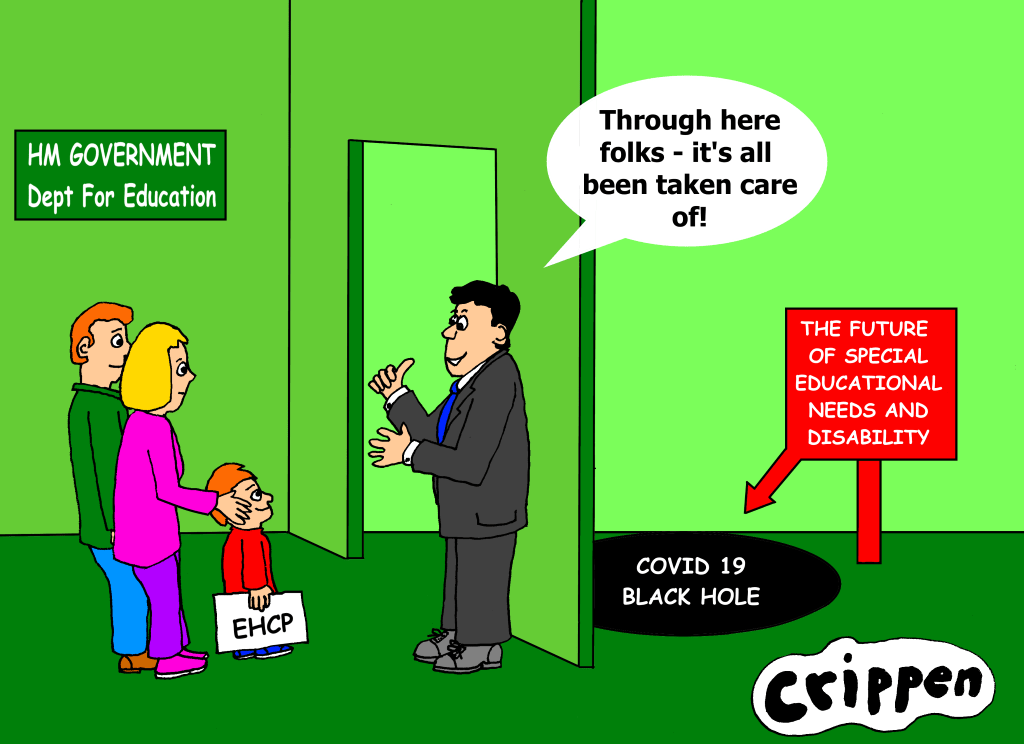
Crippen stands by ALLFIE in it’s fight for an inclusive educational system

The Alliance for Inclusive Education (ALLFIE) is concerned that disabled people’s rights to be supported within mainstream education will be suspended for up to two years under the Coronavirus Bill. The Government wants to suspend various rights disabled people have under current legislation.

They are very concerned that:

  • Disabled children with an Education, Health and Care Plan (EHCP) support could have that support withdrawn, reduced, removed or not replaced if current staff is needed elsewhere by the National Health Service England (NHSE) or even special schools;
  • Disabled children with EHCP could be transferred into special schools so that Special Educational Needs and Disability (SEND) provision can be pooled as fewer schools are open. Local authorities and schools will not have the funding to pay for additional staff if existing staff are in self-isolation or ill.
  • Disabled children with EHCP could be left without a school placement, particularly a mainstream school placement.
  • Disabled young people may not get the education, health and care support they require to flourish in mainstream education. The threshold will be lowered so that disabled people will only get support to meet the basic needs of being dressed, fed and showered.
  • If these changes to the Care Act go through disabled children and people in education may not get the support they require because education is unlikely to be considered a basic need to aid survival.

ALLFIE believes that it is totally unacceptable that the rights of disabled people, the only group of people with protected characteristic rights under the Equality Act, will be suspended.  For many disabled pupils and students, the education, health and care provision required is necessary to support both their emotional and physical wellbeing. Many of the health and social care practitioners are undertaking tasks that will help to maintain stable health, including reducing the risk of developing infections and viruses.

The education and care provisions in the Coronavirus Bill are an attack on disabled people’s human rights to education, health and care.

Click here to view ALLFIE’s briefing on the pandemic

To read their magazine click here

And to find out more about The Alliance for Inclusive Education please click here.

Description of cartoon for those people using screen reading software

The scene is set in the Department for Education. A young couple are standing facing a government official. They have a young child with them who is holding an EHCP document. The government official is standing next to an open door through which he is gesturing. He is saying: “Through here folks – it’s all been taken care of!”. Behind the door is hidden a large black hole which is identified as the ‘Covid 19 Black Hole’. A large sign points down the hole. The sign reads ‘The future of special educational needs and disabilities’.

Don’t forget, you can also follow Crippen along with other disabled artists on the Disability Arts Online (DAO web site.

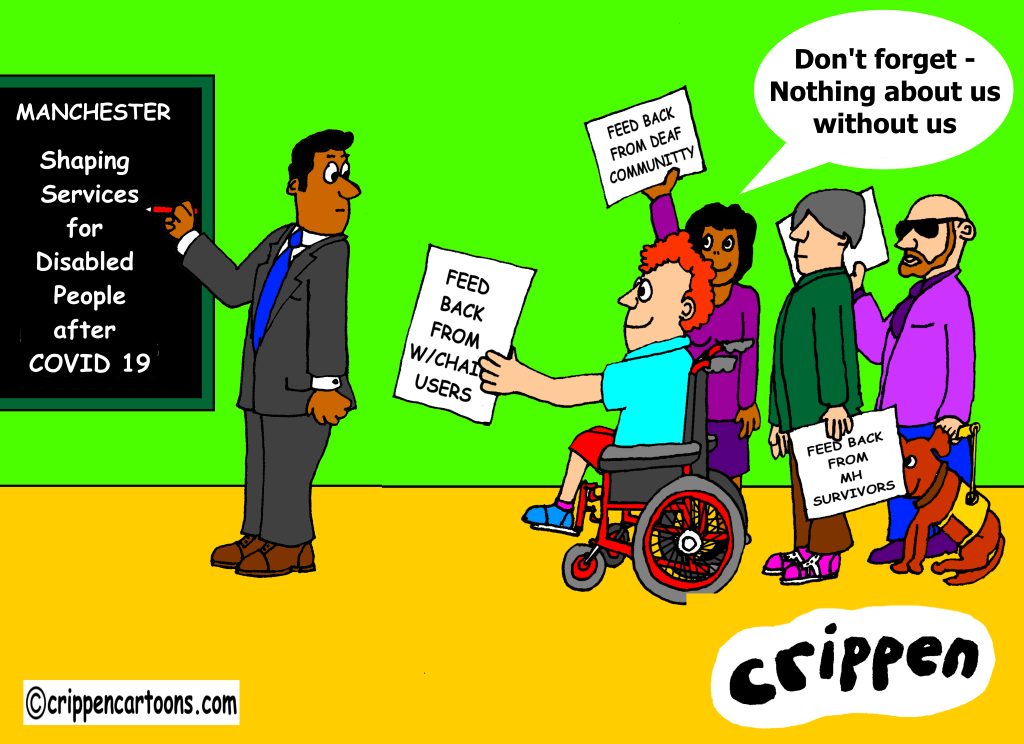
Crippen and the Greater Manchester Big Covid-19 Disability Survey

Disabled People’s Groups and Organisations have compiled a questionnaire to discover what effects the Covid 19 virus has had on disabled people in the Greater Manchester area.

The questions are designed to identify the issues and experiences that their members are currently facing. They need as many responses as they can get in order to make this a solid evidential base to shape how services in Greater Manchester are responding.

If you want to launch a similar survey for your locality then please leave your details in the comment section below and I’ll put you in touch with one of the organisers.

Remember – Nothing about us without us!

Click here to see the survey.

Description of cartoon for those people using screen reading software

A large, representative group of disabled people are holding up the results from the Greater Manchester Covid 19 survey. In front of them is an Asian man in a grey suite and blue tie who is writing on a blackboard. He has written ‘Manchester shaping services for disabled people after Covid 19’. He is also looking over his shoulder at the group of disabled people, one of whom is saying: ”Don’t forget – nothing about us without us!”

Don’t forget, you can also follow Crippen along with other disabled artists on the Disability Arts Online (DAO web site.

Crippen looks at the barriers facing disabled shoppers

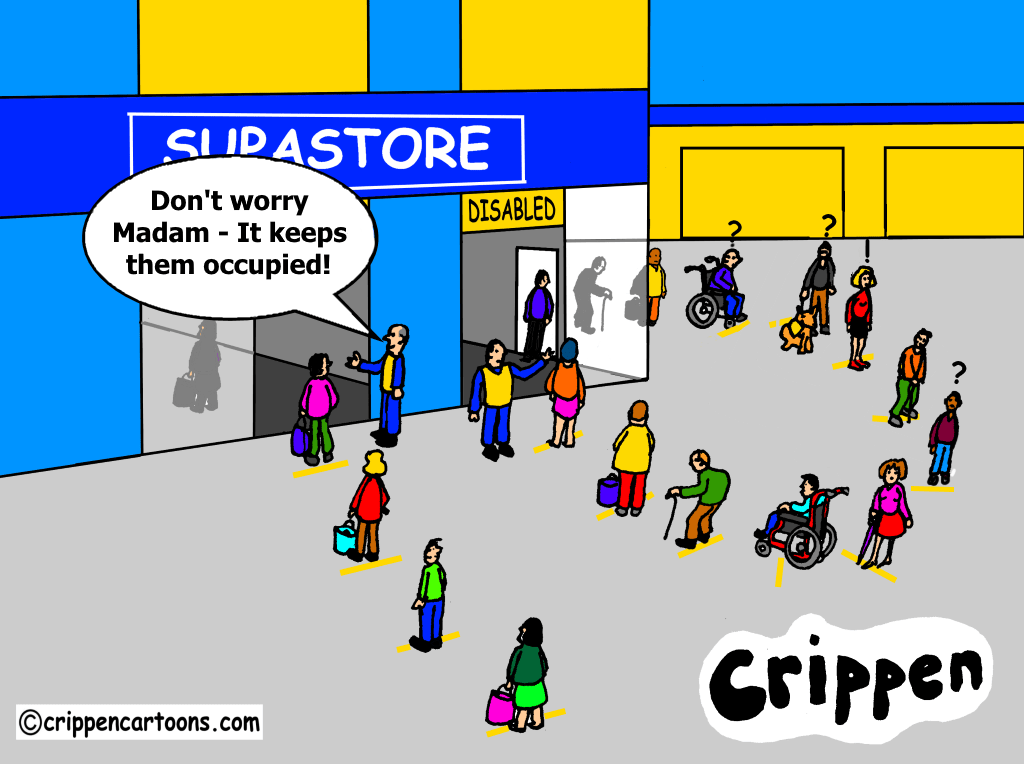
The Disability news Service reports that at least 30 disabled people have instructed solicitors to begin legal action against various supermarkets for discriminating against them under the Equality Act by failing to make the reasonable adjustments needed for them to shop safely.

Many disabled people have found it impossible to order home deliveries online, because they are not in the small proportion of disabled people seen by the government as being “extremely clinically vulnerable”. This criterion allows some disabled people to access a ‘priority delivery’ function on the various supermarket web sites. Unfortunately, ‘normal’ delivery slots are fully booked for up to four weeks in advance, and even then, offer no available slots after this period.

Some of those taking legal action are unable to shop safely in supermarkets because of the poor response to social distancing by other customers, while others are unable to travel to supermarkets for impairment-related reasons.

Some of the claimants could shop safely in-store if their local supermarket was willing to make reasonable adjustments for them, but are prevented from doing so, for example, by having to queue to enter the store – with no seats while they are waiting – or not being allowed to bring a companion with them to help them shop.

One of the claimants, who has been an online customer with Sainsburys for over 10 years has described how the failure to secure regular deliveries from Sainsbury’s has been a “huge source of anxiety”.

Although she is seen as being “at risk”, because of her health conditions, she is not one of the 1.5 million people in England on the government’s list of those most at risk from the virus and so is not seen as a priority for home deliveries, even though she receives the enhanced rates of personal independence payment for both daily living and mobility.

Go figure!

Description of cartoon for those people using screen reading software

The scene is the entrance to a large supermarket, called Supastore in the cartoon. There is a queue of people waiting, socially distanced, leading up to a door marked ‘normal’. A man in a high viz tabard is allowing them to enter one at a time. Alongside of them is another queue, but these are disabled people with varying impairment issues. They are being guided through a separate door marked ‘disabled’ by another man in a high viz jacket. You can see that the disabled shoppers are being shown to another door inside of the entrance which brings them outside again – re-joining the queue of disabled people. The disabled shoppers are therefore not making it into the shopping area of the store but are walking in a large circle, effectively getting nowhere. The man in the high viz who is policing the ‘normal’ entrance is saying to a customer: “Don’t worry Madam – it keeps them occupied!”

Don’t forget, you can also follow Crippen along with other disabled artrists on the Disability Arts Online (DAO web site.

Crippen reports on action from disabled activist Doug Paulley

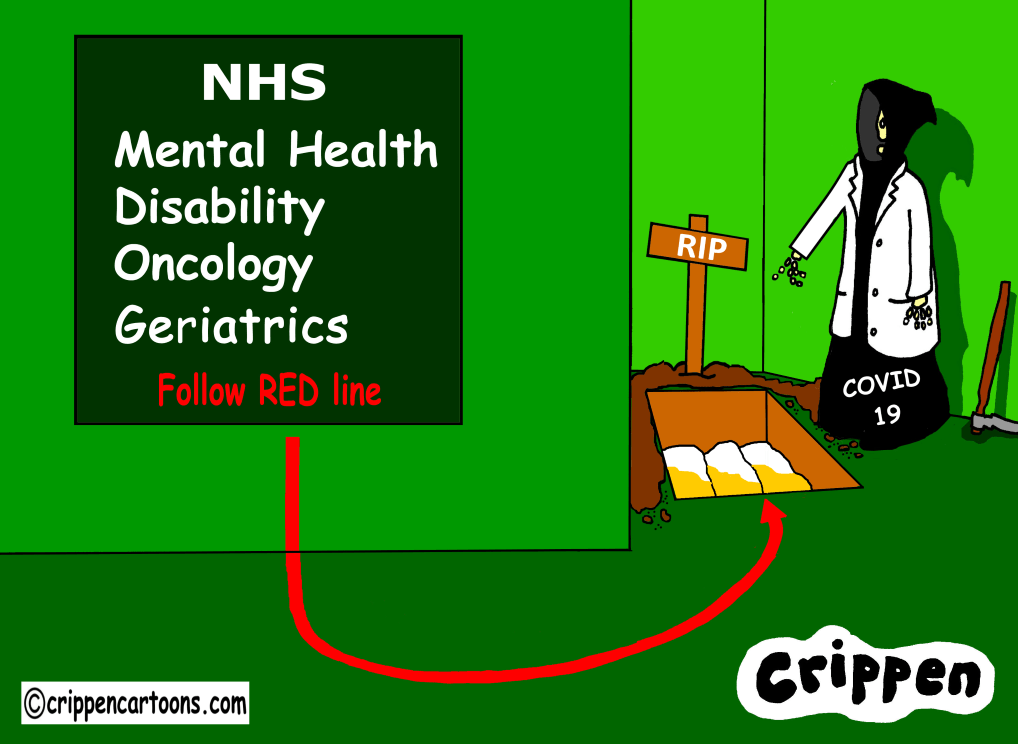
Doug Paulley, disabled activist, is taking legal action to force the government to make it clear that disabled people will have the same right to life-sustaining treatment as non-disabled people if they contract coronavirus.

Doug, along with three other disabled people, have instructed their solicitors to write to Health and Social Care secretary Matt Hancock and NHS England to challenge their failure to publish guidance for doctors on how to decide who receives life-saving treatment during the COVID-19 pandemic, if demand outstrips supply.

They fear that, if they become ill with the virus, they and other disabled people will be viewed as less likely to benefit from such treatment than non-disabled people. In effect, seeing us pushed to the back of the queue for urgent treatment.

Doug told the Disability News Service that it was an “extremely worrying” time for him and other disabled people because they “just don’t know how doctors are going to prioritise life-saving treatment for coronavirus”.

He said: “I feel strongly that I should be given the same chance as anyone else – all I’m asking for is some reassurance that my life will be valued as much as the next person.”

Description of cartoon for those people using screen reading software

On the wall within a hospital is a large sign that reads ‘NHS – mental health, disability, oncology, and geriatrics’ and ‘follow the red line’. A red line then runs from the sign, along the floor and around the corner where the Grim Reaper, wearing a doctor’s white coat, is waiting alongside an open grave. There are wrapped bodies inside of the grave with a large wooden cross with RIP printed upon it at the head of the grave. The Grim Reaper has ‘COVID 19’ printed on his black gown and is pointing into the open grave.

You can also follow Crippen on Disability Arts Online